It is obvious enough but has to be said: there is no perfect electoral system. If we want to elect a legislature, there are two major issues to resolve. Inevitably we have to compromise between representativity – giving every party or pressure group a voice – and effectiveness – creating a clear majority in the assembly so that they can actually take decisions. Secondly, we also have to build an acceptable form of responsibility into the system – who is the single legislator responsible to?
On the first issue, the most representative system is certainly the Knesset in Israel. The have a single 120 member constituency for the whole country with a threshold which used to be 1%, then 1.5% and is now 2%, still close to perfect proportionality. So in order to have a deputy, you only need to poll 2% over the whole country. Not surprisingly, there are usually between a dozen and 20 parties in the Knesset and forming a majority to support the government is normally a nightmare of bartering policy and position.
At the other extreme is the British model where there are 650 single member constituencies. The winner in each is the candidate who scores one vote more than the next candidate. Between 40 and 45% will normally give a party a large working majority around 60% of the seats. Until the last elections, Britain almost never had problems forming a government and the present government is the first fully fledged coalition since the war.
They have governability, the Israelis have representation.
On the second point, who chooses the single legislators and who are they responsible to, the usual (legitimate) answers are that they are chosen by their party or their electors and are responsible to them and their own consciences. Less legitimate answers include the lobby or pressure group that has supported or financed the legislator. Whenever the legislator votes, he or she has to weigh up the importance of the three responsibilities and if they are in conflict, take a decision over which one to follow.
The perceived failure of the present Italian electoral law is in the total lack of connection between legislator and elector. The members of parliament hold the post only through party loyalty. In many countries this is not seen as a problem but because of the personal character or many Italian parties, not only Berlusconi’s, a deputy or senator depends on the caprice of the Leader. And that is not healthy for any democratic polity.
There has been talk of adopting the French double ballot system or the German system of a list plus single member constituency or re-introducing the preference votes where voters may give one (or more) votes to individual candidate(s) of their chosen list.
One solution which has not been considered is the single transferable vote (STV) used in both the Republic and Northern Ireland, Malta and extensively in Australia. It is flexible and gives voters maximum choice in individuals and parties and ensures a small number of parties that have a good chance of forming a working government.
Constituencies are multi-member but small (three to five usually); this in practice gives an electoral threshold of around 15% though there is no official threshold. This limits the number of parties and prevents the formation one- or two-man parties as in Israel. In Malta, there are actually only two parties so that one has a majority.
The voters list their choice of candidates, normally the number of legislators to be elected and not limited to a single party. So one can vote for candidate 1 in party A as first choice, candidate 2 in party B and second and 2 in party C as third. A quota is calculated based on the number of votes cast and the first choice votes are counted. If candidate 1A polls more than necessary, his second choices are then counted and distributed to the other candidates; they are transferred until another two candidates reach the quota. If none reach it, then the lowest scoring candidate is eliminated and his votes transferred.
Voters have a choice of candidates and parties and the system minimises wasted votes. The legislator is closely linked to the electorate and to the party. The territorial link does makes for some clientelistic or pork barrelling practices but this is not just a function of the system. The number of parties is limited and will normally be able to form a government.
The only disadvantage is the complication and slowness of the count, a small price to pay for an excellent compromise. In order to give their candidates the best possible chance, Irish party workers develop mental arithmetic skills in probability that befuddle the average observer, a curious byproduct.
At the end of the day, no system will guarantee good government; the best cook cannot make a good dish from rotten material but a bad cook can ruin good raw materials.
This was published on 25 July in Italian in Europaquotidiano “Sistema elettorale, la legge di Dublino”
Wednesday, July 25, 2012

Borsellino and the mafia - 20 years on
Twenty years ago, the Sicilian judge, Paolo Borsellino and five police were killed by a huge car bomb in via D’Amelio in Palermo. Of the three mafia murders that Italy is commemorating this year, Borsellino’s is the most disturbing today because we know enough to confirm our worst suspicions of complicity between mafia and state authorities.
For the other two, the judge Giovanni Falcone, killed in May 1992 and carabiniere general, Carlo Alberto dalla Chiesa, killed in September 1982, we can only say unequivocally that they did not have the full support of the state. The worst that we can say (and that is bad enough) is that no one in the higher echelons of government and law enforcement made it clear to mafia bosses that the two men had the full support of government and the ministries. Both were killed because they were too dangerous for mafia to let them live.
For Borsellino, on the contrary, we know that there were negotiations going on between mafia and state authorities at least from the time of Falcone’s murder in April. Borsellino knew about these negotiations and was furious. He vehemently opposed to them both as a matter of principle and strategically. Negotiating with mafia was not only a betrayal of everything the he and Falcone and other colleagues had fought for but also a losing strategy.
Yesterday, Palermo investigators indicted 12 men on various charges ranging from subverting state institutions to perjury. There is a suspicion that at least some of the state authorities had more than an inkling of the impending massacre. The full story of who ordered the killings, put the bomb together and carried out the attack is still not known but much more will be revealed when the Palermo case is tried and when two other investigations come to trial.
Italians use the shorthand “the state” and “mafia” in accounts of the negotiations but both words also refer to single individuals with names, ranks or titles and responsibilities. They include carabinieri officers, secret service men and women and ministers as well as the mafiosi and various go-betweens. Since 2007, thanks to a mafioso who turned state’s evidence, some of Borsellino and Falcone’s colleagues have been investigating these allegations. Of the 12 due to stand trial in Palermo, six are mafiosi, all big names like Totò Riina, Bernardo Provenzano and Massimo Ciancimino, the son of former Palermo mayor, Vito, longtime link between mafia and the Christian Democratic party. Six were from “the state”; three carabiniere officers and three politicians, one ex-minister of the Interior, Nicola Mancino, an ex-minister for the South, Calogero Mannino and Berlusconi’s close associate, senator Marcello Dell’Utri who has already been convicted of links to mafia.
They are alleged to have negotiated the release of hundreds of mafiosi from special prison terms known as “Article 41 bis”, introduced to isolate convicted mafiosi from their business interests and power base. In return, the mafia did not kill Mannino and various other politicians threatened because they had not given the mafia the promised protection. In other words, it was a typical mafia racket, extortion-style but on a much grander scale than promising a shopkeeper that his store will not be blown up if he pays protection.
If all or even some of the accused are convicted, it will be a bombshell for Italian institutions. Even without convictions, and with what we already know, the effects on public institutions are devastating.
For decades, actually from the birth of the Italian state, there had been an intermingling of mafia and the political and state authorities, something much more intimate than a cops-and-robbers, live-and-let-live set-up. Political and business interests overlapped in the upper- and underworld with no clear border between the two. Mafia immediately recognised the potential of electoral politics and has exploited them for a century and a half. With the growth of the public sector, they used their political levers both for profit and for power.
The cosy relationship was punctuated by occasional trials of lower level mafiosi for crimes of violence. The break came in 1986-7 when the so-called maxi-trial convicted over 300 mafiosi accepting the prosecution’s case of a mafia organisation. This prosecution was led by Giovanni Falcone and Paolo Borsellino which is why they became prime targets for mafia.
Now, 20 years on, there is some chance that we will know about one episode of collusion between mafia, politics and law enforcement agencies.
But we should not hold our breath; in the most disturbing recent development, President Napolitano has demanded that two intercepted conversations between the former minister Mancino and Napolitano should be destroyed. Mancino had called the president’s legal counsellor seeking the president’s help in having his perjury case transferred to a different court (these conversations are on the record). Mancino then actually spoke to Napolitano and since his phone was under surveillance, the call was recorded. The prosecutor has said that the call is irrelevant for his case, but procedure demands that it is a judge who decrees the destruction of material after the defence has been able to intervene.
Instead, President Napolitano has taken the case to the Constitutional Court arguing that even when a person under criminal investigation calls the president, that call should be subject to presidential privilege.
Even more disturbing than Napolitano’s action, is that most of the press and political parties support him. The President represents Power and should not suffer the indignity of having his conversation recorded even when he is called by someone accused of a serious crime.
It was this lack of respect for Power in whatever form (and its converse, the respect for the Law) that killed Borsellino and Falcone and general dalla Chiesa a decade earlier.
For the other two, the judge Giovanni Falcone, killed in May 1992 and carabiniere general, Carlo Alberto dalla Chiesa, killed in September 1982, we can only say unequivocally that they did not have the full support of the state. The worst that we can say (and that is bad enough) is that no one in the higher echelons of government and law enforcement made it clear to mafia bosses that the two men had the full support of government and the ministries. Both were killed because they were too dangerous for mafia to let them live.
For Borsellino, on the contrary, we know that there were negotiations going on between mafia and state authorities at least from the time of Falcone’s murder in April. Borsellino knew about these negotiations and was furious. He vehemently opposed to them both as a matter of principle and strategically. Negotiating with mafia was not only a betrayal of everything the he and Falcone and other colleagues had fought for but also a losing strategy.
Yesterday, Palermo investigators indicted 12 men on various charges ranging from subverting state institutions to perjury. There is a suspicion that at least some of the state authorities had more than an inkling of the impending massacre. The full story of who ordered the killings, put the bomb together and carried out the attack is still not known but much more will be revealed when the Palermo case is tried and when two other investigations come to trial.
Italians use the shorthand “the state” and “mafia” in accounts of the negotiations but both words also refer to single individuals with names, ranks or titles and responsibilities. They include carabinieri officers, secret service men and women and ministers as well as the mafiosi and various go-betweens. Since 2007, thanks to a mafioso who turned state’s evidence, some of Borsellino and Falcone’s colleagues have been investigating these allegations. Of the 12 due to stand trial in Palermo, six are mafiosi, all big names like Totò Riina, Bernardo Provenzano and Massimo Ciancimino, the son of former Palermo mayor, Vito, longtime link between mafia and the Christian Democratic party. Six were from “the state”; three carabiniere officers and three politicians, one ex-minister of the Interior, Nicola Mancino, an ex-minister for the South, Calogero Mannino and Berlusconi’s close associate, senator Marcello Dell’Utri who has already been convicted of links to mafia.
They are alleged to have negotiated the release of hundreds of mafiosi from special prison terms known as “Article 41 bis”, introduced to isolate convicted mafiosi from their business interests and power base. In return, the mafia did not kill Mannino and various other politicians threatened because they had not given the mafia the promised protection. In other words, it was a typical mafia racket, extortion-style but on a much grander scale than promising a shopkeeper that his store will not be blown up if he pays protection.
If all or even some of the accused are convicted, it will be a bombshell for Italian institutions. Even without convictions, and with what we already know, the effects on public institutions are devastating.
For decades, actually from the birth of the Italian state, there had been an intermingling of mafia and the political and state authorities, something much more intimate than a cops-and-robbers, live-and-let-live set-up. Political and business interests overlapped in the upper- and underworld with no clear border between the two. Mafia immediately recognised the potential of electoral politics and has exploited them for a century and a half. With the growth of the public sector, they used their political levers both for profit and for power.
The cosy relationship was punctuated by occasional trials of lower level mafiosi for crimes of violence. The break came in 1986-7 when the so-called maxi-trial convicted over 300 mafiosi accepting the prosecution’s case of a mafia organisation. This prosecution was led by Giovanni Falcone and Paolo Borsellino which is why they became prime targets for mafia.
Now, 20 years on, there is some chance that we will know about one episode of collusion between mafia, politics and law enforcement agencies.
But we should not hold our breath; in the most disturbing recent development, President Napolitano has demanded that two intercepted conversations between the former minister Mancino and Napolitano should be destroyed. Mancino had called the president’s legal counsellor seeking the president’s help in having his perjury case transferred to a different court (these conversations are on the record). Mancino then actually spoke to Napolitano and since his phone was under surveillance, the call was recorded. The prosecutor has said that the call is irrelevant for his case, but procedure demands that it is a judge who decrees the destruction of material after the defence has been able to intervene.
Instead, President Napolitano has taken the case to the Constitutional Court arguing that even when a person under criminal investigation calls the president, that call should be subject to presidential privilege.
Even more disturbing than Napolitano’s action, is that most of the press and political parties support him. The President represents Power and should not suffer the indignity of having his conversation recorded even when he is called by someone accused of a serious crime.
It was this lack of respect for Power in whatever form (and its converse, the respect for the Law) that killed Borsellino and Falcone and general dalla Chiesa a decade earlier.
Sunday, July 15, 2012
Nine months to Elections. First Election Watch Blog.
By my calculations, allowing for Easter, Pesach, Liberation Day (25 April) and May Day, the Italian elections should be on 14-15/4 or 21-22/4 or maybe 28-29/4.
If I’m right, then we have nine months before Italians go to the polls to elect a new Parliament and, possibly, a new government. All elections are crucial for someone and they all are hyped as make-or-break-contests. More often than not, the results are banal and change little and there is a serious danger that the 2013 poll will be both make-or-break and change little.
This time, the elections are not just of interest to Italians. Between now and April, Italians and their politicians have a big responsibility on their hands. First of all, the country’s well-being, future growth and social peace depend on what the government does between now and April and how the political parties conduct the campaign; on those two points depend confidence in the euro and its future. Connected by a longer thread is the future shape of the EU itself because if the euro disintegrates, the Union will change shape; if the euro continues, it will mean a new integration and development of the EU.
In the much shorter term, but indirectly, Obama’s re-election depends at least partially on Europe showing signs of a recovery which would enhance an American recovery. Even more indirectly, the emerging economies depend on Europe and North America expanding again.
Most Italian voters do not realise the burden they are carrying (but some do). Much worse, most Italian politicians cannot see beyond the need to get re-elected and maintain their privileges. All important legislation in both the Monti government and before under Berlusconi has been passed as decree laws with votes of confidence. In practice the Houses have been reduced to a school playground where the children can shout and scream for half an hour and then when the whistle blows, they line up for a roll call.
Under Berlusconi, the showtime was extended to television talk shows where representatives of government and opposition would talk (or more usually shout) over each other, neither side listening or answering the other’s points. It was a Colosseum without the blood. Today, in deference to Monti’s “sobriety”, they are much more restrained but seldom any more to the point.
With Berlusconi’s promise or threat to return to active politics, television producers are rubbing their hands together at the prospect of a new series of bouts.
But whatever rules they fight by, their hands are tied. The three big groupings, known until last week by the acronym ABC after the three leaders (now perhaps BBC) are Berlusconi’s PdL on the centre-right (nominally led by Angelino Alfano), Pierferdinando Casini’s centrist UDC and Pierluigi Bersani’s PD. They have to fight a campaign in which they are rivals but are all supporting the same government. This will require considerable restraint and sleight of hand.

The present opposition groups are hardly better off. The Northern League is licking its wounds (caused by internal division and external prosecution for corruption) and the new leader, Roberto Maroni would like to manoevre back into some sort of alliance with the PdL, or at least leave that option open. On the left Di Pietro with his Italia dei Valori, and Nichi Vendola’s SEL (Sinistra, Ecologia e Libertà) are highly critical of the Monti government but they too dream of a possible coalition with the PD, the so-called “Vasto photo” (left) of Bersani, Vendola and Di Pietro smiling together at Di Pietro’s summer conference.
Then on the edge, there is Beppe Grillo, much more than a joker in the pack. The Genoese comedian’s “Five Star Movement” (M5S) is the second party in most opinion polls at the moment with around 20%. A PD leader, Enrico Letta, said yesterday that he preferred Berlusconi to Grillo which brought a storm of criticism from most of the rest of the party. All the parties, nonetheless, are terrified that Grillo might steal their votes and bring out otherwise alienated electors. And be a real force in the next Parliament.
All bets are open. The actual alliances will depend on what sort of electoral system they will use, probably more than the actual policies they propose or which leaders they choose.
At the moment, the PdL or rather Berlusconi wants a French semi-presidential system but there will not be time to pass the necessary constitutional amendment so they are aiming at a premium for the party that polls highest (like the Greek system) with 40% of the candidates in a fixed list (so chosen by the party) and 60% elected with preference votes (voters give a vote to a party and then to one or more candidates on the list, so they chose which candidate is actually elected). The PD would like the premium to go to the winning coalition and want a double ballot system like the French one which gave the Socialists a majority in the National Assembly.
Despite President Napolitano’s admonitions to get moving on electoral reform, there is a good chance that nothing will happen and Italians will again use the much criticised porcellum, the pig’s dinner law, which gives a premium to the winning coalition and has fixed party lists – those elected depend on the party (and its leader) rather than voters.
So over the next nine months I will write an election watch blog every two or three weeks (more often as things get hotter) looking at the electoral system debate, proposed policies, choice of leaders, influence outside of Europe and opinion polls, plus, of course the debate over who will take over as President, one of the first jobs for the new Parliament. Just before or just after Easter, we will host our usual Italian Election conference at the American University of Rome
If I’m right, then we have nine months before Italians go to the polls to elect a new Parliament and, possibly, a new government. All elections are crucial for someone and they all are hyped as make-or-break-contests. More often than not, the results are banal and change little and there is a serious danger that the 2013 poll will be both make-or-break and change little.
This time, the elections are not just of interest to Italians. Between now and April, Italians and their politicians have a big responsibility on their hands. First of all, the country’s well-being, future growth and social peace depend on what the government does between now and April and how the political parties conduct the campaign; on those two points depend confidence in the euro and its future. Connected by a longer thread is the future shape of the EU itself because if the euro disintegrates, the Union will change shape; if the euro continues, it will mean a new integration and development of the EU.
In the much shorter term, but indirectly, Obama’s re-election depends at least partially on Europe showing signs of a recovery which would enhance an American recovery. Even more indirectly, the emerging economies depend on Europe and North America expanding again.
Most Italian voters do not realise the burden they are carrying (but some do). Much worse, most Italian politicians cannot see beyond the need to get re-elected and maintain their privileges. All important legislation in both the Monti government and before under Berlusconi has been passed as decree laws with votes of confidence. In practice the Houses have been reduced to a school playground where the children can shout and scream for half an hour and then when the whistle blows, they line up for a roll call.
Under Berlusconi, the showtime was extended to television talk shows where representatives of government and opposition would talk (or more usually shout) over each other, neither side listening or answering the other’s points. It was a Colosseum without the blood. Today, in deference to Monti’s “sobriety”, they are much more restrained but seldom any more to the point.
With Berlusconi’s promise or threat to return to active politics, television producers are rubbing their hands together at the prospect of a new series of bouts.
But whatever rules they fight by, their hands are tied. The three big groupings, known until last week by the acronym ABC after the three leaders (now perhaps BBC) are Berlusconi’s PdL on the centre-right (nominally led by Angelino Alfano), Pierferdinando Casini’s centrist UDC and Pierluigi Bersani’s PD. They have to fight a campaign in which they are rivals but are all supporting the same government. This will require considerable restraint and sleight of hand.

The present opposition groups are hardly better off. The Northern League is licking its wounds (caused by internal division and external prosecution for corruption) and the new leader, Roberto Maroni would like to manoevre back into some sort of alliance with the PdL, or at least leave that option open. On the left Di Pietro with his Italia dei Valori, and Nichi Vendola’s SEL (Sinistra, Ecologia e Libertà) are highly critical of the Monti government but they too dream of a possible coalition with the PD, the so-called “Vasto photo” (left) of Bersani, Vendola and Di Pietro smiling together at Di Pietro’s summer conference.
Then on the edge, there is Beppe Grillo, much more than a joker in the pack. The Genoese comedian’s “Five Star Movement” (M5S) is the second party in most opinion polls at the moment with around 20%. A PD leader, Enrico Letta, said yesterday that he preferred Berlusconi to Grillo which brought a storm of criticism from most of the rest of the party. All the parties, nonetheless, are terrified that Grillo might steal their votes and bring out otherwise alienated electors. And be a real force in the next Parliament.
All bets are open. The actual alliances will depend on what sort of electoral system they will use, probably more than the actual policies they propose or which leaders they choose.
At the moment, the PdL or rather Berlusconi wants a French semi-presidential system but there will not be time to pass the necessary constitutional amendment so they are aiming at a premium for the party that polls highest (like the Greek system) with 40% of the candidates in a fixed list (so chosen by the party) and 60% elected with preference votes (voters give a vote to a party and then to one or more candidates on the list, so they chose which candidate is actually elected). The PD would like the premium to go to the winning coalition and want a double ballot system like the French one which gave the Socialists a majority in the National Assembly.
Despite President Napolitano’s admonitions to get moving on electoral reform, there is a good chance that nothing will happen and Italians will again use the much criticised porcellum, the pig’s dinner law, which gives a premium to the winning coalition and has fixed party lists – those elected depend on the party (and its leader) rather than voters.
So over the next nine months I will write an election watch blog every two or three weeks (more often as things get hotter) looking at the electoral system debate, proposed policies, choice of leaders, influence outside of Europe and opinion polls, plus, of course the debate over who will take over as President, one of the first jobs for the new Parliament. Just before or just after Easter, we will host our usual Italian Election conference at the American University of Rome
Friday, July 13, 2012
The Mummy Returns

When Margaret Thatcher made an unscheduled speech to a Tory election rally in Plymouth, the local cinema was showing “The Mummy returns”. She started her speech by mentioning this and adding “It turns out you did know I was coming after all” a nice self-deprecating touch for someone who was normally not very modest. This week has seen a flurry of speculation that another mummy, Italy’s most famous embalmed creature (and admirer of Mrs. T), Silvio Berlusconi, might be making his return.
Last week, Silvio Berlusconi told one of his family papers, Il Giornale, “I’m going on a diet, I’ll lose five or six kilos and then in September I’ll decide” while the rival L’Espresso put his possible return on the cover. Then his designated successor, Angelino Alfano gave the game away by saying that he would be the first person to support Berlusconi as a leader in the next elections.
It is not exactly clear what role Berlusconi will play in the campaign. The journalist and parliamentarian, Furio Colombo who cannot abide Berlusconi, is sure that he will not go as far going for the prime ministership because the likely defeat would be too painful. I am not so sure.
He has two major interests to safeguard; control of the RAI, its programming and publicity or if not control, then a strong influence. Secondly, being able to condition and pilot any changes in the criminal law or procedure. It is true that he can look after these without being centre-stage. Indeed, over the last few weeks there has been a bitter struggle over the RAI’s new president, director-general and board which at the moment Berlusconi is winning but without appearing in the first person. His people have key posts in the parliamentary committees which would oversee any law reform so, again, his position is strong.
But at the same time, he has an impelling psychological need to be the centre of attention. He has always been a performer and is clearly not going to give up now. Add to that, power is probably the strongest drug available and once tasted it is very difficult to kick the habit. It would be wonderful to savour the taste of victory in the company of world leaders who have so obviously shown their distaste for him.
It was clear from the start that Alfano was a lightweight, a dummy made of papier maché, not meant to eclipse his master intellectually, politically or even, despite being half Berlusconi’s age, physically. The dummy was ready to be shifted whenever necessary and this is what has happened. The possibility that the PdL might have some form of primary to chose their leader has been dropped completely now with Berlusconi the undisputed chief. However they might have run it, a primary would have been very divisive as all the potential leaders have been showing undignified squabbling. Opinion polls done for Berlusconi apparently show that with Alfano as leader, the PdL would poll 8-12%, with B as elder statesman in the background 17-20%, and as leader, a full 28%.
Berlusconi has been taking an increasingly active part in public life. Last month he suggested that Italy might leave the euro. He has weighed in to the debate over electoral and constitutional reform, repeating that he would like to see a French style semi-presidential system with, of course, him as the president. He gave specific instructions to the PdL senators that they a should attend the debate on semipresidentialism, an issue much closer to his heart than any change in the electoral system.
As a matter of fact, Berlusconi never went away.
Monday, July 09, 2012
From Paradise to the stocks - wasting public money and private time

If I am lucky I can park my car in Paradise – piazza del Paradiso, so named for a mediæval inn known for its gastronomic delights. One day in March, there was a space which I eagerly took, forgetting that I had not renewed the resident’s permit. The resulting fine sat on my pile of chores to be dealt with… later.
On 6 June, not even two and a half months later (instantaneous by Rome standards) the city council sent me a raccomandata or recorded delivery letter. I went to the post office to pick up a letter from a city office in Pomezia, 30 km away. The post office is close enough, the wait a mere ten minutes and fairly cool. Instead of telling me where and how to pay the fine, the letter tells me that there is another document waiting to be picked up in another city office. This is turning out to be a reverse treasure hunt.
The next stage is an office near the Circus Maximus so I at least have the river, Sta Maria in Cosmedin (near the Bocca della Verità), and the little temples opposite

(pictured on left). The office, too, is empty and two women look up from the magazine they were reading (their only activity) to search for my envelope out of a huge bundle of other malefactors’; they give me the documentation and the way to make amends. My bank is another 10 minute cycle ride away, on the flat, and mostly shaded. Only when I get there, I discover that they are not enabled to pay traffic fines… only two banks can and even then, it is not easy, you have to punch in 18 digits in order to pay at an ATM.
Instead, I discover that state lottery agencies also have the franchise and happen that my nearest Lottomatica is in… piazza del Paradiso, where I go and pay.
My little saga begins and ends in Paradise. It has cost me €52.43 and couple of hours, which with a bicycle, a decent temperature and Roman monuments were not unpleasant. But I could have been doing something more productive. The cost to the city was the computer, printer and operator in Pomezia to send me the first notice; another computer, printer and clerks in Rome to give me the full documentation and then the lottery agency to take the fine and the software to tell the city accountants that I have paid.
This is a banal and boring story matched by thousands elsewhere in Italy and no doubt other countries. The point today is that the government has just passed a decree cutting public spending by reducing public employees (at national, regional and city levels). There has been the predictable outcry from the unions and most of the left on the iniquity of such measure but I fail to see how the human resources employed to get me to pay my fine are doing anything useful. This is the Roman equivalent of paying people to dig holes and then to fill them in again, but without the Keynsian consciousness… or irony.
Only later did I discover that piazza del Paradiso had previously been called piazza della Berlina Vecchia – the place where those guilty of misdemeanors were exposed in stocks or cages, so maybe I got off lightly after all.
Follow me on Twitter @WalstonJames
Wednesday, July 04, 2012
If at first you don’t secede… Celtic fringes in Italy and Britain

As bad puns go, this one is old and stale, I know, but the would-be seceders are not exactly fresh, some more than others. The Lega Nord (Northern League, LN) has for most of its 20 years aimed at an independent state of northern Italy, Padania. Roberto Maroni has just take over from Umberto Bossi as secretary and immediately reiterated independence as the party’s strategic goal.
Maroni has a tough job on his hands. He has a divided party within where Bossi and his supporters (know has “the Magic Circle”) are loath to give up the power, perks and influence they have got used to. Even as he was stepping down, Bossi could not resist sniping at his successer and longterm rival. He compared his action to the judgement of Solomon – the message is that he is the true mother of the Lega and Maroni is an opportunistic fake. Bossi status has indeed been drastically reduced by the scandals and his condition but he is not going to retire gracefully; grace has never been in Bossi’s repetoire and he is not going to start now.
The investigations into allegations of misuse of public funds will continue; they will damage the Lega as a whole but more Bossi and his friends than Maroni and no doubt the lead up to next year’s elections will be punctuated with more details of the Bossi family’s expenses charged to the party.
Politically Maroni’s job is no easier. Much of the protest vote at the local elections went to Beppe Grillo’s Five Star Movement (M5S) while those who wanted a steady centre-right party in or near government didn’t vote. For 20 years Bossi convinced up to 10% of the electorate that the Lega was an anti-system, anti-Rome party of protest at the same time as being a responsible party of government. Maroni was minister of the interior until eight months ago. Now he is adamantly against the Monti government and has even canvassed the idea of abandoning Rome altogether; a contrast worthy of Bossi (still known as il capo).
They also have to decide whether they really want independence (or even devolution) or just to look after the interests of the conservative part of the north – the Bavarian model CSU as both Ilvo Diamante and Angelo Panebianco pointed out.
For the moment at least, Maroni his playing down Bossi’s invented Celtic traditions but there are some superficial similarities with the Scottish National Party (SNP).
They both have declared the goal of complete independence and both feel that they are giving more to the rest of the country than they are receiving. Both have been prepared to play long, waiting games, the SNP even longer than the LN.
But there the similarities end. The SNP is a social democratic party (some would say further to the left) while the Lega is a populist, xenophic centre-right party. In terms of national identity, SNP leader Alex Salmond has a huge advantage over Roberto Maroni. His future independent Scotland has a navel, in Ernest Gellner’s term, while Padania most certainly does not. Gellner divided modern nations into those with precursors or “parents” (and therefore a navel) and those without. Until 1707 Scotland only shared a king with England and even now the Scots have a different legal system and they still have banks of issue. Devolution gave them fiscal powers different from the rest of the UK.
In the UK, Salmond’s announcement of an independence referendum earlier this year led to a flurry of articles about the costs and benefits of an independent Scotland and if he really does move towards a vote, then these arguments will surely trump any memory of Bannockburn (he wants to hold the referendum on the anniversary of the battle in which the Scots defeated the English in 1314) in the same way that Scotland accepted the Act of Union in 1707 for economic reasons.
The breakup of the UK is still a long way off but the possibility is genuinely on the political agenda; an independent Padania is so much hot air.
Both cases as well as Catalonia and the Basque Country might make us face two questions: who decides on a divorce? The smaller would-be independent state or the whole? Only in Czechoslovakia “velvet divorce” was the split genuinely consensual (at least for the two governments). Secondly, how to deal with EU and euro membership assuming that either still exist in their present form in 2013. Do the new Scotland, Padania, Catalonia have automatic membership or do they join the queue with Turkey and Montenegro? Neither national governments nor the European institutions are prepared to address the question until it is posed in a very concrete way.
For the moment, though, these big questions and comparisons will disappear before the campaign questions. First of all, what sort of electoral law will Italy have by April next year? That will condition Maroni’s alliance gameplan. And then, how to capture the dissatisfaction of rising taxes without looking like a aging copy of Beppe Grillo.
Tuesday, July 03, 2012
True born Italians - a reply
A long and thoughtful response from Andrea (and my own comment below):
E' triste e vagamente irritante sentirsi ancora, e ancora, e ancora costretti a riflettere su temi come il razzismo e l'intolleranza. Perchè ne avvertiamo, all'un tempo, la stupidità e l'importanza.
Avvertiamo con imbarazzo la futilità di ripetere a noi stessi e ad altri riflessioni tanto ovvie quanto ahinoi sempre nuovamente attuali. Ci irrita dover formulare esplicitamente quelle considerazioni che dovrebbero essere patrimonio fondamentale di umanità e obiettività per chiunque, e invece non lo sono.
L'esercizio di accettare l'evidenza che viviamo in compagnia di estranei non ha nulla di moderno: i Minoici consideravano gli Achei dei bestioni ignoranti, i Latini che fondarono Roma si consideravano rivali degli Etruschi di Veio. Passiamo la vita ad elaborare concettualmente le appartenenze (nostre e degli altri) a questo o quel raggruppamento identitario, che sia definito su base linguistica, religiosa, geografica o ideologica. Alcune "appartenenze" sono addirittura a geometria variabile, e limitate a certi periodi della vita o momenti sociali: ci riconosciamo (e riconosciamo altri) alternativamente automobilisti e pedoni, consumatori, pensionati, studenti, romani, inquilini, viaggiatori, maschi, anziani, metropolitani, europei, romanisti, comunisti, bianchi, baby-boomers, intellettuali, figli, meridionali, contribuenti. E in ognuno di questi ruoli consideriamo come le nostra e le altrui caratterisctiche ci definiscano per appartenenza a un gruppo e diversità da altri.
La riflessione diventa delicata - e rivela tutte le sue più pericolose implicazioni- quando dalla considerazione di appartenenza si cerca di far conseguire un diritto: "in quanto" appartenente a questa o quella categoria di persone "ho diritto" a qualcosa di diverso e speciale rispetto agli altri.
Il collegamento fra appartenenza e diritti era più facile da elaborare e accettare come principio generale quando le comunità erano meno eterogenee ed evanescenti nel tempo e nello spazio: per secoli e secoli, per la gran parte degli esseri umani l'dentità definita dalla nascita definiva all'un tempo gran parte delle caratteristiche potenzialmente rilevanti per definire un'appartenenza in termini di razza, religione, residenza, lingua; e perfino, in larga misura, interessi economici, prospettive di sopravvivenza, legami di parentela. In tali condizioni, è fin troppo semplice per chiunque riconoscersi in quanto parte di una comunità e "diverso" da chiunque differisca anche solo per un aspetto fra questi. Colore, credo, dialetto e campanile definiscono all'unisono chi siamo e da chi ci distinguiamo, e lasciano ben pochi dubbi su quale sia "la nostra parte". Ma il progredire della storia ha significato per gran parte dell'umanità la progressiva e sistematica istruzione delle identità di appartenenza. Sotto molti punti di vista, essere "moderni" ha significato per gli uomini essere sempre meno spesso capaci di definirsi in quanto parte di una comunità definita e riconoscibile.
La definizione di noi stessi per appartenenza e differenza è, ci piaccia o meno, una componente profondamente radicata nella nostra psicologia. Siamo pur sempre una specie che si è evoluta vivendo in tribù. Per questo il razzismo emerge così facilmente nei nostri comportamenti, perfino dove sembrava essere estraneo alla cultura dominante da generazioni.
Per questo, anche, è così facile per chiunque, in ogni epoca e in ogni nazione, trovare gente entusiata e pronta ad aderire a qualsiasi iniziativa che richiami un qualche valore identitario, non importa quanto ridicolo e infondato. Riconoscersi parte di una tribù esercita su di noi un'attrazione irresistibile, come anche stabilire un criterio sbrigativo per identificare i nostri rivali.
Serve fare esempi?
Ma insomma, James.... cosa ne vuoi sapere TU, che sei INGLESE? solo perchè VIVI a Roma e PARLI italiano, credi di poter dire a NOI che siamo razzisti? Ma guarda un po', questi INTELLETTUALI, che pensano di capire IL POPOLO essendo nati in un'altra CLASSE. Che vuoi che m'importi se Balotelli è negro, quando la verità è che è BRESCIANO (e nato in SICILIA, poi...). Come TUTTI i GIOVANI d'oggi, non capisce neanche a chi deve dire grazie; che il suo stipendio lo paghiamo NOI CONTRIBUENTI.
Vedi com'è facile? ;-)
Un saluto a tutti,
Andrea
(pubblica quel che vuoi, se vuoi)
My reply: It is certainly irritating to have to repeat the same things over and over again but as long as human beings carry on doing the same dumb (and sometimes intelligent) things, we are all going to have to continue coming to terms with them… and ourselves.
That's why, Andrea, you quote ancient Greek examples, why their dramas and political analyses are as valid today as they were for Pericles or Aristophanes and long before.
And I am certainly not accusing Italians, all Italians, of being racist. Italy so far has dealt with immigration much better than Britain, Germany, France and the US. The Balotelli case is important precisely because it should help Italy avoid the mess that other countries have been through… or at least create new and different messes. Balotelli has multiple identities like the rest of us - he is claimed as an Italian and Bresciano, and maybe as a Palermitano and also by Ghanaians who would like to see him playing for the Black Stars. But he's also a son as I pointed out and is soon to be a father. I was just looking at one aspect.
E' triste e vagamente irritante sentirsi ancora, e ancora, e ancora costretti a riflettere su temi come il razzismo e l'intolleranza. Perchè ne avvertiamo, all'un tempo, la stupidità e l'importanza.
Avvertiamo con imbarazzo la futilità di ripetere a noi stessi e ad altri riflessioni tanto ovvie quanto ahinoi sempre nuovamente attuali. Ci irrita dover formulare esplicitamente quelle considerazioni che dovrebbero essere patrimonio fondamentale di umanità e obiettività per chiunque, e invece non lo sono.
L'esercizio di accettare l'evidenza che viviamo in compagnia di estranei non ha nulla di moderno: i Minoici consideravano gli Achei dei bestioni ignoranti, i Latini che fondarono Roma si consideravano rivali degli Etruschi di Veio. Passiamo la vita ad elaborare concettualmente le appartenenze (nostre e degli altri) a questo o quel raggruppamento identitario, che sia definito su base linguistica, religiosa, geografica o ideologica. Alcune "appartenenze" sono addirittura a geometria variabile, e limitate a certi periodi della vita o momenti sociali: ci riconosciamo (e riconosciamo altri) alternativamente automobilisti e pedoni, consumatori, pensionati, studenti, romani, inquilini, viaggiatori, maschi, anziani, metropolitani, europei, romanisti, comunisti, bianchi, baby-boomers, intellettuali, figli, meridionali, contribuenti. E in ognuno di questi ruoli consideriamo come le nostra e le altrui caratterisctiche ci definiscano per appartenenza a un gruppo e diversità da altri.
La riflessione diventa delicata - e rivela tutte le sue più pericolose implicazioni- quando dalla considerazione di appartenenza si cerca di far conseguire un diritto: "in quanto" appartenente a questa o quella categoria di persone "ho diritto" a qualcosa di diverso e speciale rispetto agli altri.
Il collegamento fra appartenenza e diritti era più facile da elaborare e accettare come principio generale quando le comunità erano meno eterogenee ed evanescenti nel tempo e nello spazio: per secoli e secoli, per la gran parte degli esseri umani l'dentità definita dalla nascita definiva all'un tempo gran parte delle caratteristiche potenzialmente rilevanti per definire un'appartenenza in termini di razza, religione, residenza, lingua; e perfino, in larga misura, interessi economici, prospettive di sopravvivenza, legami di parentela. In tali condizioni, è fin troppo semplice per chiunque riconoscersi in quanto parte di una comunità e "diverso" da chiunque differisca anche solo per un aspetto fra questi. Colore, credo, dialetto e campanile definiscono all'unisono chi siamo e da chi ci distinguiamo, e lasciano ben pochi dubbi su quale sia "la nostra parte". Ma il progredire della storia ha significato per gran parte dell'umanità la progressiva e sistematica istruzione delle identità di appartenenza. Sotto molti punti di vista, essere "moderni" ha significato per gli uomini essere sempre meno spesso capaci di definirsi in quanto parte di una comunità definita e riconoscibile.
La definizione di noi stessi per appartenenza e differenza è, ci piaccia o meno, una componente profondamente radicata nella nostra psicologia. Siamo pur sempre una specie che si è evoluta vivendo in tribù. Per questo il razzismo emerge così facilmente nei nostri comportamenti, perfino dove sembrava essere estraneo alla cultura dominante da generazioni.
Per questo, anche, è così facile per chiunque, in ogni epoca e in ogni nazione, trovare gente entusiata e pronta ad aderire a qualsiasi iniziativa che richiami un qualche valore identitario, non importa quanto ridicolo e infondato. Riconoscersi parte di una tribù esercita su di noi un'attrazione irresistibile, come anche stabilire un criterio sbrigativo per identificare i nostri rivali.
Serve fare esempi?
Ma insomma, James.... cosa ne vuoi sapere TU, che sei INGLESE? solo perchè VIVI a Roma e PARLI italiano, credi di poter dire a NOI che siamo razzisti? Ma guarda un po', questi INTELLETTUALI, che pensano di capire IL POPOLO essendo nati in un'altra CLASSE. Che vuoi che m'importi se Balotelli è negro, quando la verità è che è BRESCIANO (e nato in SICILIA, poi...). Come TUTTI i GIOVANI d'oggi, non capisce neanche a chi deve dire grazie; che il suo stipendio lo paghiamo NOI CONTRIBUENTI.
Vedi com'è facile? ;-)
Un saluto a tutti,
Andrea
(pubblica quel che vuoi, se vuoi)
My reply: It is certainly irritating to have to repeat the same things over and over again but as long as human beings carry on doing the same dumb (and sometimes intelligent) things, we are all going to have to continue coming to terms with them… and ourselves.
That's why, Andrea, you quote ancient Greek examples, why their dramas and political analyses are as valid today as they were for Pericles or Aristophanes and long before.
And I am certainly not accusing Italians, all Italians, of being racist. Italy so far has dealt with immigration much better than Britain, Germany, France and the US. The Balotelli case is important precisely because it should help Italy avoid the mess that other countries have been through… or at least create new and different messes. Balotelli has multiple identities like the rest of us - he is claimed as an Italian and Bresciano, and maybe as a Palermitano and also by Ghanaians who would like to see him playing for the Black Stars. But he's also a son as I pointed out and is soon to be a father. I was just looking at one aspect.
Sunday, July 01, 2012
A true-born Italian.
In a couple of hours, Italian strikers Balotelli and Cassano will try and repeat their prowess against Germany and win the European Championship for Italy. But whether Italy wins or not Balotelli made his mark in the semi-finals. Not as a player, which was never in any doubt despite his ups and downs. His mark is on Italian society. In a striking way, he has changed what it means to be “Italian”.
Like so many other prominent sportsmen and women, particular black or brown ones, Balotelli represents a country which is uneasy and equivocal about whether he is truly “Italian”. Racist and crypto-racist Italians have no difficulty rejecting Ghanaian fruitpickers exploited by the camorra and the ndrangheta in the south. Most of them are irregular, their Italian is poor and above all, they’re poor and black. Ergo, they are not and cannot be Italian. Balotelli in contrast, was born in Italy, he is (now) an Italian citizen, he is a wealthy celebrity who scored the two Italian goals on Thursday. But he’s still black and like English footballers a generation ago, the racism comes out… on the field and off.
Before the Italy-England match, the Gazzetta dello Sport had a cartoon of Balotelli as King Kong on Big Ben rather than the Empire State. Like Silvio Berlusconi who called a journalist an “imbecile” when he suggested that Berlusconi calling Obama “suntanned” was racist, the Gazzetta was sorry that anyone could have been stupid enough to take offence at the cartoon, not that the cartoon itself was offensive. The episode was nicely analysed by Simon Martin in the Independent where he took some flack for even talking about it.
Eighty years ago, an Italian middle-weight, national champion, Leone Jacovacci whose father was Italian and mother Conglese, was greeted on the ring and in the press with the slogan “there are no black Italians” (sometimes repeated about Balotelli). That was under fascism a few years before Mussolini “Fascist scientists” decreed that there was an “Italian race” (and that Jews were not part of it) in adocument they called The “Manifesto della Razza” which was absurd in scientific terms and would have been comic if it had not been for the Racial Laws which followed and their tragic consequences.
Italians were then as racially mixed as any other nation. Daniel Defoe’s satire on English “purity” could easily be adapted to Italy.
Thus from a mixture of all kinds began,
That het'rogeneous thing, an Englishman:
In eager rapes, and furious lust begot
Betwixt a painted Britain and a Scot.
Whose gend'ring off-spring quickly learn'd to bow,
And yoke their heifers to the Roman plough:
From whence a mongrel half-bred race there came,
With neither name, nor nation, speech nor fame.
In whose hot veins new mixtures quickly ran,
Infus'd betwixt a Saxon and a Dane
While their rank daughters, to their parents just,
Receiv'd all nations with promiscuous lust.
This nauseous brood directly did contain
The well-extracted blood of Englishmen.
Daniel Defoe, 1701
He wrote this 300 years ago in defence of the Dutch king William of Orange. A century and a half ago, the prime minister of Britain, Benjamin Disraeli, was the son of an Italian Jew. But Britain still went through sometimes violent moments trying to integrate the millions of post-war, non-white immigrants and all is still far from perfect today despite the progress. Today, the Belgian prime minister is a second generation Italian, Sarkozy is also the child of immigrants and of course there is Obama. Surely there are enough role models for well-integrated societies? Especially in sport and show business where the rules are more relaxed.
Well no. We know that there are still problems about who is a “real” Italian (or Englishman, Frenchman or whatever). This is why Balotelli is so important to push the boundaries of “Italian-ness”. There are two iconic photographs from Thursday’s match.

The first is just after his first goal when he took off his shirt to display an exceptionally well-sculpted torso (in a curious role-reversal of the Gazzetta cartoon, one paper had a cartoon of a bare-chested Mario Monti in Balotelli pose, flexing his muscles towards Europe and Chancellor Merkel). Balotelli has a fantastic body by any standards and in a country which puts much store in physical beauty, that counted.

The second is him hugging his mother. A natural enough gesture and again particularly significant in a country where “la mamma” is fundamental. In this case the picture is even more striking because he is black and she is white; it is a simbolic moment but between real people – it helps to exorcise whatever residual phobias there are over “miscegenation”.
The question of “Italian-ness” is not only about colour. There are more than half a million children born and brought up in Italy, speaking Italian as their first language, who are not Italian citizens because their parents are foreign. There are bills before Parliament which would change this but they are unlikely to see the statute book in this session.
In the meantime, Mario Balotelli is an icon and model for millions of Italians (as well as those Ghanaian fruit pickers) whatever else he does… and if he works his magic this evening, that will be another step as well as making a whole country jubilant for a few days.
Thursday, May 24, 2012
Legality
In his speech yesterday commemoration Giovanni Falcone, President Napolitanto exhorted young people to come out on the streets in favour of “legality”. He really meant it and his voice almost broke with emotion as he read that part of the speech.
Then there were indeed thousands of young people who had arrived in Palermo by boat and bus as part of a campaign for “legality”. They gave the ceremony in the Bunker Courtroom in Palermo an almost festive air and their presence gave a substance to the the commemoration way beyond that of the official speeches.
That was yesterday and I like millions of others was moved by the ceremonies and above all Falcone's contribution to the rule of law and justice.
Today, in a very different part of the woods, I am stopped by a young carabiniere who was stopping cars and pedestrians in a very narrow-streeted part of Trastevere in order to allow a carabiniere bus through a one-way street… in the wrong direction of course.
To bring a big bus into Trastevere is unwise at the best of times – to drive against the traffic of a one-way street is just arrogantly bloody-minded. Laws (and rules of all kinds) exist either for common convenience or to protect the weak, at least in democratic societies so for the law enforcement officers to break them (without a hint of emergency – the bus had no passengers nor flashing lights or sirens) sets a bad example.
You might say “there is no connection between putting 500 kilos of TNT under a road and killing five people and driving the wrong way up a street”. Of course, for the gravity of the action but we know well enough from the “fixing broken windows” theory (and practice) that legality breeds legality and even minor breaches of the law encourage others.
I am sure that the next time a carabinere stops me and does not fine me for a traffic offence, I will take it as normal or be very angry if he does fine me. But today the contrast was too striking especially coming a few days after the PdL tried to stop an anti-corruption bill going through Parliament.
Then there were indeed thousands of young people who had arrived in Palermo by boat and bus as part of a campaign for “legality”. They gave the ceremony in the Bunker Courtroom in Palermo an almost festive air and their presence gave a substance to the the commemoration way beyond that of the official speeches.
That was yesterday and I like millions of others was moved by the ceremonies and above all Falcone's contribution to the rule of law and justice.
Today, in a very different part of the woods, I am stopped by a young carabiniere who was stopping cars and pedestrians in a very narrow-streeted part of Trastevere in order to allow a carabiniere bus through a one-way street… in the wrong direction of course.
To bring a big bus into Trastevere is unwise at the best of times – to drive against the traffic of a one-way street is just arrogantly bloody-minded. Laws (and rules of all kinds) exist either for common convenience or to protect the weak, at least in democratic societies so for the law enforcement officers to break them (without a hint of emergency – the bus had no passengers nor flashing lights or sirens) sets a bad example.
You might say “there is no connection between putting 500 kilos of TNT under a road and killing five people and driving the wrong way up a street”. Of course, for the gravity of the action but we know well enough from the “fixing broken windows” theory (and practice) that legality breeds legality and even minor breaches of the law encourage others.
I am sure that the next time a carabinere stops me and does not fine me for a traffic offence, I will take it as normal or be very angry if he does fine me. But today the contrast was too striking especially coming a few days after the PdL tried to stop an anti-corruption bill going through Parliament.
Wednesday, May 23, 2012
Giovanni Falcone, Capaci 20 years on.

1992 was a traumatic year for Italy. This year has seen a wave of commemorations of those events. The most dramatic and most traumatic (but not the last) was 20 years ago today, 23 May when Giovanni Falcone, his wife and three of his police escorts were killed by a massive bomb put under the motorway that they were travelling on (picture left). And the most traumatic element of the commemorations is that there are almost as many mysteries surrounding the murder today as there were 20 years ago.
Normally anniversaries are opportunities to comment on how much has changed since then but with this years’, there are threads which tie us to the past in web which is part metaphorical and part very concrete.
The arrests and deaths of two decades ago signalled the end of an era and the beginning of what looked like renewal. Today we are again in the throes of a major transformation in Italian society and politics. There are arrests and scandals which are undermining the traditional parties and on Saturday a bomb exploded outside a school in Brindisi killing one girl and injuring many others.
It all looks grimly familiar.
Twenty years ago in February, Milanese prosecutors arrested Mario Chiesa for corruption setting off the “Clean Hands” investigation which put an end to Bettino Craxi’s bid for the premiership and led to the end of both his Socialist Party and the Christian Democratic Party as well as of the smaller parties. In March, Giulio Andreotti’s man in Sicily, Salvo Lima was killed as part of an internal mafia feud. This ended Andreotti’s hopes of becoming President of the Republic and was a potent sign that the mafia had declared that previous deals were off and had raised the stakes. Two months later they killed Falcone and in July, they killed Falcone’s close friend and colleague, Paolo Borsellino. For Lima, both victim and method were traditional mafia – a single gunman and an obvious and identified target; for Falcone and Borsellino, the targets were very clear but the method was new and demonstrative as well as lethal. They did not just want to kill the two men, they wanted to show their arrogance and power.
The following year, they used the same method but on very different targets and for even more demonstrational purposes. There were bombs in Rome, Florence and Milan aimed to frighten a wider public and the government, a threat of worse possibilities to come.
Thankfully, those threats were not realised and some of the bosses of the Sicilian mafia at least, were arrested in due course. The men who actually prepared and set off the bombs have been convicted but there is still a thick fog around who might have been behind the Falcone and Borsellino killings and the 1993 bombs. It has now been definitely established that there were contacts and possible deals between senior police and civil servants and mafia over the summer of 1992. It seems very likely that Borsellino discovered what was going on which was at least one of the reasons that he was killed. It is the connections between organised crime and local and national politics which distinguishes Italy from any comparable western democracy.
Today President Napolitano and Prime Minister Mario Monti were at the commemoration ceremony in Palermo and Napolitano made a moving appeal to young people especially to fight for legality. Tomorrow he will take part in the state funeral for Pacido Rizzotto, the trade unionist killed by the mafia in 1948 and no doubt there will be more moving words. But it takes more than worthy speeches to defeat mafia (even though the rhetoric is important). The ndrangheta or Calabrian mafia is more powerful than ever and has spread its tentacles deep into Lombard soil and even further afield. The camorra, despite some knocks is still a force to be reckoned with and Apulian organised crime, the Sacred United Crown, Sacra Corona Unita, very likely had some hand in Saturday’s Brindisi bomb. Corruption is if anything worse than in 1992. Hence the importance of figures like Giovanni Falcone.
Falcone’s legacy was, above all, a commitment to the rule of law and to justice in the widest sense; in Italy, he is often presented as one who “served the State”. He did that certainly but he also served the community, his own Palermo and Sicilian community as well as the wider Italian society because he believed that the arbitrary violence of mafia was not inevitable.
He also introduced methods for dealing effectively with mafiosi who turned state’s evidence and encouraging them to collaborate and he developed the methods that had been started by his former boss, Rocco Chinnici who himself was the first victim of a Beirut-style killing nine years before.

Paradoxically, given how he died and what has happened since then, he also inspires hope. He had a smile (Falcone and Borsellino pictured together) which was in glorious contrast with the pressures he faced and which seemed to indicate an inner serenity more than a passing moment of happiness. And then there is his most famous remark that “the mafia is a human construct and like all things human will come to an end some time”.
He did not say when and we are still a long way from that date.
Saturday, April 21, 2012
Partying in Italy
Italy does parties very well, as we all know. The festive kind have been around at least since the pre-Roman Etruscan triumphs, political parties are a bit more recent but they ran all aspects of the country in such a way as to have led to the creation of a new word: partitocrazia. They have never been loved but today their credibility has sunk to new lows.
In one recent poll, just over 48.2% of the Italian electorate said they would not vote for any party (compared to a turnout of just under 80% in 2008 – 22.8% did not vote). Overall confidence in the parties is as low as 4% in some polls and none gives them more than a 10% approval rating. This is lower than the trades unions and much lower than the unelected prime minister Monti who still scores over 50% despite the austerity budgets and some confusion and indecision of his government over the last few weeks.

In contrast, the quintessential anti-system group (from the left), the Movimento 5 Stelle (the 5 star movement) led by the Genoese comic Beppe Grillo (pictured above) is scoring more than 7% in the polls, the third biggest party if the polls are accurate. There are local elections on 6 May for about a fifth of the country and a general election by spring next year or possibly earlier, so the hypothetical numbers will become real soon enough. Grillo is “surfing the wave”, a wave that he reckons will wipe away the parties.
The professional politicians have been quick to complain about the dangers of “populism” and “antipolitica” evoking the spectre of the 1940s crypto-fascist, Poujadist movement, the Uomo Qualunque. Former prime minister and leader of the Democratic Party, Massimo D’Alema called the Grillo trend “a poison in society”.
Grillo certainly steals votes from the conventional left but he is also taking advantage of the Northern League’s (LN) scandals. The League has always been a protest movement but the scandals have show how much they have become part of the establishment so it is not surprising that dissatisfied LN people might support Grillo.
Enough has come out about the LN to make one wonder how it still exists. This week, the former treasurer delivered 10 gold ingots, 11 diamonds and an Audi A6 used by Renzo Bossi to party headquarters. Renzo (“the Trout”) is the son of party leader Umberto. These were supposedly party “investments”. Former minister and Bossi faithful, Calderoli has admitted that the party is paying €2,200 a month for his flat in Rome. Prosecutors in Calabria are accusing the Lega of managing €80m of party and Calabrian mafia (ndrangheta) funds together and trying to take over a Swiss bank together. To top it all, there are allegations that the former treasurer was also spying on Bossi’s rival, Roberto Maroni looking for dirt.
The League makes a better tabloid story but it is the the government parties, left right and centre, that really matter.
Berlusconi was in court yesterday explaining that his girls dressed up as nuns and police because “women are exhibitionists” and that there was nothing improper, but bunga-bunga aside his People of Freedom (PdL) party is disintegrating anyway.
Senator Beppe Pisanu and 30 other PdL parliamentarians launched an appeal to “moderates” yesterday presaging another split in the PdL. At the same time, the centrist leader Pierferdinando Casini of the Christian Democrat Centre Union, (UDC) launched the new Partito della Nazione (Party of the Nation) which would like to include some of the more popular supposedly “technical” ministers in Monti government; people like Corrado Passera, Andrea Riccardi and Anna Maria Cancellieri, perhaps even Monti himself.
Casini has also been trying to bring former Fiat and Ferrari boss Luca Cordero di Montezemolo into his circle. Montezemolo set up a foundation a couple of years ago which seemed to be the statement of intent to go into politics but he has dithered ever since. Montezemolo met with Berlusconi yesterday but still has not put his hat in the ring either with Casini or Berlusconi.
All this means that there is a crowd in the centre, elbowing each other in time for next year’s elections and presuming that the Berlusconi era is over. Berlusconi himself (through his mouthpiece, Angelino Alfano) has promised a “new campaign and new political actor” after the local elections. For decades now, political parties have been sold like washing powder but now we even have the “mystery product”, the new model which is advertised even under wraps – actually, being under wraps is supposed to make it all the more seductive. This is the hope, but the competition between Casini and Alfano is too obvious to attract anyone. If Berlusconi comes back, not unlikely, then the balance changes.
On the left, the Democrtic Party (PD) has been showing its divisions for months now especially on economic and labour issues. Apart from Grillo, there is an attempt to set up a party or movement to appeal to the disappointed left wing voters, yet another try to make a coherent, votable party for people of the left without a real political home. Next week there will be a meeting to try and set up a new party.
In the meantime, the big issues of employment, growth and taxes are being sidelined by personal or party interests. Berlusconi and the PdL are fighting a government move to auction off television frequencies instead of giving them free to Mediaset and the RAI. The PdL is delaying the progress of an anti-corruption bill before Parliament and all the big parties are defending their own generous public funding. While they all complain about the antipolitica, none of them is prepared to look to the causes.
Last summer I wrote a blog entitled “They don’t get it” about politicians who were out of touch with reality (and many others have been writing similar laments for ages before that). You would think that after all that has happened since then something would have changed in politicians’ perceptions of themselves… but they still don’t get it! As one correspondent put it “Pitchforks!” but that would be populist, wouldn’t it?
In one recent poll, just over 48.2% of the Italian electorate said they would not vote for any party (compared to a turnout of just under 80% in 2008 – 22.8% did not vote). Overall confidence in the parties is as low as 4% in some polls and none gives them more than a 10% approval rating. This is lower than the trades unions and much lower than the unelected prime minister Monti who still scores over 50% despite the austerity budgets and some confusion and indecision of his government over the last few weeks.

In contrast, the quintessential anti-system group (from the left), the Movimento 5 Stelle (the 5 star movement) led by the Genoese comic Beppe Grillo (pictured above) is scoring more than 7% in the polls, the third biggest party if the polls are accurate. There are local elections on 6 May for about a fifth of the country and a general election by spring next year or possibly earlier, so the hypothetical numbers will become real soon enough. Grillo is “surfing the wave”, a wave that he reckons will wipe away the parties.
The professional politicians have been quick to complain about the dangers of “populism” and “antipolitica” evoking the spectre of the 1940s crypto-fascist, Poujadist movement, the Uomo Qualunque. Former prime minister and leader of the Democratic Party, Massimo D’Alema called the Grillo trend “a poison in society”.
Grillo certainly steals votes from the conventional left but he is also taking advantage of the Northern League’s (LN) scandals. The League has always been a protest movement but the scandals have show how much they have become part of the establishment so it is not surprising that dissatisfied LN people might support Grillo.
Enough has come out about the LN to make one wonder how it still exists. This week, the former treasurer delivered 10 gold ingots, 11 diamonds and an Audi A6 used by Renzo Bossi to party headquarters. Renzo (“the Trout”) is the son of party leader Umberto. These were supposedly party “investments”. Former minister and Bossi faithful, Calderoli has admitted that the party is paying €2,200 a month for his flat in Rome. Prosecutors in Calabria are accusing the Lega of managing €80m of party and Calabrian mafia (ndrangheta) funds together and trying to take over a Swiss bank together. To top it all, there are allegations that the former treasurer was also spying on Bossi’s rival, Roberto Maroni looking for dirt.
The League makes a better tabloid story but it is the the government parties, left right and centre, that really matter.
Berlusconi was in court yesterday explaining that his girls dressed up as nuns and police because “women are exhibitionists” and that there was nothing improper, but bunga-bunga aside his People of Freedom (PdL) party is disintegrating anyway.
Senator Beppe Pisanu and 30 other PdL parliamentarians launched an appeal to “moderates” yesterday presaging another split in the PdL. At the same time, the centrist leader Pierferdinando Casini of the Christian Democrat Centre Union, (UDC) launched the new Partito della Nazione (Party of the Nation) which would like to include some of the more popular supposedly “technical” ministers in Monti government; people like Corrado Passera, Andrea Riccardi and Anna Maria Cancellieri, perhaps even Monti himself.
Casini has also been trying to bring former Fiat and Ferrari boss Luca Cordero di Montezemolo into his circle. Montezemolo set up a foundation a couple of years ago which seemed to be the statement of intent to go into politics but he has dithered ever since. Montezemolo met with Berlusconi yesterday but still has not put his hat in the ring either with Casini or Berlusconi.
All this means that there is a crowd in the centre, elbowing each other in time for next year’s elections and presuming that the Berlusconi era is over. Berlusconi himself (through his mouthpiece, Angelino Alfano) has promised a “new campaign and new political actor” after the local elections. For decades now, political parties have been sold like washing powder but now we even have the “mystery product”, the new model which is advertised even under wraps – actually, being under wraps is supposed to make it all the more seductive. This is the hope, but the competition between Casini and Alfano is too obvious to attract anyone. If Berlusconi comes back, not unlikely, then the balance changes.
On the left, the Democrtic Party (PD) has been showing its divisions for months now especially on economic and labour issues. Apart from Grillo, there is an attempt to set up a party or movement to appeal to the disappointed left wing voters, yet another try to make a coherent, votable party for people of the left without a real political home. Next week there will be a meeting to try and set up a new party.
In the meantime, the big issues of employment, growth and taxes are being sidelined by personal or party interests. Berlusconi and the PdL are fighting a government move to auction off television frequencies instead of giving them free to Mediaset and the RAI. The PdL is delaying the progress of an anti-corruption bill before Parliament and all the big parties are defending their own generous public funding. While they all complain about the antipolitica, none of them is prepared to look to the causes.
Last summer I wrote a blog entitled “They don’t get it” about politicians who were out of touch with reality (and many others have been writing similar laments for ages before that). You would think that after all that has happened since then something would have changed in politicians’ perceptions of themselves… but they still don’t get it! As one correspondent put it “Pitchforks!” but that would be populist, wouldn’t it?
Monday, April 16, 2012
The Labours of Monti
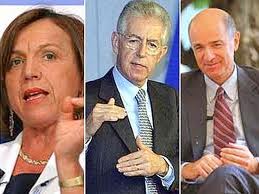
Prime Minister Mario Monti has set himself three major tasks so far. The first was the austerity budget, which he called Salvitalia or “Save Italy”, passed in November and now beginning to bite. The second was the Crescitalia or “Grow Italy” drafted in January and now before Parliament. The third, with no easy nametag, is labour reform. After a couple of months of discussions between the Minister of Labour, Elsa Fornero and unions and employers, a bill is about to go to Parliament.
Fornero, Monti and the other high profile minister, Corrado Passera (pictured) have been swapping roles since they took the jobs, with one or other of them playing tough or mediating. Over the weekend, it was Fornero who said that if the labour reform is not accepted (by the majority in Parliament), then, the government will go home. This has been Monti’s subtext since he became prime minister; he acknowledges that his government has no electoral legitimacy and can be brought down by Parliament in any division. But he and they know full well that the parties cannot take the responsibility of bringing down a government which is keeping Italy afloat in the euro storm.
The red rag (to both unions and employers and to their supporters in Parliament) is article 18 of the 1970 Worker’s Statute. This allows a worker who has been unfairly dismissed (as established by a court) to be reinstated. It only applies to firms with more than 15 employees and in practice only applies to employees who have an indefinite contract.
The secretary of the employers’ federation Confindustria, Emma Marcegaglia recently accused the Monti government of giving in to union and PD pressure over article 18. The centre-right PdL has moved in to back up the Confindustria in the parliamentary debate. Marcegaglia and others have maintained that article 18 is a fundamental brake on growth, not because it is used in practice but because it dissuades foreign investment. Granted it is difficult to prove a negative but all Confindustria people can come up with are very vague “colleagues have told me…”. Last month British Gas formally gave up on a project to build a regasification plant in Brindisi. They had spent 11 years and €250m on the project but even then had not been able to complete the paperwork for the necessary authorisations.
Only today, the emir of Qatar told Monti that the most important reason for not investing in Italy was corruption. Monti added that the uncertainty and desperate slowness of reaching a verdict in civil law was another reason.
Over the medium term, Italy’s position in the Heritage Foundation’s ratings on “Economic Freedom” have continued to fall with Italy now coming in (in 2012) at an abysmal 92nd (out of 179) place. According to the conservative thinktank, almost all their criteria have worsened (freedom from corruption, labour and monetary freedom, trade freedom, fiscal freedom). Italy is in the class of “mostly unfree” countries, between Azerbaijan and Honduras. Heritage is partnered by the Wall Street Journal which recently also accused the Monti government of giving in to the unions over article 18 but they have condemned Italy for the last decade for its lack of economic liberalism – left, right and Monti governments.
These seem to me to be much more convincing reasons for not investing in Italy than the distant possibility that if an employee is laid off and a court finds that the dismissal was without “just cause”, the employee will have the choice of getting the job back instead of monetary compensation.
The unions too have made the defence of article 18 into an article of faith with the more left wing CGIL threatening a general strike if it is abolished. The Democratic Party is preparing to move into parliamentary trenches though neither they nor the PdL are prepared to fight too violently because they cannot afford to bring down the government.
Hence the grandstanding from Fornero followed by rude rejections from the party leaders and then conciliatory moves by Passera and then Monti.
The parties are concerned with their own credibility (and that will be the next blog) while government and civil society organisations including employers and unions are trying to deal with the domestic and foreign pressure.
At home there is a new nightmare word, esodati, a neologism meaning literally “exodused”, in practice a class in limbo. These are people who were paid by the cassa integrazione, a temporary redundancy fund, on the understanding that their pay would come first from the cassa and then they would retire and get a pension. With Monti’s November reform, the retirement age has moved and these people find themselves without the cassa and without a pension; far from being led by Moses, they are stuck halfway across the Red Sea with the waters about to cover them. The problem is that we have no idea how many they are. The government says 65,000 and says they can take early retirement. INPS, the national pension fund says double that and that the pensions are not covered. The unions reckon the figure is closer to 300,000.
Youth unemployment continues to grow. ISTAT says that unemployment is up 0.2% in February on January at 9.3% and is the highest figure since 2004 when this series began. Youth (15-24) unemployment is 31.9%. Women suffer more. The eurozone is 10.8% so Italy is still slightly better off.
On the other side, a reliable research institute reckons that in 2011, a record 11,600 businesses closed, the worst year since the crisis began. The figures are given flesh by the increasing number of suicides of bankrupt businessmen.
Meanwhile, internationally, the spread between German and Italian bonds wobbles more upwards than down and some of Monti’s previous supporters are less vocal.
This afternoon I got an invitation to express my “views on Italy's political situation and how it can ride the wave of financial problems”. It was consoling that the question was “how” and not “if” which is the way many consider it. It is still “how” and not “if” but Monti’s tasks and difficulties are increasing rather than decreasing.
Wednesday, April 11, 2012
The best democracy that money can buy
[with acknowledgements to Greg Palast’s 2003 book of that title]
How much does politics cost? Italians and Americans have very different figures but they both have the same answer… too much. And in both countries it is democracy that is brought into disrepute.
The present rot in Italy began a long time ago, when Parliament reintroduced public financing of parties within months of a referendum which had abolished it in 1993. They called it “elections campaign reimbursements”, a fiction to begin with made even more absurd when they did not even have to show their expenses for the campaign. The absurdity was cubed when we learnt that the “reimbursements” ran for five years even when the legislature only lasted two as in 2006-08 (the clock obviously started again after the 2008 elections). Last month we also learnt that a party does not even have to exist any more in order to receive the taxpayers’ manna.
Since 1994, the different groups received €2.5 bn but accounted for less than €600m with bona fide election expenses. The rest went into the party kitty. The combination of corruption in the now defunct Margherita and the Northern League with the swingeing tax increases and benefit reduction have meant that political party approval ratings are below 10% and sinking. A bill to change the public financing of parties will probably be presented to Parliament this week but is more likely to be a fudge than any serious reform. None of the parties is willing to give up public support nor their control over many public resources.
After the Lockheed bribery scandals in 1974, explained because of the need to pay for election campaigns, Parliament introduced public funding. This was abolished in the April 1993 referendum (90.3% for abolition)in the wake of the kickback scandals only to be reintroduced later the same year as “reimbursements”. Parliament revised an existing law on electoral expenses so that €47m were paid out for the 1994 general election.
In 1999 the centre-left introduced electoral expenses at 800 lire per year per vote received. And three years later, in 2002 the Berlusconi government more than doubled the reimbursement to €1 (lire 1,936) for European Parliament elections, Chamber, Senate and Italian regional elections. For a total of almost €50m p.a.
The parties are given a “reimbursement for electoral expenses” which are paid yearly over the five years following the elections. In 2006, the outgoing Berlusconi government introduced a small amendment which means that if there are early elections, the parties are paid for the original elections and for the early ones which is exactly what happened in 2008.
On top of all this, there is the indirect financing of politics. Friends, relations and political supporters are given jobs either in the public administration (anything from road sweepers on the town council’s wages bill to senior civil servants in ministries) to the very popular “consultants” or as elected representatives. Berlusconi’s “dental hygienist” and alleged procuress for his Arcore parties, Nicole Minetti is a regional councillor for Lombardy (salary €12,000 pm) as was Umberto Bossi’s son Renzo until Monday; other female friends of Berlusconi are in the European Parliament.
The shows of indignation by politicians at the moment is amazing. You remember the old one, the Spaniard who asks the Irishman if they have a word for mañana. “We would” replies the Irishman, “but without its sense of urgency”. Is there a word for chutzpah in Italian? “Of course, but without its sense of ethical rigour”.
This is another proof of my contention that chutzpah is actually originally an Italian word. It is only now that once again after two party treasurers have been shown to have been rather too relaxed about the public financing of their parties that something might be done.
The Genoese comic Maurizio Crozza was already saying it five years ago when he asked “how much does politics cost?”. The style was very funny but the detailed and accurate figures wiped any smile off taxpayers’ faces; and the situation has only got worse. All the numbers he used were taken from the bestseller La Casta, the bestseller by two Corriere della Sera journalists, Gianantonio Stella and Sergio Rizzo. Yesterday, Rizzo wrote yet another horror story explaining that tax relief for donations to parties and party newspapers receive 51 times more tax relief than donations to research on child leukemia. He adds bitterly that there are some deputies who think that even that is not enough tax relief.
In the US, things are different. It is true that the taxpayer makes only limited direct contributions to campaign. But all donations are tax deductible so in the end, the taxpayer is indeed paying. The damage to American democracy is not in the illegal use of those funds it’s the uncontrolled quantity of funds. Since the Supreme Court’s Citizens United verdict in 2010, corporations may contribute unlimited funds to election candidates via supposedly independent Political Action Committees (PACs). The power of PACs has been shown by Romney’s ability to outspend all his opponents on the airwaves.
In France, starting on Easter Monday television and radio media access is strictly limited and controlled for all ten presidential candidates, a stark contrast to both the US and Italian campaign and financing methods. There are flaws in France, too, no doubt, but for the moment neither Italy nor the US give the idea of democracy a good name.
How much does politics cost? Italians and Americans have very different figures but they both have the same answer… too much. And in both countries it is democracy that is brought into disrepute.
The present rot in Italy began a long time ago, when Parliament reintroduced public financing of parties within months of a referendum which had abolished it in 1993. They called it “elections campaign reimbursements”, a fiction to begin with made even more absurd when they did not even have to show their expenses for the campaign. The absurdity was cubed when we learnt that the “reimbursements” ran for five years even when the legislature only lasted two as in 2006-08 (the clock obviously started again after the 2008 elections). Last month we also learnt that a party does not even have to exist any more in order to receive the taxpayers’ manna.
Since 1994, the different groups received €2.5 bn but accounted for less than €600m with bona fide election expenses. The rest went into the party kitty. The combination of corruption in the now defunct Margherita and the Northern League with the swingeing tax increases and benefit reduction have meant that political party approval ratings are below 10% and sinking. A bill to change the public financing of parties will probably be presented to Parliament this week but is more likely to be a fudge than any serious reform. None of the parties is willing to give up public support nor their control over many public resources.
After the Lockheed bribery scandals in 1974, explained because of the need to pay for election campaigns, Parliament introduced public funding. This was abolished in the April 1993 referendum (90.3% for abolition)in the wake of the kickback scandals only to be reintroduced later the same year as “reimbursements”. Parliament revised an existing law on electoral expenses so that €47m were paid out for the 1994 general election.
In 1999 the centre-left introduced electoral expenses at 800 lire per year per vote received. And three years later, in 2002 the Berlusconi government more than doubled the reimbursement to €1 (lire 1,936) for European Parliament elections, Chamber, Senate and Italian regional elections. For a total of almost €50m p.a.
The parties are given a “reimbursement for electoral expenses” which are paid yearly over the five years following the elections. In 2006, the outgoing Berlusconi government introduced a small amendment which means that if there are early elections, the parties are paid for the original elections and for the early ones which is exactly what happened in 2008.
On top of all this, there is the indirect financing of politics. Friends, relations and political supporters are given jobs either in the public administration (anything from road sweepers on the town council’s wages bill to senior civil servants in ministries) to the very popular “consultants” or as elected representatives. Berlusconi’s “dental hygienist” and alleged procuress for his Arcore parties, Nicole Minetti is a regional councillor for Lombardy (salary €12,000 pm) as was Umberto Bossi’s son Renzo until Monday; other female friends of Berlusconi are in the European Parliament.
The shows of indignation by politicians at the moment is amazing. You remember the old one, the Spaniard who asks the Irishman if they have a word for mañana. “We would” replies the Irishman, “but without its sense of urgency”. Is there a word for chutzpah in Italian? “Of course, but without its sense of ethical rigour”.
This is another proof of my contention that chutzpah is actually originally an Italian word. It is only now that once again after two party treasurers have been shown to have been rather too relaxed about the public financing of their parties that something might be done.
The Genoese comic Maurizio Crozza was already saying it five years ago when he asked “how much does politics cost?”. The style was very funny but the detailed and accurate figures wiped any smile off taxpayers’ faces; and the situation has only got worse. All the numbers he used were taken from the bestseller La Casta, the bestseller by two Corriere della Sera journalists, Gianantonio Stella and Sergio Rizzo. Yesterday, Rizzo wrote yet another horror story explaining that tax relief for donations to parties and party newspapers receive 51 times more tax relief than donations to research on child leukemia. He adds bitterly that there are some deputies who think that even that is not enough tax relief.
In the US, things are different. It is true that the taxpayer makes only limited direct contributions to campaign. But all donations are tax deductible so in the end, the taxpayer is indeed paying. The damage to American democracy is not in the illegal use of those funds it’s the uncontrolled quantity of funds. Since the Supreme Court’s Citizens United verdict in 2010, corporations may contribute unlimited funds to election candidates via supposedly independent Political Action Committees (PACs). The power of PACs has been shown by Romney’s ability to outspend all his opponents on the airwaves.
In France, starting on Easter Monday television and radio media access is strictly limited and controlled for all ten presidential candidates, a stark contrast to both the US and Italian campaign and financing methods. There are flaws in France, too, no doubt, but for the moment neither Italy nor the US give the idea of democracy a good name.
Monday, April 09, 2012
Bossi and Orwell’s Pigs

Umberto Bossi has finally resigned as leader of the Northern League which he founded and personified. He began his political career almost 30 years ago attacking the thieving capital, Roma ladrona, as a vampire which sucked the hardearned taxes of honest northerners into a vortex of corruption to support a lazy, workshy, gangster-ridden south. If even half the allegations against him are true, he has shown that he has learnt how to play that particular political game even better than those he once excoriated.
In the last scene of Animal Farm the animals look in through the window
Twelve voices were shouting in anger, and they were all alike. No question, now, what had happened to the faces of the pigs. The creatures outside looked from pig to man, and from man to pig, and from pig to man again; but already it was impossible to say which was which.
The great revolution had come to an end with the revolutionaries morphed into their former oppressors.
We poor animals of Italy have been witnessing this scene for some time now. Thankfully the result has been mostly an expensive comedy rather than the bloody tragedy that Orwell was satirising. And even better, Bossi has indeed stepped down, at least for the moment. Today, his eldest son, Renzo, has resigned from the Lombardy Regional Assembly under pressure from the grass roots.
Before that happened, Bossi, his family and close political allies had become more “southern” and more “Roman” than the real Romans and southerners.
Bossi started in a small way in his native Varese, north of Milan working hard to create a northern, populist party, the Lombard League. In 1987, he was elected to the Senate and since then is often referred to as Senatur, the Lombard for senatore. In 1990, he joined forces with the other northern parties which had imitated him to form the Northern League (LN) and in ’92 was both a cause and beneficiary of the collapse of the existing parties. They took 8.6% of the vote for the Chamber and 55 deputies. The following year, they won the local elections in Milan.
With the other parties seriously weakened and a new majoritarian system, in 1994, with 8.4%, they won 102 seats in the Chamber and became part of Silvio Berlusconi’s first government with five ministers. That only lasted seven months until Bossi left the coalition. Next time, in 2001, Berlusconi had prepared the ground better and the government lasted the whole term. Again in 2008, Bossi and Berlusconi were partners. The anti-establishment party has had cabinet ministers for more than nine of the last 18 years.
Right from the beginning, Bossi was way over the top and very soon became a caricature of himself. He and the leghisti were and are coarse in language and gesture with frequent expletives in public, middle fingers (Bossi and Roberto Calderoli in a typical pose) and the more traditional Italian translation (left hand in the crook of the right arm followed by a sharp upward movement of the right forearm – the English two fingers, the American one finger are much more economical but less expressive). His deputies waved a noose in the Chamber of Deputies as part of their contempt for political corruption – an irony not lost today. Bossi and his close associates make racist remarks, insult their opponents (including sometime and future allies like Berlusconi) and say that the the national flag should be used as lavatory paper (only he was more explicit). He has no illusions about his son, Renzo (pictured), who had to re-sit his maturità, high school exam, twice before passing the third time with a bare minimum; when someone suggested that Renzo was his Dauphin, he said “he’s no dolphin – at best he’s a trout”. Nonetheless, the Trout was elevated to the Lombardy Assembly with a €12,000 per month salary. He is also alleged to be taking a degree at a “private university in London” paid for with LN funds. Today, he resigned from the Assembly.

The LN treasurer also resigned last week after it became clear that he had had links with the Calabrian mafia, the ndrangheta, had probably been creating and using slush funds and had been investing millions of public funds in Tanzania.
Rosy Mauro, the woman who has looked after Bossi politically since his 2004 stroke was made deputy speaker of the Senate where she famously conducted the divisions on a whole bill without taking any notice of the assembly in front of her. That was a couple of years ago; now she is in the news because of her alleged lover whose degree was paid for (€130,000) with LN funds and who now has a job in the Senate. Even better, he made his name as an Elvis impersonator and singer in his own right with numbers like “Kooly noody” (or culi nudi – bare bums). After Renzo’s departure today, Mauro cannot be far behind him, at least as deputy speaker (pictured in the Senate).

They have all been dubbed “the magic circle” but the spell is wearing off.
In England, the performance could be “Carry on polenta” (or Madonnina or some other symbol of northern-ness) with Syd James as Bossi, Hattie Jacques as Rosy Mauro, Kenneth Williams as the Trout. Orwell who loved the saucy post cards of Donald McGill would surely smile at some of the League’s antics but tut-tutted the excesses. In any case, I have no doubt that Italian filmmakers are already working on the script – commedia all’italiana has no need to copy foreigners.
The rest is not very funny. The real scandal is not that an anti-corruption party should be caught buying degrees and cars, renovating the leader’s house or investing in Tanzania, it is that they have the funds to do it; these are the so-called “reimbursements” which don’t reimburse real electoral expenses but are part of a massive public funding for political parties.
In political terms, the LN will pay for some of the scandals in next month’s local elections and is going towards a long-awaited showdown between Bossi and his friends and his erstwhile lieutenant and partner, Roberto Maroni. The first test will be tomorrow evening in Bergamo for a League Pride (Orgoglio leghista) rally, the first opportunity for the party faithful to express themselves and show support for either Maroni or Bossi.
The League’s longterm aims of either secession or real federalism or devolution are no closer today than they were in 1994 when they first went into government bu they still have the best grass roots organisation of any Italian party. They have taken on and developed the local clientelism that used to be the prerogative of the old parties of the “First Republic” so despite the policy failure and the leadership scandals the League is not dead yet.
It is not only the leaders who have come to look like the old-style polticians.
Sunday, April 01, 2012
Why let the truth get in the way of a good slogan.

There is something more than perverse in the way some American Republicans view both the word “Europe” and the term “socialism”.
Once upon a time, there was a loony left which dubbed the mildest conservative or even liberal as “Fascist” advertising their ignorance of what the word means together with their intolerance. Today, serious candidates for the US presidency and representatives of the party which controls one of the houses of the US Congress show the same crazy disregard for reality. This is dangerous not just for Americans but for us in Europe too as widening the Atlantic helps neither side.
Last week, I was asked to try and understand what what going on How GOP candidates get Europe wrong which forced me to think about the issue.
Almost four years ago, during the Thanksgiving weekend after the US elections, I visited the Budapest House of Terror, a museum which seeks to describe the city under the Hungarian fascist Arrow Cross movement during the war and the subsequent Communist regime. The museum’s intention is to evoke unmitigated disgust for the two regimes and paint a picture of bleak, grey and painful city and it succeeds. So it was with some surprise that I came across these two entries in the museum’s visitors’ book:
"
Thank you for this fantastic exhibition. With the new Obama nation in the United States, soon [underlined] we will be a Communist nation. Please try and help us."
A New Yorker
dated 25 November 2008
same date but in the other book and in a different handwriting
"
It is shocking and scary how similar the earlier days of the Nazis and the Communists look to the promises and plans of the Obama administration in the United States. All Americans should learn about what really happens under Communism and Socialism"
JF
Republicans are only more circumspect in the way they talk about “European socialism” but the substance is the same. The intention is muddle any differences between Stalin’s gulags and Danish social democracy, between Greek debt and Spain’s high unemployment and Germany’s growth and low unemployment, between the European Union, the euro zone and geographical Europe. But all these distinctions don’t fit in 15 second sound bite.
Of course caricatures must have a grain of truth to have any currency. The way the euro crisis was allowed to deepen is hardly a positive lesson in financial management (but Romney and Santorum should explain how bailing out banks is “socialist”). Most European countries do indeed have socialised medicine, rarely free, but the candidates should explain why in Europe (by any definition) we spend a smaller proportion of our GDPs on health and it mostly gives us care which is as good or better than the US (according to the WHO, for 2008, social democratic Norway spends 8.5%, the UK and Italy 8.7%, Netherlands 9.9 and Germany 10.5%… while the US spent 15.2%). There are plenty of Americans who would love to have those figures and that sort of health care – it’s true that top American health is the best in the world but it requires insurance that the majority cannot afford. It is also true that not all Americans consider European health care as pre-Florence Nightingale Crimea. This week’s New Yorker has David Sedaris writing lyrically on dentists in France… but New Yorker readers are unlikely to vote for Rick Santorum. How Obamacare can be perceived as “socialist” in any way defies the lexicon and political definition. Even if it allows some wry humour about eating broccoli.

But the “socialist” ploy is not new “We are all socialists now” Jon Meacham in Newsweek thought so in 2009. Actually William Harcourt made the remark in 1887 when a bill was passed in the House of Commons allowing local authorities to acquire land compulsorily on behalf of the community. For him, the revolution had already arrived and he could almost hear the tumbrils coming down Whitehall. A lot of rhetoric has flowed under the bridges of both Thames and Potomac since then and the word has taken on many different nuances since then.
In most of western Europe at least, both the word and the substance of community responsibility have positive connotations. Conservative parties have to reassure voters that their neo-liberal, free market rhetoric will not mean high prices for education, health, pensions and support for the unemployed. In eastern Europe, the word does have negative connotations for some but the substance is if anything more ingrained than on other side of the old Iron Curtain.
But for all the (necessary) pedantry about what “Europe” and “socialism” really mean, the most disturbing conclusion is that the Republicans who rant against “socialism” are merely covering up a vitriolic racism against a black president.
Thursday, March 22, 2012
Corruption – Italian style - 2012

Walking home after dinner with friends, we noticed that someone else was still partying. The lights were on on top floor of one of the houses in piazza Farnese and many guests were admiring the square below and the stunning view of Michaelangelo’s cornice on Palazzo Farnese, the rest of its façade, the fountains and St. Brigid’s opposite.
The scene was an ironic and bitter reminder of the state of Italy.
The party taking place in a beautiful flat overlooking one of the most beautiful squares in the world was hosted by a convicted felon who had just served a six year sentence for corruption in that very flat.
The sentence-beginner “only in Italy…” is over used, but surely only in Italy, could there be such a blatant manifestation of the inequity of the administration of justice and politics; at least in the democratic world which purports to respect the rule of law.
The convict in question is Cesare Previti, a pit-bull lawyer, now 77, who has looked after Silvio Berlusconi’s interests for 40 years. In one case, he was accused of bribing a judge in order to fix an arbitration judgement for Berlusconi. He was convicted in the court of first instance and on appeal but the Supreme Court ordered a retrial. The statute of limitations, not for the first time, prevented the case from coming to verdict. In the midst of the serious charges, a minor point was not even noted by the court or commentators – the prosecution alleged that the bribe had been paid from Berlusconi’s account to Previti’s Swiss account to the judge’s. Previti defended himself by saying that the $434,000 was a fee paid to a foreign account to avoid paying taxes. At the time Previti was Minister of Defence. No one seemed to consider anything untoward that a Minister of the Republic admitted in court that he had evaded taxes on a hefty sum.
In 2006, he was actually convicted of bribery in the IMI-SIR Mondadori case for having persuaded a court in an arbitration case to award companies to Berlusconi rather than his rival Carlo De Benedetti. This is one of the few cases which went to the third level of judgement without being stopped by the statute of limitations. A law was immediately passed preventing anyone over 70 from serving time – hence Previti’s “prison” in piazza Farnese.
On Sunday, President Napolitano held a ceremony to close the celebrations of Italy’s 150 years. His speech was mostly about history but he concluded with an endorsement of Mario Monti’s government today and a near explicit exhortation to deal with illegality and corruption. The government, he said should “guarantee transparent behaviour in morality and a higher quality of governmental and institutional representation”. For a non-political head of state, that is strong stuff and most of the commentators focussed on the admonition.
The message was clear. There are half a dozen high profile corruption cases coming to the boil which will make for an interesting election campaign next year as most of the parties will try and paint everyone grey and only their most serious opposition as actually criminal.
On the centre-left there is Luigi Lusi who was accused of having removed €13m from the Margherita party when he was treasurer. He was a Democratic Party (PD) senator until February when he was expelled. At the moment, he has admitted to having taken the money and would like to plea bargain. In the meantime, it is not clear whether he embezzled €13, €18 or €21m. The leader of the party, Francesco Rutelli says that he was completely unaware of the theft and feels that he is the victim. To make the episode surreal, the party no longer exists and the funds that Lusi is accused of having stolen are a reimbursement of public funds… to a non-existent party. Lusi, by the way, lives 200 yards from Previti. Together, they rather lower the tone of the neighbourhood.
In Lombardy, the PD has been shaken by accusations that the city of Sesto San Giovanni ran what was in practice a racket, fleecing businesses in an urban renewal scheme. It was so well-known and practiced that it was called “Il sistema Sesto” and was run by a senior PD figure, sometime mayor of Sesto, Filippo Penati.
On the centre right in Lombardy, the situation is if anything, worse. More than 10% of the regional assembly is under investigation for taking bribes. Some were arrested in January. Most of the accused are from the centre right, People of Freedom (PdL) but the Northern League assemblyman Davide Boni is also accused of taking kickbacks.
There are dozens of other episodes; from Bari in the south to Genoa in the north with allegations that the kickbacks are not just in used notes as they used to be 20 years ago. Today, they are often payments to foundations or for “consultations fees” which are much more difficult to secure convictions on. Whatever the judicial outcomes over the next few years, there is a perception and resignation that once again, corruption is rampant, if it ever was under control.
Eurobarometer reckons that 87% of Italians think corruption is a problem compared to the hardly encouraging European average of 74% with 12% of those surveyed saying that they were asked to pay a bribe in the last year (compared to the average 8%).
Transparency international puts Italy at 69th place with the same score as Ghana and Macedonia. Their corruption barometer has two thirds of Italians thinking that corruption has increased over the last year.
At the same time, though, parts of the coalition supporting the Monti government has growled at the idea of tackling corruption. The PdL secretary Alfano said explicitly that Monti was overstepping his mark and there are plenty of other ways in which the government is kept in check. After the employers and the unions, Monti will have a much more difficult task reforming the politicians. As the economist Michele Salvati said recently, legality is certainly a good prerequisite for growth . In Greece, too, there is concern.
But don’t hold your breath in either country – it will take more than Napolitano’s polite exhortation and I am sure we’ll see a lot more parties at Previti’s and Lusi’s in my part of town.
Subscribe to:
Posts (Atom)