Italy does parties very well, as we all know. The festive kind have been around at least since the pre-Roman Etruscan triumphs, political parties are a bit more recent but they ran all aspects of the country in such a way as to have led to the creation of a new word: partitocrazia. They have never been loved but today their credibility has sunk to new lows.
In one recent poll, just over 48.2% of the Italian electorate said they would not vote for any party (compared to a turnout of just under 80% in 2008 – 22.8% did not vote). Overall confidence in the parties is as low as 4% in some polls and none gives them more than a 10% approval rating. This is lower than the trades unions and much lower than the unelected prime minister Monti who still scores over 50% despite the austerity budgets and some confusion and indecision of his government over the last few weeks.
In contrast, the quintessential anti-system group (from the left), the Movimento 5 Stelle (the 5 star movement) led by the Genoese comic Beppe Grillo (pictured above) is scoring more than 7% in the polls, the third biggest party if the polls are accurate. There are local elections on 6 May for about a fifth of the country and a general election by spring next year or possibly earlier, so the hypothetical numbers will become real soon enough. Grillo is “surfing the wave”, a wave that he reckons will wipe away the parties.
The professional politicians have been quick to complain about the dangers of “populism” and “antipolitica” evoking the spectre of the 1940s crypto-fascist, Poujadist movement, the Uomo Qualunque. Former prime minister and leader of the Democratic Party, Massimo D’Alema called the Grillo trend “a poison in society”.
Grillo certainly steals votes from the conventional left but he is also taking advantage of the Northern League’s (LN) scandals. The League has always been a protest movement but the scandals have show how much they have become part of the establishment so it is not surprising that dissatisfied LN people might support Grillo.
Enough has come out about the LN to make one wonder how it still exists. This week, the former treasurer delivered 10 gold ingots, 11 diamonds and an Audi A6 used by Renzo Bossi to party headquarters. Renzo (“the Trout”) is the son of party leader Umberto. These were supposedly party “investments”. Former minister and Bossi faithful, Calderoli has admitted that the party is paying €2,200 a month for his flat in Rome. Prosecutors in Calabria are accusing the Lega of managing €80m of party and Calabrian mafia (ndrangheta) funds together and trying to take over a Swiss bank together. To top it all, there are allegations that the former treasurer was also spying on Bossi’s rival, Roberto Maroni looking for dirt.
The League makes a better tabloid story but it is the the government parties, left right and centre, that really matter.
Berlusconi was in court yesterday explaining that his girls dressed up as nuns and police because “women are exhibitionists” and that there was nothing improper, but bunga-bunga aside his People of Freedom (PdL) party is disintegrating anyway.
Senator Beppe Pisanu and 30 other PdL parliamentarians launched an appeal to “moderates” yesterday presaging another split in the PdL. At the same time, the centrist leader Pierferdinando Casini of the Christian Democrat Centre Union, (UDC) launched the new Partito della Nazione (Party of the Nation) which would like to include some of the more popular supposedly “technical” ministers in Monti government; people like Corrado Passera, Andrea Riccardi and Anna Maria Cancellieri, perhaps even Monti himself.
Casini has also been trying to bring former Fiat and Ferrari boss Luca Cordero di Montezemolo into his circle. Montezemolo set up a foundation a couple of years ago which seemed to be the statement of intent to go into politics but he has dithered ever since. Montezemolo met with Berlusconi yesterday but still has not put his hat in the ring either with Casini or Berlusconi.
All this means that there is a crowd in the centre, elbowing each other in time for next year’s elections and presuming that the Berlusconi era is over. Berlusconi himself (through his mouthpiece, Angelino Alfano) has promised a “new campaign and new political actor” after the local elections. For decades now, political parties have been sold like washing powder but now we even have the “mystery product”, the new model which is advertised even under wraps – actually, being under wraps is supposed to make it all the more seductive. This is the hope, but the competition between Casini and Alfano is too obvious to attract anyone. If Berlusconi comes back, not unlikely, then the balance changes.
On the left, the Democrtic Party (PD) has been showing its divisions for months now especially on economic and labour issues. Apart from Grillo, there is an attempt to set up a party or movement to appeal to the disappointed left wing voters, yet another try to make a coherent, votable party for people of the left without a real political home. Next week there will be a meeting to try and set up a new party.
In the meantime, the big issues of employment, growth and taxes are being sidelined by personal or party interests. Berlusconi and the PdL are fighting a government move to auction off television frequencies instead of giving them free to Mediaset and the RAI. The PdL is delaying the progress of an anti-corruption bill before Parliament and all the big parties are defending their own generous public funding. While they all complain about the antipolitica, none of them is prepared to look to the causes.
Last summer I wrote a blog entitled “They don’t get it” about politicians who were out of touch with reality (and many others have been writing similar laments for ages before that). You would think that after all that has happened since then something would have changed in politicians’ perceptions of themselves… but they still don’t get it! As one correspondent put it “Pitchforks!” but that would be populist, wouldn’t it?
A forum of free voices discussing today's Italian politics and its historical roots
Saturday, April 21, 2012
Monday, April 16, 2012
The Labours of Monti
Prime Minister Mario Monti has set himself three major tasks so far. The first was the austerity budget, which he called Salvitalia or “Save Italy”, passed in November and now beginning to bite. The second was the Crescitalia or “Grow Italy” drafted in January and now before Parliament. The third, with no easy nametag, is labour reform. After a couple of months of discussions between the Minister of Labour, Elsa Fornero and unions and employers, a bill is about to go to Parliament.
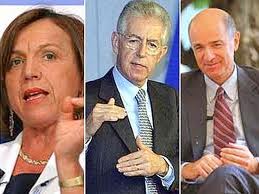
Fornero, Monti and the other high profile minister, Corrado Passera (pictured) have been swapping roles since they took the jobs, with one or other of them playing tough or mediating. Over the weekend, it was Fornero who said that if the labour reform is not accepted (by the majority in Parliament), then, the government will go home. This has been Monti’s subtext since he became prime minister; he acknowledges that his government has no electoral legitimacy and can be brought down by Parliament in any division. But he and they know full well that the parties cannot take the responsibility of bringing down a government which is keeping Italy afloat in the euro storm.
The red rag (to both unions and employers and to their supporters in Parliament) is article 18 of the 1970 Worker’s Statute. This allows a worker who has been unfairly dismissed (as established by a court) to be reinstated. It only applies to firms with more than 15 employees and in practice only applies to employees who have an indefinite contract.
The secretary of the employers’ federation Confindustria, Emma Marcegaglia recently accused the Monti government of giving in to union and PD pressure over article 18. The centre-right PdL has moved in to back up the Confindustria in the parliamentary debate. Marcegaglia and others have maintained that article 18 is a fundamental brake on growth, not because it is used in practice but because it dissuades foreign investment. Granted it is difficult to prove a negative but all Confindustria people can come up with are very vague “colleagues have told me…”. Last month British Gas formally gave up on a project to build a regasification plant in Brindisi. They had spent 11 years and €250m on the project but even then had not been able to complete the paperwork for the necessary authorisations.
Only today, the emir of Qatar told Monti that the most important reason for not investing in Italy was corruption. Monti added that the uncertainty and desperate slowness of reaching a verdict in civil law was another reason.
Over the medium term, Italy’s position in the Heritage Foundation’s ratings on “Economic Freedom” have continued to fall with Italy now coming in (in 2012) at an abysmal 92nd (out of 179) place. According to the conservative thinktank, almost all their criteria have worsened (freedom from corruption, labour and monetary freedom, trade freedom, fiscal freedom). Italy is in the class of “mostly unfree” countries, between Azerbaijan and Honduras. Heritage is partnered by the Wall Street Journal which recently also accused the Monti government of giving in to the unions over article 18 but they have condemned Italy for the last decade for its lack of economic liberalism – left, right and Monti governments.
These seem to me to be much more convincing reasons for not investing in Italy than the distant possibility that if an employee is laid off and a court finds that the dismissal was without “just cause”, the employee will have the choice of getting the job back instead of monetary compensation.
The unions too have made the defence of article 18 into an article of faith with the more left wing CGIL threatening a general strike if it is abolished. The Democratic Party is preparing to move into parliamentary trenches though neither they nor the PdL are prepared to fight too violently because they cannot afford to bring down the government.
Hence the grandstanding from Fornero followed by rude rejections from the party leaders and then conciliatory moves by Passera and then Monti.
The parties are concerned with their own credibility (and that will be the next blog) while government and civil society organisations including employers and unions are trying to deal with the domestic and foreign pressure.
At home there is a new nightmare word, esodati, a neologism meaning literally “exodused”, in practice a class in limbo. These are people who were paid by the cassa integrazione, a temporary redundancy fund, on the understanding that their pay would come first from the cassa and then they would retire and get a pension. With Monti’s November reform, the retirement age has moved and these people find themselves without the cassa and without a pension; far from being led by Moses, they are stuck halfway across the Red Sea with the waters about to cover them. The problem is that we have no idea how many they are. The government says 65,000 and says they can take early retirement. INPS, the national pension fund says double that and that the pensions are not covered. The unions reckon the figure is closer to 300,000.
Youth unemployment continues to grow. ISTAT says that unemployment is up 0.2% in February on January at 9.3% and is the highest figure since 2004 when this series began. Youth (15-24) unemployment is 31.9%. Women suffer more. The eurozone is 10.8% so Italy is still slightly better off.
On the other side, a reliable research institute reckons that in 2011, a record 11,600 businesses closed, the worst year since the crisis began. The figures are given flesh by the increasing number of suicides of bankrupt businessmen.
Meanwhile, internationally, the spread between German and Italian bonds wobbles more upwards than down and some of Monti’s previous supporters are less vocal.
This afternoon I got an invitation to express my “views on Italy's political situation and how it can ride the wave of financial problems”. It was consoling that the question was “how” and not “if” which is the way many consider it. It is still “how” and not “if” but Monti’s tasks and difficulties are increasing rather than decreasing.
Wednesday, April 11, 2012
The best democracy that money can buy
[with acknowledgements to Greg Palast’s 2003 book of that title]
How much does politics cost? Italians and Americans have very different figures but they both have the same answer… too much. And in both countries it is democracy that is brought into disrepute.
The present rot in Italy began a long time ago, when Parliament reintroduced public financing of parties within months of a referendum which had abolished it in 1993. They called it “elections campaign reimbursements”, a fiction to begin with made even more absurd when they did not even have to show their expenses for the campaign. The absurdity was cubed when we learnt that the “reimbursements” ran for five years even when the legislature only lasted two as in 2006-08 (the clock obviously started again after the 2008 elections). Last month we also learnt that a party does not even have to exist any more in order to receive the taxpayers’ manna.
Since 1994, the different groups received €2.5 bn but accounted for less than €600m with bona fide election expenses. The rest went into the party kitty. The combination of corruption in the now defunct Margherita and the Northern League with the swingeing tax increases and benefit reduction have meant that political party approval ratings are below 10% and sinking. A bill to change the public financing of parties will probably be presented to Parliament this week but is more likely to be a fudge than any serious reform. None of the parties is willing to give up public support nor their control over many public resources.
After the Lockheed bribery scandals in 1974, explained because of the need to pay for election campaigns, Parliament introduced public funding. This was abolished in the April 1993 referendum (90.3% for abolition)in the wake of the kickback scandals only to be reintroduced later the same year as “reimbursements”. Parliament revised an existing law on electoral expenses so that €47m were paid out for the 1994 general election.
In 1999 the centre-left introduced electoral expenses at 800 lire per year per vote received. And three years later, in 2002 the Berlusconi government more than doubled the reimbursement to €1 (lire 1,936) for European Parliament elections, Chamber, Senate and Italian regional elections. For a total of almost €50m p.a.
The parties are given a “reimbursement for electoral expenses” which are paid yearly over the five years following the elections. In 2006, the outgoing Berlusconi government introduced a small amendment which means that if there are early elections, the parties are paid for the original elections and for the early ones which is exactly what happened in 2008.
On top of all this, there is the indirect financing of politics. Friends, relations and political supporters are given jobs either in the public administration (anything from road sweepers on the town council’s wages bill to senior civil servants in ministries) to the very popular “consultants” or as elected representatives. Berlusconi’s “dental hygienist” and alleged procuress for his Arcore parties, Nicole Minetti is a regional councillor for Lombardy (salary €12,000 pm) as was Umberto Bossi’s son Renzo until Monday; other female friends of Berlusconi are in the European Parliament.
The shows of indignation by politicians at the moment is amazing. You remember the old one, the Spaniard who asks the Irishman if they have a word for mañana. “We would” replies the Irishman, “but without its sense of urgency”. Is there a word for chutzpah in Italian? “Of course, but without its sense of ethical rigour”.
This is another proof of my contention that chutzpah is actually originally an Italian word. It is only now that once again after two party treasurers have been shown to have been rather too relaxed about the public financing of their parties that something might be done.
The Genoese comic Maurizio Crozza was already saying it five years ago when he asked “how much does politics cost?”. The style was very funny but the detailed and accurate figures wiped any smile off taxpayers’ faces; and the situation has only got worse. All the numbers he used were taken from the bestseller La Casta, the bestseller by two Corriere della Sera journalists, Gianantonio Stella and Sergio Rizzo. Yesterday, Rizzo wrote yet another horror story explaining that tax relief for donations to parties and party newspapers receive 51 times more tax relief than donations to research on child leukemia. He adds bitterly that there are some deputies who think that even that is not enough tax relief.
In the US, things are different. It is true that the taxpayer makes only limited direct contributions to campaign. But all donations are tax deductible so in the end, the taxpayer is indeed paying. The damage to American democracy is not in the illegal use of those funds it’s the uncontrolled quantity of funds. Since the Supreme Court’s Citizens United verdict in 2010, corporations may contribute unlimited funds to election candidates via supposedly independent Political Action Committees (PACs). The power of PACs has been shown by Romney’s ability to outspend all his opponents on the airwaves.
In France, starting on Easter Monday television and radio media access is strictly limited and controlled for all ten presidential candidates, a stark contrast to both the US and Italian campaign and financing methods. There are flaws in France, too, no doubt, but for the moment neither Italy nor the US give the idea of democracy a good name.
How much does politics cost? Italians and Americans have very different figures but they both have the same answer… too much. And in both countries it is democracy that is brought into disrepute.
The present rot in Italy began a long time ago, when Parliament reintroduced public financing of parties within months of a referendum which had abolished it in 1993. They called it “elections campaign reimbursements”, a fiction to begin with made even more absurd when they did not even have to show their expenses for the campaign. The absurdity was cubed when we learnt that the “reimbursements” ran for five years even when the legislature only lasted two as in 2006-08 (the clock obviously started again after the 2008 elections). Last month we also learnt that a party does not even have to exist any more in order to receive the taxpayers’ manna.
Since 1994, the different groups received €2.5 bn but accounted for less than €600m with bona fide election expenses. The rest went into the party kitty. The combination of corruption in the now defunct Margherita and the Northern League with the swingeing tax increases and benefit reduction have meant that political party approval ratings are below 10% and sinking. A bill to change the public financing of parties will probably be presented to Parliament this week but is more likely to be a fudge than any serious reform. None of the parties is willing to give up public support nor their control over many public resources.
After the Lockheed bribery scandals in 1974, explained because of the need to pay for election campaigns, Parliament introduced public funding. This was abolished in the April 1993 referendum (90.3% for abolition)in the wake of the kickback scandals only to be reintroduced later the same year as “reimbursements”. Parliament revised an existing law on electoral expenses so that €47m were paid out for the 1994 general election.
In 1999 the centre-left introduced electoral expenses at 800 lire per year per vote received. And three years later, in 2002 the Berlusconi government more than doubled the reimbursement to €1 (lire 1,936) for European Parliament elections, Chamber, Senate and Italian regional elections. For a total of almost €50m p.a.
The parties are given a “reimbursement for electoral expenses” which are paid yearly over the five years following the elections. In 2006, the outgoing Berlusconi government introduced a small amendment which means that if there are early elections, the parties are paid for the original elections and for the early ones which is exactly what happened in 2008.
On top of all this, there is the indirect financing of politics. Friends, relations and political supporters are given jobs either in the public administration (anything from road sweepers on the town council’s wages bill to senior civil servants in ministries) to the very popular “consultants” or as elected representatives. Berlusconi’s “dental hygienist” and alleged procuress for his Arcore parties, Nicole Minetti is a regional councillor for Lombardy (salary €12,000 pm) as was Umberto Bossi’s son Renzo until Monday; other female friends of Berlusconi are in the European Parliament.
The shows of indignation by politicians at the moment is amazing. You remember the old one, the Spaniard who asks the Irishman if they have a word for mañana. “We would” replies the Irishman, “but without its sense of urgency”. Is there a word for chutzpah in Italian? “Of course, but without its sense of ethical rigour”.
This is another proof of my contention that chutzpah is actually originally an Italian word. It is only now that once again after two party treasurers have been shown to have been rather too relaxed about the public financing of their parties that something might be done.
The Genoese comic Maurizio Crozza was already saying it five years ago when he asked “how much does politics cost?”. The style was very funny but the detailed and accurate figures wiped any smile off taxpayers’ faces; and the situation has only got worse. All the numbers he used were taken from the bestseller La Casta, the bestseller by two Corriere della Sera journalists, Gianantonio Stella and Sergio Rizzo. Yesterday, Rizzo wrote yet another horror story explaining that tax relief for donations to parties and party newspapers receive 51 times more tax relief than donations to research on child leukemia. He adds bitterly that there are some deputies who think that even that is not enough tax relief.
In the US, things are different. It is true that the taxpayer makes only limited direct contributions to campaign. But all donations are tax deductible so in the end, the taxpayer is indeed paying. The damage to American democracy is not in the illegal use of those funds it’s the uncontrolled quantity of funds. Since the Supreme Court’s Citizens United verdict in 2010, corporations may contribute unlimited funds to election candidates via supposedly independent Political Action Committees (PACs). The power of PACs has been shown by Romney’s ability to outspend all his opponents on the airwaves.
In France, starting on Easter Monday television and radio media access is strictly limited and controlled for all ten presidential candidates, a stark contrast to both the US and Italian campaign and financing methods. There are flaws in France, too, no doubt, but for the moment neither Italy nor the US give the idea of democracy a good name.
Monday, April 09, 2012
Bossi and Orwell’s Pigs
Umberto Bossi has finally resigned as leader of the Northern League which he founded and personified. He began his political career almost 30 years ago attacking the thieving capital, Roma ladrona, as a vampire which sucked the hardearned taxes of honest northerners into a vortex of corruption to support a lazy, workshy, gangster-ridden south. If even half the allegations against him are true, he has shown that he has learnt how to play that particular political game even better than those he once excoriated.
In the last scene of Animal Farm the animals look in through the window
Twelve voices were shouting in anger, and they were all alike. No question, now, what had happened to the faces of the pigs. The creatures outside looked from pig to man, and from man to pig, and from pig to man again; but already it was impossible to say which was which.
The great revolution had come to an end with the revolutionaries morphed into their former oppressors.
We poor animals of Italy have been witnessing this scene for some time now. Thankfully the result has been mostly an expensive comedy rather than the bloody tragedy that Orwell was satirising. And even better, Bossi has indeed stepped down, at least for the moment. Today, his eldest son, Renzo, has resigned from the Lombardy Regional Assembly under pressure from the grass roots.
Before that happened, Bossi, his family and close political allies had become more “southern” and more “Roman” than the real Romans and southerners.
Bossi started in a small way in his native Varese, north of Milan working hard to create a northern, populist party, the Lombard League. In 1987, he was elected to the Senate and since then is often referred to as Senatur, the Lombard for senatore. In 1990, he joined forces with the other northern parties which had imitated him to form the Northern League (LN) and in ’92 was both a cause and beneficiary of the collapse of the existing parties. They took 8.6% of the vote for the Chamber and 55 deputies. The following year, they won the local elections in Milan.
With the other parties seriously weakened and a new majoritarian system, in 1994, with 8.4%, they won 102 seats in the Chamber and became part of Silvio Berlusconi’s first government with five ministers. That only lasted seven months until Bossi left the coalition. Next time, in 2001, Berlusconi had prepared the ground better and the government lasted the whole term. Again in 2008, Bossi and Berlusconi were partners. The anti-establishment party has had cabinet ministers for more than nine of the last 18 years.
Right from the beginning, Bossi was way over the top and very soon became a caricature of himself. He and the leghisti were and are coarse in language and gesture with frequent expletives in public, middle fingers (Bossi and Roberto Calderoli in a typical pose) and the more traditional Italian translation (left hand in the crook of the right arm followed by a sharp upward movement of the right forearm – the English two fingers, the American one finger are much more economical but less expressive). His deputies waved a noose in the Chamber of Deputies as part of their contempt for political corruption – an irony not lost today. Bossi and his close associates make racist remarks, insult their opponents (including sometime and future allies like Berlusconi) and say that the the national flag should be used as lavatory paper (only he was more explicit). He has no illusions about his son, Renzo (pictured), who had to re-sit his maturità, high school exam, twice before passing the third time with a bare minimum; when someone suggested that Renzo was his Dauphin, he said “he’s no dolphin – at best he’s a trout”. Nonetheless, the Trout was elevated to the Lombardy Assembly with a €12,000 per month salary. He is also alleged to be taking a degree at a “private university in London” paid for with LN funds. Today, he resigned from the Assembly.
The LN treasurer also resigned last week after it became clear that he had had links with the Calabrian mafia, the ndrangheta, had probably been creating and using slush funds and had been investing millions of public funds in Tanzania.
Rosy Mauro, the woman who has looked after Bossi politically since his 2004 stroke was made deputy speaker of the Senate where she famously conducted the divisions on a whole bill without taking any notice of the assembly in front of her. That was a couple of years ago; now she is in the news because of her alleged lover whose degree was paid for (€130,000) with LN funds and who now has a job in the Senate. Even better, he made his name as an Elvis impersonator and singer in his own right with numbers like “Kooly noody” (or culi nudi – bare bums). After Renzo’s departure today, Mauro cannot be far behind him, at least as deputy speaker (pictured in the Senate).
They have all been dubbed “the magic circle” but the spell is wearing off.
In England, the performance could be “Carry on polenta” (or Madonnina or some other symbol of northern-ness) with Syd James as Bossi, Hattie Jacques as Rosy Mauro, Kenneth Williams as the Trout. Orwell who loved the saucy post cards of Donald McGill would surely smile at some of the League’s antics but tut-tutted the excesses. In any case, I have no doubt that Italian filmmakers are already working on the script – commedia all’italiana has no need to copy foreigners.
The rest is not very funny. The real scandal is not that an anti-corruption party should be caught buying degrees and cars, renovating the leader’s house or investing in Tanzania, it is that they have the funds to do it; these are the so-called “reimbursements” which don’t reimburse real electoral expenses but are part of a massive public funding for political parties.
In political terms, the LN will pay for some of the scandals in next month’s local elections and is going towards a long-awaited showdown between Bossi and his friends and his erstwhile lieutenant and partner, Roberto Maroni. The first test will be tomorrow evening in Bergamo for a League Pride (Orgoglio leghista) rally, the first opportunity for the party faithful to express themselves and show support for either Maroni or Bossi.
The League’s longterm aims of either secession or real federalism or devolution are no closer today than they were in 1994 when they first went into government bu they still have the best grass roots organisation of any Italian party. They have taken on and developed the local clientelism that used to be the prerogative of the old parties of the “First Republic” so despite the policy failure and the leadership scandals the League is not dead yet.
It is not only the leaders who have come to look like the old-style polticians.
Sunday, April 01, 2012
Why let the truth get in the way of a good slogan.
There is something more than perverse in the way some American Republicans view both the word “Europe” and the term “socialism”.
Once upon a time, there was a loony left which dubbed the mildest conservative or even liberal as “Fascist” advertising their ignorance of what the word means together with their intolerance. Today, serious candidates for the US presidency and representatives of the party which controls one of the houses of the US Congress show the same crazy disregard for reality. This is dangerous not just for Americans but for us in Europe too as widening the Atlantic helps neither side.
Last week, I was asked to try and understand what what going on How GOP candidates get Europe wrong which forced me to think about the issue.
Almost four years ago, during the Thanksgiving weekend after the US elections, I visited the Budapest House of Terror, a museum which seeks to describe the city under the Hungarian fascist Arrow Cross movement during the war and the subsequent Communist regime. The museum’s intention is to evoke unmitigated disgust for the two regimes and paint a picture of bleak, grey and painful city and it succeeds. So it was with some surprise that I came across these two entries in the museum’s visitors’ book:
"
Thank you for this fantastic exhibition. With the new Obama nation in the United States, soon [underlined] we will be a Communist nation. Please try and help us."
A New Yorker
dated 25 November 2008
same date but in the other book and in a different handwriting
"
It is shocking and scary how similar the earlier days of the Nazis and the Communists look to the promises and plans of the Obama administration in the United States. All Americans should learn about what really happens under Communism and Socialism"
JF
Republicans are only more circumspect in the way they talk about “European socialism” but the substance is the same. The intention is muddle any differences between Stalin’s gulags and Danish social democracy, between Greek debt and Spain’s high unemployment and Germany’s growth and low unemployment, between the European Union, the euro zone and geographical Europe. But all these distinctions don’t fit in 15 second sound bite.
Of course caricatures must have a grain of truth to have any currency. The way the euro crisis was allowed to deepen is hardly a positive lesson in financial management (but Romney and Santorum should explain how bailing out banks is “socialist”). Most European countries do indeed have socialised medicine, rarely free, but the candidates should explain why in Europe (by any definition) we spend a smaller proportion of our GDPs on health and it mostly gives us care which is as good or better than the US (according to the WHO, for 2008, social democratic Norway spends 8.5%, the UK and Italy 8.7%, Netherlands 9.9 and Germany 10.5%… while the US spent 15.2%). There are plenty of Americans who would love to have those figures and that sort of health care – it’s true that top American health is the best in the world but it requires insurance that the majority cannot afford. It is also true that not all Americans consider European health care as pre-Florence Nightingale Crimea. This week’s New Yorker has David Sedaris writing lyrically on dentists in France… but New Yorker readers are unlikely to vote for Rick Santorum. How Obamacare can be perceived as “socialist” in any way defies the lexicon and political definition. Even if it allows some wry humour about eating broccoli.
But the “socialist” ploy is not new “We are all socialists now” Jon Meacham in Newsweek thought so in 2009. Actually William Harcourt made the remark in 1887 when a bill was passed in the House of Commons allowing local authorities to acquire land compulsorily on behalf of the community. For him, the revolution had already arrived and he could almost hear the tumbrils coming down Whitehall. A lot of rhetoric has flowed under the bridges of both Thames and Potomac since then and the word has taken on many different nuances since then.
In most of western Europe at least, both the word and the substance of community responsibility have positive connotations. Conservative parties have to reassure voters that their neo-liberal, free market rhetoric will not mean high prices for education, health, pensions and support for the unemployed. In eastern Europe, the word does have negative connotations for some but the substance is if anything more ingrained than on other side of the old Iron Curtain.
But for all the (necessary) pedantry about what “Europe” and “socialism” really mean, the most disturbing conclusion is that the Republicans who rant against “socialism” are merely covering up a vitriolic racism against a black president.
Thursday, March 22, 2012
Corruption – Italian style - 2012
Walking home after dinner with friends, we noticed that someone else was still partying. The lights were on on top floor of one of the houses in piazza Farnese and many guests were admiring the square below and the stunning view of Michaelangelo’s cornice on Palazzo Farnese, the rest of its façade, the fountains and St. Brigid’s opposite.
The scene was an ironic and bitter reminder of the state of Italy.
The party taking place in a beautiful flat overlooking one of the most beautiful squares in the world was hosted by a convicted felon who had just served a six year sentence for corruption in that very flat.
The sentence-beginner “only in Italy…” is over used, but surely only in Italy, could there be such a blatant manifestation of the inequity of the administration of justice and politics; at least in the democratic world which purports to respect the rule of law.
The convict in question is Cesare Previti, a pit-bull lawyer, now 77, who has looked after Silvio Berlusconi’s interests for 40 years. In one case, he was accused of bribing a judge in order to fix an arbitration judgement for Berlusconi. He was convicted in the court of first instance and on appeal but the Supreme Court ordered a retrial. The statute of limitations, not for the first time, prevented the case from coming to verdict. In the midst of the serious charges, a minor point was not even noted by the court or commentators – the prosecution alleged that the bribe had been paid from Berlusconi’s account to Previti’s Swiss account to the judge’s. Previti defended himself by saying that the $434,000 was a fee paid to a foreign account to avoid paying taxes. At the time Previti was Minister of Defence. No one seemed to consider anything untoward that a Minister of the Republic admitted in court that he had evaded taxes on a hefty sum.
In 2006, he was actually convicted of bribery in the IMI-SIR Mondadori case for having persuaded a court in an arbitration case to award companies to Berlusconi rather than his rival Carlo De Benedetti. This is one of the few cases which went to the third level of judgement without being stopped by the statute of limitations. A law was immediately passed preventing anyone over 70 from serving time – hence Previti’s “prison” in piazza Farnese.
On Sunday, President Napolitano held a ceremony to close the celebrations of Italy’s 150 years. His speech was mostly about history but he concluded with an endorsement of Mario Monti’s government today and a near explicit exhortation to deal with illegality and corruption. The government, he said should “guarantee transparent behaviour in morality and a higher quality of governmental and institutional representation”. For a non-political head of state, that is strong stuff and most of the commentators focussed on the admonition.
The message was clear. There are half a dozen high profile corruption cases coming to the boil which will make for an interesting election campaign next year as most of the parties will try and paint everyone grey and only their most serious opposition as actually criminal.
On the centre-left there is Luigi Lusi who was accused of having removed €13m from the Margherita party when he was treasurer. He was a Democratic Party (PD) senator until February when he was expelled. At the moment, he has admitted to having taken the money and would like to plea bargain. In the meantime, it is not clear whether he embezzled €13, €18 or €21m. The leader of the party, Francesco Rutelli says that he was completely unaware of the theft and feels that he is the victim. To make the episode surreal, the party no longer exists and the funds that Lusi is accused of having stolen are a reimbursement of public funds… to a non-existent party. Lusi, by the way, lives 200 yards from Previti. Together, they rather lower the tone of the neighbourhood.
In Lombardy, the PD has been shaken by accusations that the city of Sesto San Giovanni ran what was in practice a racket, fleecing businesses in an urban renewal scheme. It was so well-known and practiced that it was called “Il sistema Sesto” and was run by a senior PD figure, sometime mayor of Sesto, Filippo Penati.
On the centre right in Lombardy, the situation is if anything, worse. More than 10% of the regional assembly is under investigation for taking bribes. Some were arrested in January. Most of the accused are from the centre right, People of Freedom (PdL) but the Northern League assemblyman Davide Boni is also accused of taking kickbacks.
There are dozens of other episodes; from Bari in the south to Genoa in the north with allegations that the kickbacks are not just in used notes as they used to be 20 years ago. Today, they are often payments to foundations or for “consultations fees” which are much more difficult to secure convictions on. Whatever the judicial outcomes over the next few years, there is a perception and resignation that once again, corruption is rampant, if it ever was under control.
Eurobarometer reckons that 87% of Italians think corruption is a problem compared to the hardly encouraging European average of 74% with 12% of those surveyed saying that they were asked to pay a bribe in the last year (compared to the average 8%).
Transparency international puts Italy at 69th place with the same score as Ghana and Macedonia. Their corruption barometer has two thirds of Italians thinking that corruption has increased over the last year.
At the same time, though, parts of the coalition supporting the Monti government has growled at the idea of tackling corruption. The PdL secretary Alfano said explicitly that Monti was overstepping his mark and there are plenty of other ways in which the government is kept in check. After the employers and the unions, Monti will have a much more difficult task reforming the politicians. As the economist Michele Salvati said recently, legality is certainly a good prerequisite for growth . In Greece, too, there is concern.
But don’t hold your breath in either country – it will take more than Napolitano’s polite exhortation and I am sure we’ll see a lot more parties at Previti’s and Lusi’s in my part of town.
Saturday, March 10, 2012
Italy, Britain and Nigeria
Not following the rules is fine as long as you succeed but when an operation fails, especially a military operation where lives are at stake, then there is inevitably a double blame – for the failure of the operation and for going against the rules.
Clearly the attempt to save Lamolinara and McManus, the Italian and British engineers held hostage in northern Nigeria was botched in military terms. If it is confirmed that there was a seven hour gun battle between the hostage takers and the rescuers, there was little chance of the hostages coming out alive; it now seems in any case that they were shot just as the rescue began. If the operation had succeeded, then we can guess that there might have been some Italian grumbling at not being informed about what was being planned but it would have been covered by the rescue of the hostages. But the Italian government was only informed when the operation had already begun, another breach of the rules.
Instead, with the two men dead, there is a serious row between the two countries. It is inconceivable that there were not close contacts between the Farnesina and the Foreign Office in the 9 months since they were kidnapped. If there were not, then both sides are at fault. But it is possible, even likely, that the two countries’ intelligence services and special forces were not cooperating fully.
First of all, spooks are wary of sharing information with anyone, even close allies and special forces are equally hesitant to mount combined operations where a high degree of trust and coordination are needed. There have been hostagetaking episodes in both Iraq and Afghanistan where the Italian secret services and special forces have been accused of ransoming hostages or cutting some sort of deal with local warlords. True or not, the allegations could well have dissuaded the British intelligence and special forces from being open with their Italian counterparts, especially in the Nigerian context where local factions already make secret operations difficult.
The political distance is less easy to explain. Cameron’s statement was notable in ignoring any Italian relevance. “We have been working with the Nigerian authorities…” since the men were taken. Not with the Italian and Nigerian authorities. The decision to mount the operation was again taken “with the Nigerian authorities”, not with the Italian and Nigerian authorities. As far as Cameron and Hague were concerned, it was as if the Italian government was irrelevant to the fate of an Italian citizen. This is what most Italian commentators are actually saying. President Napolitano said that the lack of cooperation was “inexplicable”. Unfortunately, it is is all to understandable.
It is true that Britain has much closer links with Nigeria than Italy, links which are political, police and military based a little on former colonial links but above all on contemporary cooperation on organised crime and terrorism prevention and commercial and human ties between the countries.
Britain and France still consider west Africa as their responsibility and their military interventions in Sierra Leone and Côte d’Ivoire over the last decade have been successful as well as legal and appreciated. None of this, though, justifies ignoring a European partner and ally.
This slight comes on top of being ignored by the Indian authorities who have arrested the two Italian marines for allegedly killing two fishermen. The marines were anti-pirate guards on an Italian ship. Italy maintains that the ship was in international waters when the incident took place (and maintain that no one was injured) while the Indians put the ship in territorial waters. In any case, the marines are in Indian custody, a snub at the very least.
Two slaps in the face in a week. They underline two points, I think. The first is Italy’s longterm weakness in foreign affairs; its status and prestige have always been much less than its size and wealth should warrant. There are many reasons for “punching below its weight”; Berlusconi’s antics recently, the Prodi governments’ structural weaknesses and before that, Italy’s ambiguity, what Sergio Romano called “the anxiety to participate and the desire to avoid the rule of participation.” The newfound confidence created by Monti and Napolitano over the last four months are not enough to change that perception.
The other point is that once again, the hope of having common European foreign policy measures are as far from being realised as ever. It is true that Catherine Ashton has promised to intervene in the Indian case but there has hardly been a loud and clear European reaction and there is not likely to be one.
This is a very slightly modified translation of Lo sgarbo di Cameron
and there's more on Radio Onda d'Urto NIGERIA: FINISCE TRAGICAMENTE IL BLITZ ANGLO-NIGERIANO PER LIBERARE OSTAGGIO BRITANNICO E ITALIANO
Clearly the attempt to save Lamolinara and McManus, the Italian and British engineers held hostage in northern Nigeria was botched in military terms. If it is confirmed that there was a seven hour gun battle between the hostage takers and the rescuers, there was little chance of the hostages coming out alive; it now seems in any case that they were shot just as the rescue began. If the operation had succeeded, then we can guess that there might have been some Italian grumbling at not being informed about what was being planned but it would have been covered by the rescue of the hostages. But the Italian government was only informed when the operation had already begun, another breach of the rules.
Instead, with the two men dead, there is a serious row between the two countries. It is inconceivable that there were not close contacts between the Farnesina and the Foreign Office in the 9 months since they were kidnapped. If there were not, then both sides are at fault. But it is possible, even likely, that the two countries’ intelligence services and special forces were not cooperating fully.
First of all, spooks are wary of sharing information with anyone, even close allies and special forces are equally hesitant to mount combined operations where a high degree of trust and coordination are needed. There have been hostagetaking episodes in both Iraq and Afghanistan where the Italian secret services and special forces have been accused of ransoming hostages or cutting some sort of deal with local warlords. True or not, the allegations could well have dissuaded the British intelligence and special forces from being open with their Italian counterparts, especially in the Nigerian context where local factions already make secret operations difficult.
The political distance is less easy to explain. Cameron’s statement was notable in ignoring any Italian relevance. “We have been working with the Nigerian authorities…” since the men were taken. Not with the Italian and Nigerian authorities. The decision to mount the operation was again taken “with the Nigerian authorities”, not with the Italian and Nigerian authorities. As far as Cameron and Hague were concerned, it was as if the Italian government was irrelevant to the fate of an Italian citizen. This is what most Italian commentators are actually saying. President Napolitano said that the lack of cooperation was “inexplicable”. Unfortunately, it is is all to understandable.
It is true that Britain has much closer links with Nigeria than Italy, links which are political, police and military based a little on former colonial links but above all on contemporary cooperation on organised crime and terrorism prevention and commercial and human ties between the countries.
Britain and France still consider west Africa as their responsibility and their military interventions in Sierra Leone and Côte d’Ivoire over the last decade have been successful as well as legal and appreciated. None of this, though, justifies ignoring a European partner and ally.
This slight comes on top of being ignored by the Indian authorities who have arrested the two Italian marines for allegedly killing two fishermen. The marines were anti-pirate guards on an Italian ship. Italy maintains that the ship was in international waters when the incident took place (and maintain that no one was injured) while the Indians put the ship in territorial waters. In any case, the marines are in Indian custody, a snub at the very least.
Two slaps in the face in a week. They underline two points, I think. The first is Italy’s longterm weakness in foreign affairs; its status and prestige have always been much less than its size and wealth should warrant. There are many reasons for “punching below its weight”; Berlusconi’s antics recently, the Prodi governments’ structural weaknesses and before that, Italy’s ambiguity, what Sergio Romano called “the anxiety to participate and the desire to avoid the rule of participation.” The newfound confidence created by Monti and Napolitano over the last four months are not enough to change that perception.
The other point is that once again, the hope of having common European foreign policy measures are as far from being realised as ever. It is true that Catherine Ashton has promised to intervene in the Indian case but there has hardly been a loud and clear European reaction and there is not likely to be one.
This is a very slightly modified translation of Lo sgarbo di Cameron
and there's more on Radio Onda d'Urto NIGERIA: FINISCE TRAGICAMENTE IL BLITZ ANGLO-NIGERIANO PER LIBERARE OSTAGGIO BRITANNICO E ITALIANO
Sunday, February 12, 2012
Painful Memory, Healing Memory.
Last week a remarkable man was in Italy; he was here to tell his own story and mission on the Day of Memory, the anniversary of the liberation of Auschwitz on 27 January 1945. His name is Michael Lapsley (pictured during his talk at the American University of Rome); he is an Anglican priest who went to South Africa in 1973 from New Zealand and very soon took an active role in the anti-apartheid movement, so much so that he was exiled first to Lesotho and then to Zimbabwe. In 1990, after Nelson Mandela had been released from prison, he was the victim of a letterbomb which destroyed both hands, an eye and the hearing in an ear. Since then, he has worked to use memory to heal past wounds: “knowledge and acknowledge” is the key phrase of his mission. First of all there must be the knowledge of what happened in the past and then for any form of healing, there has to be acknowledgement of the tort committed by the perpetrator. This is true for nations and communities as it is for individuals.
He took part in South Africa’s Truth and Reconciliation Commission and later founded the Institute for Healing Memories “We believe that when personal stories are heard and acknowledged, individuals feel healed and empowered”.
After listening to Fr. Michael, the following day, I witnessed a ceremony in which a tragic episode in World War II became part of a memory which was being healed; the story was being told and the suffering acknowledged. On 28 January 1944, US Airforce planes bombed a train and a bridge just north of Orvieto in Umbria. There were more than a thousand allied POWs on the train and between two and three hundred died. In the general picture of the war, it was a minor incident and was not even part of a battle where death can be justified by heroism or the overall aims. It was a case of friendly fire and so certainly not to be emphasised and glorified by the Allies. So the efforts to create the monument were very much part of establishing knowledge of the event and acknowledging responsibilities and the sufferings of survivors or relations.
The ceremony was the result of hard work by local historians in Orvieto and a British veteran of the Italian campaign, Harry Shindler (pictured in the centre during the ceremony) who has spent the last decade uncovering some of the minutiæ. Shindler spends a lot of time looking for single victims of the war but never loses sight of the reasons why he and millions of other allied soldiers were fighting more than 60 years ago.
As for the Day of Memory itself, it has become very much part of the Italian calendar with speeches by the President to schoolchildren invited to his palace, the Quirinale, as well as thousands of other initiatives. My local cinema showed “Sarah’s Key” for schoolkids in the afternoon. At first they were loud and giggly but soon shut up and followed the film enthralled.
A few days before the speaker of the Chamber of Deputies, Gianfranco Fini announced a university network “to know and not to forget” saying “without memory, dangerous passages open up”.
Fini is the most striking example in Italy of the principle of “knowledge and acknowledge”. He is a man of the right with his political roots in the neo-Fascist MSI who precisely because of that has done more than anyone else to force the right to acknowledge the crimes of Mussolini and Fascism.
He is correct too, to urge us not to lower our guard. On 27 January, there was a Holocaust negationist conference in Como. More insidious in a way was the case of Mario Vattani, the Italian consul in Osaka who has a long history of extreme right wing militancy. He was recalled after a video was posted with him singing in a fascist rock band with lyrics “in five years I’ll hoist the black flag”. Vattani is facing disciplinary proceedings within the Ministry of Foreign Affairs and the Foreign Minister, Giulio Terzi has said that fascism is incompatible with the state – fair enough but Vattani has been a diplomat for 20 years and has never made a secret of his activities. The place where he was filmed is Casa Pound, a very popular extreme right wing organisation, seen by some as “Fascism lite” but in practice a semi respectable front for genuine extremists. Memory here seems to be more a forgettery.
Another recent case of domestic fascism (and forgetting) was the Turinese schoolteacher, Renato Pallavidini, who told the world on his Facebook page that “I could carry out a massacre in a synagogue” repeated on YouTube.
With all of us, unfortunately, there is a tendency to remember the torts commited against us and forget the ones that we have committed. There was a an uproar in Italy recently when the International Court of Justice at the Hague declared that today’s German state was not liable for civil damages awarded by an Italian court for Nazi massacres. Italians, not surprisingly, were angry that somehow Nazi were being declared not responsible for the reprisal killing of civilians (not quite what the court found). Today’s German government has indeed accepted responsibility for the massacres (and for example, made special efforts for the reconstruction of Onna near L’Aquila after the 2009 earthquake because of a Nazi reprisal there in 1944).
No one denies the Nazi massacres but “acknowledgement” is not only about civil liability, and there are many torts to be remembered and forgotten.
In Italy (and only Italy), this week also sees the “Day of Memory” for the victims of the foibe (those Italians and Yugoslav sympathisers killed by Yugoslav troops in 1943 and 1945) and the Istrian refugees insituted in 2004. The number of victims is still disputed. The commemoration brings together left and right wing Italians but makes no mention of the Yugoslavs killed or interned before and during the war.
We are right enough to remember both the Nazi horrors and apartheid but that is not enough; to really heal, we have to open our minds to everything that happened and put ourselves collectively and nationally on the psychoanalyst’s couch… and that is not easy.
Friday, February 10, 2012
Changing international geometry. Monti in the US.
The invitation to the top table has always been a measure of prestige for leaders of Italian governments. Yesterday, Mario Monti met President Obama, less than three months after becoming prime minister, showing his weight in Washington. It was a guaranteed success; before he left the US ambassador explicitly endorsed Monti. In an interview in Corriere della Sera, David Thorne left no doubts “I think Italy has become the USA’s most trustworthy ally in Europe”.
The following day the president himself gave Monti fulsome support and praise in an interview with Maurizio Molinari in La Stampa “Under Monti’s leadership, Italy is taking impressive steps to modernise its economy and reduce its deficit”. He repeated that praise in person when they finally met and even upset his schedule by extending the meeting. The Monti triumph was crowned by a Time (international edition) cover story entitled “Can this man save Europe?” implicitly answering the question with an article inside entitled “Why Mario Monti is the most important man in Europe”.
Monti’s American trip is very visible evidence of Italy’s changed status. Over the last two months, it has become very clear that there are three leaders in the euro zone, not two. Monti is able to talk with authority to the EU and government leaders, (in English, French and German which is always an advantage), an authority which comes from his personal reputation and his skills as an economist. As prime minister and economics minister, he is a powerful presence in both the Council of Ministers and ECOFIN. He is not Merkel’s poodle (or dachshund or whatever canine metaphor is appropriate). He is very much his own man. This is why Obama was so welcoming. The United States fear an European meltdown almost as much as the Europeans.
On one score, at least, Monti has already shown his mettle – the markets act on that intangible variable confidence, almost as much as they act on hard numbers and Monti has re-established enough of it for the moment.
In the international geopolitical arena, Monti’s Italy is indeed a useful ally for the United States – there is little change from before in that a close alliance with the US has been one of the fundamental pillars of Italian foreign policy since World War II. In Syria, Italy has a definitely minor supporting role; Italy’s dependence on Russian gas hardly gives it leverage on Russia but Berlusconi’s close personal ties with Putin would not have changed the Russian stance or its support for Assad.
In Libya, Italy is back to playing a serious role, gas supplies have begun again which is a relief given this week’s cold snap and reduced Russian supplies. Last month Monti was in Tripoli mending fences. Renewed close commercial and political relations with Libya are also in the broader interests of both the US and EU.
The American success and the re-establishment of an authoritative Italian presence in Brussels obviously give Monti a bounce back home. As it is, he has to navigate between a European (mainly German) Scylla and a domestic Charibdis. He has already shown that he is part of the European directoire, able to talk on equal terms with Merkel, Sarkozy and Cameron. He now has American support. Together, they mean that he can face the Italian parliament and convince them that he is the right man to successfully defend Italian interests abroad.
His mere presence in the European summit changed the geometry of power – instead of having a two way tension between France and Germany, there is now a triangle for the euro and a quadrilateral with Britain for the wider issues. The new power dynamics mean that the chances of reaching some sort of closer fiscal union to protect the euro and the EU itself are much higher now than they were a couple of months ago whatever happens in Greece this coming week.
Sunday, February 05, 2012
Snow and Strawberries
Giordano Bruno’s cowl is covered in snow and yesterday there were only two stalls open on the market in Campo de’ Fiori. All the nearby newsagents were closed and naturally, my Saturday treat of a paper copy of the Economist and IHT did not happen.
Rome is covered in snow and along with the white stuff, there is a heavy covering of polemics; the streets are silent but there is the strident sound of bucks being passed. For those of us lucky enough to be at home, warm and with a full fridge and storecupboard and with nothing pressing to force us outside we can enjoy the once in a generation view of ancient and ecclesiastic monuments in alpine garb.
We had had a week’s warning that snow and cold weather were coming and on Friday morning I thought I would be very clever and do some chores in the country, buy fruit and vegetables, wine and supermarket shopping. And be back home before the snow arrived in late afternoon… the rain began at about midday but all was fine until we reached a short but steep hill. The rain turned to sleet and then snow and after a climb of 50 metres it was clear that a car with summer tyres was not going to make it. We retreated and did the shopping. One of the stops was at a newish greengrocer, a Moroccan (I think) who sells fruit which is as good as or better than the supermarket, most of it for either €1.00 or €0.50 per kilo, whatever it is, and at times when most other shops are closed. He is one tiny example of the effects of immigrant enterprise.
He offered me some strawberries on top the usual; I turned up my nose at the idea of strawberries in February “They taste of nothing”. “Try one” he said, offering me a succulent berry which even in the cold gave off a delicious perfume. The taste matched the smell and I bought half a dozen punnets.
The journey home was fraught; 50 km in four hours, much of it stopped while those in front tried to negotiate gentle inclines inappropriately shod. And then trying to do it myself, sliding everywhere and hoping not to careen into a similarly out of control neighbour. We were very lucky – many were not. Some spent 8 or 12 hours in trains or traffic jams. One train was stopped for a full 24 hours. Heavy lorries have been stopped on many motorways (a Bulgarian driver interviewed explained that in his country the roads worked perfectly down to -30° C. and ended with a dismissive “Italiya katastrof!”).
Not quite fair – it would be absurd to equip Rome for crises which happen every 27 years (the last serious snow was in 1987) and any city administration would be rightly accused of corruption if they kept snowploughs and chains for this type of emergency. We don’t live in Bulgaria… or St. Petersburg or Toronto.
But the level of lack of preparation was staggering. There was no salt or sand, or rather there was but no one knew where it was or how to apply it and when to apply it. So far it has not been very cold in town, only a little below freezing at night, so a little salt would have gone a long way.
Instead the mayor blamed the weather forecast. Like me he thought it would come later in the afternoon and that there would be less of it. But I was risking my car and my comfort for myself, he was risking the whole city. Classes were cancelled at all schools… but the schools were left open, increasing traffic and the difficulties when the snow did come.
It was a pathetic performance made worse by sniping between the mayor and the civil protection authority each blaming the other for not being prepared. No one said that it was “the wrong kind of snow” like British Rail in 1991 but they did blame the messenger. “The forecast was for 10-15 mm or rain” said the mayor. Apparently no one in the Campidoglio knew that a millimetre of water becomes a centimetre of snow if the temperature drops a few degrees. For a week, the whole country had been told that we would have a cold weekend. Once again, a little bit of thought would have made a lot of difference.
It was all very Roman (but not only) and for my part as one of the lucky ones, I have had strawberries and snow, a very un-Roman combination but all the more enjoyable for that.
Rome is covered in snow and along with the white stuff, there is a heavy covering of polemics; the streets are silent but there is the strident sound of bucks being passed. For those of us lucky enough to be at home, warm and with a full fridge and storecupboard and with nothing pressing to force us outside we can enjoy the once in a generation view of ancient and ecclesiastic monuments in alpine garb.
We had had a week’s warning that snow and cold weather were coming and on Friday morning I thought I would be very clever and do some chores in the country, buy fruit and vegetables, wine and supermarket shopping. And be back home before the snow arrived in late afternoon… the rain began at about midday but all was fine until we reached a short but steep hill. The rain turned to sleet and then snow and after a climb of 50 metres it was clear that a car with summer tyres was not going to make it. We retreated and did the shopping. One of the stops was at a newish greengrocer, a Moroccan (I think) who sells fruit which is as good as or better than the supermarket, most of it for either €1.00 or €0.50 per kilo, whatever it is, and at times when most other shops are closed. He is one tiny example of the effects of immigrant enterprise.
He offered me some strawberries on top the usual; I turned up my nose at the idea of strawberries in February “They taste of nothing”. “Try one” he said, offering me a succulent berry which even in the cold gave off a delicious perfume. The taste matched the smell and I bought half a dozen punnets.
The journey home was fraught; 50 km in four hours, much of it stopped while those in front tried to negotiate gentle inclines inappropriately shod. And then trying to do it myself, sliding everywhere and hoping not to careen into a similarly out of control neighbour. We were very lucky – many were not. Some spent 8 or 12 hours in trains or traffic jams. One train was stopped for a full 24 hours. Heavy lorries have been stopped on many motorways (a Bulgarian driver interviewed explained that in his country the roads worked perfectly down to -30° C. and ended with a dismissive “Italiya katastrof!”).
Not quite fair – it would be absurd to equip Rome for crises which happen every 27 years (the last serious snow was in 1987) and any city administration would be rightly accused of corruption if they kept snowploughs and chains for this type of emergency. We don’t live in Bulgaria… or St. Petersburg or Toronto.
But the level of lack of preparation was staggering. There was no salt or sand, or rather there was but no one knew where it was or how to apply it and when to apply it. So far it has not been very cold in town, only a little below freezing at night, so a little salt would have gone a long way.
Instead the mayor blamed the weather forecast. Like me he thought it would come later in the afternoon and that there would be less of it. But I was risking my car and my comfort for myself, he was risking the whole city. Classes were cancelled at all schools… but the schools were left open, increasing traffic and the difficulties when the snow did come.
It was a pathetic performance made worse by sniping between the mayor and the civil protection authority each blaming the other for not being prepared. No one said that it was “the wrong kind of snow” like British Rail in 1991 but they did blame the messenger. “The forecast was for 10-15 mm or rain” said the mayor. Apparently no one in the Campidoglio knew that a millimetre of water becomes a centimetre of snow if the temperature drops a few degrees. For a week, the whole country had been told that we would have a cold weekend. Once again, a little bit of thought would have made a lot of difference.
It was all very Roman (but not only) and for my part as one of the lucky ones, I have had strawberries and snow, a very un-Roman combination but all the more enjoyable for that.
Wednesday, January 25, 2012
Monti’s Mountains
Friday saw the long awaited and much leaked liberalisation decree. It is supposed to be the first step in the Crescitalia (“Grow Italy”) process that prime minister Mario Monti promised would follow his Salva Italia (“Save Italy”) austerity measures. He reckons that there are three obstacles to Italian economic growth: insufficient market competition, inadequate infrastructure and excessive bureaucracy. The decree was supposed to address the first two problems.
Probably the two most important elements, in my view, are the proposal to have a fast track court to deal with business disagreements and the possibility for under 35s to set up a business for €1. The glacial time scale for most Italian civil cases means that even if you win, there’s a good chance that your business will have closed in the meantime. The delay means that any damages will be paid heaven knows when which encourages bad practices. Anything that accelerates resolution can only encourage businesses to invest and act. This new measure means avoiding a wholescale reform of the justice system which would be neverending, hence the partial solution. Before having a disagreement to take to court, though, you have to actually have a business; if the €1 deal really works, it will revolutionise Italian practice; Italy will not become Hong Kong or Singapore overnight but it might at least get closer to some other Europeans.
Then there were the measures which have generated much heat both before and after they were passed. By their nature, taxi drivers are very visible and they work in cities which is where the media live so their protests get a lot of coverage. If the decree is confirmed, they will come under a new national transport authority which they are strongly against as it would cut their direct links with mayors and city councils. But even if the authority is set up, another toothless watchdog is unlikely to regulate Italy’s transport – the other authorities have a mostly ineffectual role. In any case, it is not by having another thousand cabs in Rome that Italy’s economy will magically become competitive.
Nor will having estimates from lawyers, notaries and accountants, more of them and no minimum fees, though of course the changes will help and establish the idea that the guilds and closed shops have lost their privileges. The message is more important than the substance. Ditto for chemists where there should be one for every 3,000 inhabitants.
More important for our collective pockets would be for petrol stations to buy their fuel from any distributor rather than be obliged to have one brand. As important will be breaking the monopoly of gas sale and distribution.
This week the minister of labour, Elsa Fornero, has started negotiations with employers and unions to produce a new agreement on the labour market. She has promised to conclude in a month.
The markets seem to approve of the measures and the difference between German and Italian 10 year bonds is down to around 400 points from a high of 550 (but a year ago it was 150). Even with yesterday’s report from the IMF warning that the world economy is in a “danger zone”, Milan closed a touch up and the spread did not increase.
The problem is in the future and whether Monti overcome the obstacles. These are the questions I have been asked over the last week and here are some tentative answers.
Challenges for Monti. Assuming that the measures proposed by Monti are the right ones to solve Italy’s problems and contribute to the solution of the European crisis, his main obstacles are:
• Parliamentary opposition. The decree has to be converted into law within 60 days. It is still not clear whether there will be a full debate and unlimited possibilities of amendment or if there will be a vote of confidence. Either way, despite much grumbling from the centre right and some from the centre-left, neither dare pull the house down because whoever does will be blamed for the catastrophe that follows. So it will pass, probably modified but not beyond recognition. Today there will be a motion approving the government’s overall action, a sort of supplementary vote of confidence which underlines the parties’ support.
• Social opposition and possible unrest. Role of unions and other pressure groups. Sicily was in revolt last week (the “pitchfork movement”), lorry drivers blocked motorways today and taxidrivers have been protesting for a week. They are minority movements even within the drivers associations and are very unpopular as there has been a run on both fuel and fresh produce. Paradoxically, the protests might actually increase the government’s popularity especially as the Minister of the Interior has ordered the dismantling of the roadblocks and the police are carrying it our effectively.
• Implementation. Ministries. There is perceptive and apposite remark of Bismarck’s à propos laws and implementation: “With bad laws and good civil servants, one can still govern, with bad civil servants the best laws cannot help” . This is the biggest obstacle because it is almost invisibile and will require all Monti’s skill and good will to overcome.
• Finally there are the international obstacles. None of these reforms can function without at least the cooperation and in practice the full scale support from European and international institutions: ECB, Commission, IMF, Germany. Monti needs this to implement the reforms but also to maintain the support of the majority of Italians and to keep anti-German and anti-European resentment under control. Once again, he is likely to make it, if only because it is in everyone’s interest despite chancellor Merkel hesitance. The problem might be that the pace is too slow both for the markets and Italian public opinion. But Monti has personal good credit in the European and international institutions so the prospects are good.
Does all this mean a major change in Italian society? Of course it does. The economic boom of the 1950s changed the whole of Italy radically – these changes will do the same and we’re still at the beginning. It will be a long and hard climb.
Probably the two most important elements, in my view, are the proposal to have a fast track court to deal with business disagreements and the possibility for under 35s to set up a business for €1. The glacial time scale for most Italian civil cases means that even if you win, there’s a good chance that your business will have closed in the meantime. The delay means that any damages will be paid heaven knows when which encourages bad practices. Anything that accelerates resolution can only encourage businesses to invest and act. This new measure means avoiding a wholescale reform of the justice system which would be neverending, hence the partial solution. Before having a disagreement to take to court, though, you have to actually have a business; if the €1 deal really works, it will revolutionise Italian practice; Italy will not become Hong Kong or Singapore overnight but it might at least get closer to some other Europeans.
Then there were the measures which have generated much heat both before and after they were passed. By their nature, taxi drivers are very visible and they work in cities which is where the media live so their protests get a lot of coverage. If the decree is confirmed, they will come under a new national transport authority which they are strongly against as it would cut their direct links with mayors and city councils. But even if the authority is set up, another toothless watchdog is unlikely to regulate Italy’s transport – the other authorities have a mostly ineffectual role. In any case, it is not by having another thousand cabs in Rome that Italy’s economy will magically become competitive.
Nor will having estimates from lawyers, notaries and accountants, more of them and no minimum fees, though of course the changes will help and establish the idea that the guilds and closed shops have lost their privileges. The message is more important than the substance. Ditto for chemists where there should be one for every 3,000 inhabitants.
More important for our collective pockets would be for petrol stations to buy their fuel from any distributor rather than be obliged to have one brand. As important will be breaking the monopoly of gas sale and distribution.
This week the minister of labour, Elsa Fornero, has started negotiations with employers and unions to produce a new agreement on the labour market. She has promised to conclude in a month.
The markets seem to approve of the measures and the difference between German and Italian 10 year bonds is down to around 400 points from a high of 550 (but a year ago it was 150). Even with yesterday’s report from the IMF warning that the world economy is in a “danger zone”, Milan closed a touch up and the spread did not increase.
The problem is in the future and whether Monti overcome the obstacles. These are the questions I have been asked over the last week and here are some tentative answers.
Challenges for Monti. Assuming that the measures proposed by Monti are the right ones to solve Italy’s problems and contribute to the solution of the European crisis, his main obstacles are:
• Parliamentary opposition. The decree has to be converted into law within 60 days. It is still not clear whether there will be a full debate and unlimited possibilities of amendment or if there will be a vote of confidence. Either way, despite much grumbling from the centre right and some from the centre-left, neither dare pull the house down because whoever does will be blamed for the catastrophe that follows. So it will pass, probably modified but not beyond recognition. Today there will be a motion approving the government’s overall action, a sort of supplementary vote of confidence which underlines the parties’ support.
• Social opposition and possible unrest. Role of unions and other pressure groups. Sicily was in revolt last week (the “pitchfork movement”), lorry drivers blocked motorways today and taxidrivers have been protesting for a week. They are minority movements even within the drivers associations and are very unpopular as there has been a run on both fuel and fresh produce. Paradoxically, the protests might actually increase the government’s popularity especially as the Minister of the Interior has ordered the dismantling of the roadblocks and the police are carrying it our effectively.
• Implementation. Ministries. There is perceptive and apposite remark of Bismarck’s à propos laws and implementation: “With bad laws and good civil servants, one can still govern, with bad civil servants the best laws cannot help” . This is the biggest obstacle because it is almost invisibile and will require all Monti’s skill and good will to overcome.
• Finally there are the international obstacles. None of these reforms can function without at least the cooperation and in practice the full scale support from European and international institutions: ECB, Commission, IMF, Germany. Monti needs this to implement the reforms but also to maintain the support of the majority of Italians and to keep anti-German and anti-European resentment under control. Once again, he is likely to make it, if only because it is in everyone’s interest despite chancellor Merkel hesitance. The problem might be that the pace is too slow both for the markets and Italian public opinion. But Monti has personal good credit in the European and international institutions so the prospects are good.
Does all this mean a major change in Italian society? Of course it does. The economic boom of the 1950s changed the whole of Italy radically – these changes will do the same and we’re still at the beginning. It will be a long and hard climb.
Wednesday, January 18, 2012
Haywire History or Criminal Streets
Italy has a problem digesting its history. At the Epiphany fair in piazza Navona there was a stall which happily sold Mussolini memorabilia alongside 1950s advertisements with leggy filmstars, with even a Hitler mug and another with a star of David – not so much historical schizophrenia as a complete lack of concern about the historical significance of the objects.
It is not just the fascist past which is difficult to come to terms with; the recent and far less brutal past is equally indigestible. Or rather, the way a society treats its past tells us more about the present than the past so it will be very interesting to see if there is any change in how the anniversary of Bettino Craxi’s death is remembered this week.
He died 12 years ago, on 19 January 2000, the most controversial politician in post-war Italy. He was by far the most important victim of the Clean Hands investigations in Milan in the early ‘90s; in 1996 he was given a definitive five and half year sentence for corruption and in 1999, four and half for illegal party financing and taking kickbacks. When he died, he had four other gaol sentences pending from the courts of first instance or appeal. Unlike many others involved in the Milan corruption scandals, Craxi did not serve even a day of his sentences as he left the country for Tunisia in 1994 just before his parliamentary immunity was revoked. He died at his home in Hammamet honoured by Tunisian and Italian authorities.
Craxi’s protegé, closest supporter and political successor is Silvio Berlusconi, no longer prime minister but still the leader of the biggest party in Parliament and even a possible prime ministerial candidate. As he begins his long and slow final act, it is a good moment to look at the man who allowed Berlusconi to get where he did and who together with Berlusconi changed Italian politics and society.
There is a Fondazione Bettino Craxi founded by his daughter, Stefania a few months after his death. This weekend they have organised a trip to Hammamet to commemorate Craxi; they also keeps his archives and organises conferences on his work where scholars and politicians praise his achievements. It also, by the way, seeks public funding through taxpayers’ contributions.
When he died, the ex-Communist prime minister, Massimo D’Alema offered the family a state funeral but they refused because the felt that he had been treated badly by the Italian state and establishment. Since then most of that establishment has come round to the family’s way of thinking. It is hardly surprising that the Berlusconi family Il Giornale remembered the tenth anniversary with gushing hagiography, The irony of a right wing paper praising a man who early in his career was actually a socialist (rather than just a Socialist Party leader) was lost on the editor.
Nor was it surprising that the then director of RAI 1’s evening news, Augusto Minzolini, declared that Craxi was a scapegoat and that there was no need to “rehabilitate” him. It is more striking, though, when a leader of the centre-left like Piero Fassino, now mayor Turin, declared “I continue to think that picturing Craxi as a criminal is a foolish and unacceptable caricature… there’s no doubt that there was a reticent and ambiguous silence towards his speech to the Chamber” . In the months leading up to Craxi’s flight, he had written articles for the Socialist party daily using the pseudonym “Ghino di Tacco”, a mediæval bandit. The speech that Fassino referred to was an admission that he had taken kickbacks at the same time as saying that all the other parties were part of the same game. True enough but is an illegal action any more acceptable because it is brazen?
There are some towns which have honoured him with a street and in Aulla, there is even a statue dedicated to the “exile and martyr”. In both Milan and Rome, there were proposals by both left and right to give him a street but there were stopped by storms to protests.
No one doubts that Craxi was an important figure in post-war Italy and that he changed his party and the country. He was an innovative thinker and an effective doer and as such is certainly worthy of respect and considerable interest on the part of historians and political analysts. His family and party colleagues may obviously pay their respects. But he was also a criminal, declared as much by a court system which is certainly flawed but which is still the accepted administrator of justice in Italy. So for senior members of the political establishment to honour him is to explicitly condemn Italian justice and condone Craxi’s actions sending the message that politicians may steal from the taxpayer and that’s fine.
Condemning Craxi and those that want to rehabilitate him is not “moralism”, it is morality, legality and also the difference between good and bad government. The issues that Craxi was an example of are still with us and the way in which he is remembered reflects heavily on the present, not just the past.
There were no Craxi mugs on sale in piazza Navona which is just as well, but the reasons were neither moral nor legal which is a pity.
It is not just the fascist past which is difficult to come to terms with; the recent and far less brutal past is equally indigestible. Or rather, the way a society treats its past tells us more about the present than the past so it will be very interesting to see if there is any change in how the anniversary of Bettino Craxi’s death is remembered this week.
He died 12 years ago, on 19 January 2000, the most controversial politician in post-war Italy. He was by far the most important victim of the Clean Hands investigations in Milan in the early ‘90s; in 1996 he was given a definitive five and half year sentence for corruption and in 1999, four and half for illegal party financing and taking kickbacks. When he died, he had four other gaol sentences pending from the courts of first instance or appeal. Unlike many others involved in the Milan corruption scandals, Craxi did not serve even a day of his sentences as he left the country for Tunisia in 1994 just before his parliamentary immunity was revoked. He died at his home in Hammamet honoured by Tunisian and Italian authorities.
Craxi’s protegé, closest supporter and political successor is Silvio Berlusconi, no longer prime minister but still the leader of the biggest party in Parliament and even a possible prime ministerial candidate. As he begins his long and slow final act, it is a good moment to look at the man who allowed Berlusconi to get where he did and who together with Berlusconi changed Italian politics and society.
There is a Fondazione Bettino Craxi founded by his daughter, Stefania a few months after his death. This weekend they have organised a trip to Hammamet to commemorate Craxi; they also keeps his archives and organises conferences on his work where scholars and politicians praise his achievements. It also, by the way, seeks public funding through taxpayers’ contributions.
When he died, the ex-Communist prime minister, Massimo D’Alema offered the family a state funeral but they refused because the felt that he had been treated badly by the Italian state and establishment. Since then most of that establishment has come round to the family’s way of thinking. It is hardly surprising that the Berlusconi family Il Giornale remembered the tenth anniversary with gushing hagiography, The irony of a right wing paper praising a man who early in his career was actually a socialist (rather than just a Socialist Party leader) was lost on the editor.
Nor was it surprising that the then director of RAI 1’s evening news, Augusto Minzolini, declared that Craxi was a scapegoat and that there was no need to “rehabilitate” him. It is more striking, though, when a leader of the centre-left like Piero Fassino, now mayor Turin, declared “I continue to think that picturing Craxi as a criminal is a foolish and unacceptable caricature… there’s no doubt that there was a reticent and ambiguous silence towards his speech to the Chamber” . In the months leading up to Craxi’s flight, he had written articles for the Socialist party daily using the pseudonym “Ghino di Tacco”, a mediæval bandit. The speech that Fassino referred to was an admission that he had taken kickbacks at the same time as saying that all the other parties were part of the same game. True enough but is an illegal action any more acceptable because it is brazen?
There are some towns which have honoured him with a street and in Aulla, there is even a statue dedicated to the “exile and martyr”. In both Milan and Rome, there were proposals by both left and right to give him a street but there were stopped by storms to protests.
No one doubts that Craxi was an important figure in post-war Italy and that he changed his party and the country. He was an innovative thinker and an effective doer and as such is certainly worthy of respect and considerable interest on the part of historians and political analysts. His family and party colleagues may obviously pay their respects. But he was also a criminal, declared as much by a court system which is certainly flawed but which is still the accepted administrator of justice in Italy. So for senior members of the political establishment to honour him is to explicitly condemn Italian justice and condone Craxi’s actions sending the message that politicians may steal from the taxpayer and that’s fine.
Condemning Craxi and those that want to rehabilitate him is not “moralism”, it is morality, legality and also the difference between good and bad government. The issues that Craxi was an example of are still with us and the way in which he is remembered reflects heavily on the present, not just the past.
There were no Craxi mugs on sale in piazza Navona which is just as well, but the reasons were neither moral nor legal which is a pity.
Monday, January 16, 2012
How to Find a Job or a House in Italy. Merit, Friends and the Free Market
“Liberalisation” is the buzzword today but it is not always clear exactly what it means.
One example: an American television journalist, Wolf Achtner, is doing something revolutionary – he is applying for the job of editor of the RAI’s flagship evening news programme, a post which is vacant at the moment. He is qualified and should be a plausible candidate so his application should not be news; what makes it extraordinary is that senior jobs in the public sector are rarely advertised on the open market and even more rarely given to qualified outsiders. Political loyalty is the first requisite for any of these jobs and if the chosen candidate happens to be good, then that is an unexpected bonus.
It’s not only high profile media jobs which are handed out for political loyalty rather than professional qualifications. A recent Eurostat survey found that more than three out of four young people (77%) look for work through friends and relations. Less than a third (31.9%) use the employment exchange, the lowest in the EU apart from Cyprus (in Germany the figure is 82.8%, EU27 56.1%). This means that it is certainly not just the public sector where loyalty often trumps merit and ability. There are more small and medium sized Italian companies than in most of the rest of Europe which is a partial explanation for the use of private connections but the downside is that merit is often irrelevant.
Of course Italy is not the only country where jobs come through connections and apparently open search procedures are a cover to legitimise an insider candidate but it is striking how even the form of a level playing field is not respected.
Public sector jobs, from ministries to universities to the magistrature, are normally awarded by competitive exams and procedures which often mask the stringpulling and clientelistic practices but either way, connections are essential.
Another ongoing story illustrates the importance of connections over more universal principles. The Minister for the Public Administration, the magistrate, Filippo Patroni Griffi is in the spotlight after having paid €177,000 in 2008 for a three bedroom flat close to the Coliseum, a property with a market value of around €800,000 today. He bought the flat from INPS, the national pension fund, when he was a sitting tenant and after having won a case against INPS to lower the price. No one suggests anything illegal, the resentment is in the knowledge that first of all one needs friends in order to become an INPS tenant (or in any other public institution) and friends in the magistrature are certainly a help in any legal action. When INPS and other public bodies sell property, the prices are far from the free market. The minister’s good fortune is paid for by the people who receive their pensions from INPS, as well as with a good measure of social resentment.
Then there are the measures which the government is preparing and and should be made public on Wednesday or Thursday and passed as a decree law on Friday. Whatever the law says in detail, it will affect a wide range of services and categories from taxi to lawyers to petrol stations and public services. Even if only half are implemented, it will mean a revolution in both the Italian economy and consumer habits, one which today’s opinion polls say that most Italians strongly favour. They think, not unreasonably, that they will save money. Who will pay is not very clear yet.
The number of taxi and pharmacy licences is likely to be increased; lawyers accountants and notaries are also likely to have to open their doors as well as giving clients estimates for the job to do. Fuel distribution is going to be eased allowing petrol stations to sell a wide variety of goods as in most other European countries and to buy their fuel from other distributors rather than be tied to a single brand. The railways too are likely to see other companies using the tracks, a reform which has already begun in a small way. Also on the public side there is a good chance that local transport service will be opened to competition along with some other services.
There are ongoing rumblings to make the labour market more flexible, possibly introducing the Danish model which makes hiring and firing relatively easy but also provides sufficient support for laid off workers.
It all sounds wonderful if you don’t belong to one of the “liberalised” fields, most of which have been threatening action. Taxi drivers are already on the warpath and have already had some dress rehearsals for what is more a lockout than a strike. Lawyers are very represented in parliament and have already said that they will boycott the ceremony of the opening of the new judicial year. There’s a transport strike planned for 27th and a seven day petrol station strike. The unions have repeatedly said they will not accept any reduction of job security.
There is a potential for serious social unrest; and yet the political parties all pay lip service to the need to liberalise, but they too are looking to their constituencies and saying “open up everything but don’t touch our supporters’ interests”.
This is the real test for Monti – his austerity budget was child’s play. Now he will have to navigate between very, very divergent interest groups with very different game plans to look after those interests, plus political parties which are increasingly disconnected from society.
His strongest weapon is the depth of the crisis which does allow procrastination. He could set the ball rolling by offering jobs in the public broadcaster to the most qualified and sell publically owned housing to the highest bidder on the open market.
One example: an American television journalist, Wolf Achtner, is doing something revolutionary – he is applying for the job of editor of the RAI’s flagship evening news programme, a post which is vacant at the moment. He is qualified and should be a plausible candidate so his application should not be news; what makes it extraordinary is that senior jobs in the public sector are rarely advertised on the open market and even more rarely given to qualified outsiders. Political loyalty is the first requisite for any of these jobs and if the chosen candidate happens to be good, then that is an unexpected bonus.
It’s not only high profile media jobs which are handed out for political loyalty rather than professional qualifications. A recent Eurostat survey found that more than three out of four young people (77%) look for work through friends and relations. Less than a third (31.9%) use the employment exchange, the lowest in the EU apart from Cyprus (in Germany the figure is 82.8%, EU27 56.1%). This means that it is certainly not just the public sector where loyalty often trumps merit and ability. There are more small and medium sized Italian companies than in most of the rest of Europe which is a partial explanation for the use of private connections but the downside is that merit is often irrelevant.
Of course Italy is not the only country where jobs come through connections and apparently open search procedures are a cover to legitimise an insider candidate but it is striking how even the form of a level playing field is not respected.
Public sector jobs, from ministries to universities to the magistrature, are normally awarded by competitive exams and procedures which often mask the stringpulling and clientelistic practices but either way, connections are essential.
Another ongoing story illustrates the importance of connections over more universal principles. The Minister for the Public Administration, the magistrate, Filippo Patroni Griffi is in the spotlight after having paid €177,000 in 2008 for a three bedroom flat close to the Coliseum, a property with a market value of around €800,000 today. He bought the flat from INPS, the national pension fund, when he was a sitting tenant and after having won a case against INPS to lower the price. No one suggests anything illegal, the resentment is in the knowledge that first of all one needs friends in order to become an INPS tenant (or in any other public institution) and friends in the magistrature are certainly a help in any legal action. When INPS and other public bodies sell property, the prices are far from the free market. The minister’s good fortune is paid for by the people who receive their pensions from INPS, as well as with a good measure of social resentment.
Then there are the measures which the government is preparing and and should be made public on Wednesday or Thursday and passed as a decree law on Friday. Whatever the law says in detail, it will affect a wide range of services and categories from taxi to lawyers to petrol stations and public services. Even if only half are implemented, it will mean a revolution in both the Italian economy and consumer habits, one which today’s opinion polls say that most Italians strongly favour. They think, not unreasonably, that they will save money. Who will pay is not very clear yet.
The number of taxi and pharmacy licences is likely to be increased; lawyers accountants and notaries are also likely to have to open their doors as well as giving clients estimates for the job to do. Fuel distribution is going to be eased allowing petrol stations to sell a wide variety of goods as in most other European countries and to buy their fuel from other distributors rather than be tied to a single brand. The railways too are likely to see other companies using the tracks, a reform which has already begun in a small way. Also on the public side there is a good chance that local transport service will be opened to competition along with some other services.
There are ongoing rumblings to make the labour market more flexible, possibly introducing the Danish model which makes hiring and firing relatively easy but also provides sufficient support for laid off workers.
It all sounds wonderful if you don’t belong to one of the “liberalised” fields, most of which have been threatening action. Taxi drivers are already on the warpath and have already had some dress rehearsals for what is more a lockout than a strike. Lawyers are very represented in parliament and have already said that they will boycott the ceremony of the opening of the new judicial year. There’s a transport strike planned for 27th and a seven day petrol station strike. The unions have repeatedly said they will not accept any reduction of job security.
There is a potential for serious social unrest; and yet the political parties all pay lip service to the need to liberalise, but they too are looking to their constituencies and saying “open up everything but don’t touch our supporters’ interests”.
This is the real test for Monti – his austerity budget was child’s play. Now he will have to navigate between very, very divergent interest groups with very different game plans to look after those interests, plus political parties which are increasingly disconnected from society.
His strongest weapon is the depth of the crisis which does allow procrastination. He could set the ball rolling by offering jobs in the public broadcaster to the most qualified and sell publically owned housing to the highest bidder on the open market.
Saturday, January 14, 2012
Ratings and the Lexicographer’s Quandary
Those who compose dictionaries tell us that they just reflect the reality of the language and do not impose it – they are descriptive not normative; they argue that they do not tell us how to use a word, we use it and they record our use. In practice, we know that is not true; when we disagree on the meaning of a word, we rush to the OED or Websters to resolve the question and Scrabble players must decide which is to be the judge before they start.
Ratings agencies have the same equivocal function only the stakes are a mite higher than in Scrabble.
Whenever a country is downgraded, like now, the markets and the country’s authorities go into overdrive to justify their own policies and downplay the move as if the agencies’ opinions were somehow the absolute truth. But it is worthwhile to go back to the source to see what the agencies’ ratings actually claim. This is Standard & Poor’s account of what ratings mean:
Ratings should not be viewed as assurances of credit quality or exact measures of the likelihood of default. Rather, ratings denote a relative level of credit risk that reflects a rating agency’s carefully considered and analytically informed opinion as to the creditworthiness of an issuer or the credit quality of a particular debt issue.
This is the sort of obfuscation worthy of Sir Humphrey Appleby or the much more direct Italian “qui lo dico e qui lo nego”. Like the lexicographers, they say that they do not impose a value; theirs is only a considered opinion. Except of course, the markets act and react on changes in ratings. Standard & Poor’s downgrading of most of the euro zone sovereign debt yesterday will certainly have effects on the cost of servicing those countries’ debts after the timid signs of recovery over the last few days. We will see on Monday when the markets reopen.
On Thursday and Friday, the difference between Italian and German bonds stayed below the psychologically sensitive figure of 500 points. Italian three-year bonds sold well and at lower interest rates than before. And Milan seemed to be regaining some of the ground it had lost. The Monti medicine, austerity now and promises of growth, seemed to be working.
Ratings agencies have another quality in common with dictionaries at least when they are being descriptive rather than prescriptive – they reflect changes that have already taken place; S & P gave a warning that they might downgrade Italy and the others early in December. And so they did, without taking into account latest developments. This might just mean that on Monday the markets will stay relatively calm.
S&P’s hammerblow arrived at almost exactly the same time yesterday evening as the huge Italian cruise liner “Costa Concordia” went aground and then keeled over. It would be tempting to use the ship as a metaphor for the Italian economy: grand, immobile, half-sunk, a wrecked fun palace with some casualties (thankfully relatively few) and thousands shivering in the winter night. Even the ship’s name has ironic resonance in a country known for discord.
The disaster is indeed a blow to Italian pride but it is not even a distorted reflection of the reality. S&P’s call for more growth is a valid one (but hardly original). The downgrade will certainly act as a prod to Monti and an instrument he can use to persuade unwilling sectors of the Italian economy to liberalise. It will also push the European authorities to move quickly to introduce real powers of monetary control if they want to save the euro. And it will no doubt accelerate moves to limit the ratings agencies possibilities of publishing sensitive opinions at difficult times. They are, after all, even more guilty of the newspapers proprietors’ aim of “power without responsibility, the prerogative of the harlot through the ages”.
The only meagre consolation for Italians (and particularly Berlusconi supporters) is to see that France and Sarkozy got their comeuppance. In real politics, though, it does mean that European leaders will have to work together with less of a heirarchy. As ever, Corriere’s Giannelli got it right again; Monti visited the pope today and Giannelli has the prime minister saying “Holiness, we need a miracle” and Ratzinger replies “I will pray in German”.
Ratings agencies have the same equivocal function only the stakes are a mite higher than in Scrabble.
Whenever a country is downgraded, like now, the markets and the country’s authorities go into overdrive to justify their own policies and downplay the move as if the agencies’ opinions were somehow the absolute truth. But it is worthwhile to go back to the source to see what the agencies’ ratings actually claim. This is Standard & Poor’s account of what ratings mean:
Ratings should not be viewed as assurances of credit quality or exact measures of the likelihood of default. Rather, ratings denote a relative level of credit risk that reflects a rating agency’s carefully considered and analytically informed opinion as to the creditworthiness of an issuer or the credit quality of a particular debt issue.
This is the sort of obfuscation worthy of Sir Humphrey Appleby or the much more direct Italian “qui lo dico e qui lo nego”. Like the lexicographers, they say that they do not impose a value; theirs is only a considered opinion. Except of course, the markets act and react on changes in ratings. Standard & Poor’s downgrading of most of the euro zone sovereign debt yesterday will certainly have effects on the cost of servicing those countries’ debts after the timid signs of recovery over the last few days. We will see on Monday when the markets reopen.
On Thursday and Friday, the difference between Italian and German bonds stayed below the psychologically sensitive figure of 500 points. Italian three-year bonds sold well and at lower interest rates than before. And Milan seemed to be regaining some of the ground it had lost. The Monti medicine, austerity now and promises of growth, seemed to be working.
Ratings agencies have another quality in common with dictionaries at least when they are being descriptive rather than prescriptive – they reflect changes that have already taken place; S & P gave a warning that they might downgrade Italy and the others early in December. And so they did, without taking into account latest developments. This might just mean that on Monday the markets will stay relatively calm.
S&P’s hammerblow arrived at almost exactly the same time yesterday evening as the huge Italian cruise liner “Costa Concordia” went aground and then keeled over. It would be tempting to use the ship as a metaphor for the Italian economy: grand, immobile, half-sunk, a wrecked fun palace with some casualties (thankfully relatively few) and thousands shivering in the winter night. Even the ship’s name has ironic resonance in a country known for discord.
The disaster is indeed a blow to Italian pride but it is not even a distorted reflection of the reality. S&P’s call for more growth is a valid one (but hardly original). The downgrade will certainly act as a prod to Monti and an instrument he can use to persuade unwilling sectors of the Italian economy to liberalise. It will also push the European authorities to move quickly to introduce real powers of monetary control if they want to save the euro. And it will no doubt accelerate moves to limit the ratings agencies possibilities of publishing sensitive opinions at difficult times. They are, after all, even more guilty of the newspapers proprietors’ aim of “power without responsibility, the prerogative of the harlot through the ages”.
The only meagre consolation for Italians (and particularly Berlusconi supporters) is to see that France and Sarkozy got their comeuppance. In real politics, though, it does mean that European leaders will have to work together with less of a heirarchy. As ever, Corriere’s Giannelli got it right again; Monti visited the pope today and Giannelli has the prime minister saying “Holiness, we need a miracle” and Ratzinger replies “I will pray in German”.
Thursday, January 12, 2012
Pigs’ Dinners and Rolling Pins – the Constitutional Court Verdict on the Electoral System Referendum
Over the last week there was a crescendo of rumour and counter-rumour on the Constitutional Court’s likely verdict on whether to allow two referendums to change the Italian electoral system. The referendums were to be another moment in process of changing the whole political system. Now the Court has spoken and the answer is No. We will know the precise legal reasoning in a fortnight when they publish the sentence but in the meantime the political consequences are already being faced.
Supporters of the referendum like Antonio Di Pietro have already cried foul accusing the Court of killing Italian democracy and suggesting that the verdict was a favour to President Napolitano. Napolitano responded rapidly and curtly saying that any connection between the Court and the President was “a vulgar insinuation”. The debate on whether and how to change the present law will start now.
Electoral systems are normally less than controversial but the way the Italians elect their Parliament has generated much heat since it was passed in 2005. As the second Berlusconi government moved towards the end of its mandate due in spring 2006, it changed the existing mixed system (three quarters single member constituencies, one quarter fixed party lists) to one which was all fixed party lists and with a premium for the majority party or coalition. It was a thinly veiled attempt to hold onto power and it almost worked.
The old law was nicknamed “Mattarellum” after its proposer, Sergio Mattarella (and mattarello means rolling pin). The new one was dubbed “porcata” or pigs’ mess by its proposer, Roberto Calderoli, giving an idea of how much its own supporters supported it. This was immediately rendered into dog-Latin by Giovanni Sartori as “Porcellum”.
In practice, the Porcellum allows party leaders to decide who will be elected and who will not. Election depends on a candidate’s rank on the list not on any link with electors. As a voter, I have no say in who is elected – I might prefer Party A but not like their candidate X but I cannot vote for candidate Y. When there is a well running party organisation, then the party debates and bickers over the order and the system works tolerably well as in Israel though even there, there are complaints. In Italy where most of the parties have a weak organisation and are heavily dependent on the single leader (not just Berlusconi), the Porcellum means that each deputy is responsible to and dependent on the leader rather than the voters.
Then there is the premium. To give a winning party a premium (a higher proportion of seats than votes polled) is not such a bad idea if all accept the way the premium is given out. It allows the winner to actually govern without having to worry about a single missing deputies. All but the Lib.Dems in Britain accept that 40-45% of the vote will normally give a party 60% of the seats in the Commons – not mathematically fair but legitimated by habit. In Italy there had been half a century of proportional representation and the only attempt to change it, in 1953 was called the “swindle law” or legge truffa. So Italians are less happy about premiums.
Hence the campaign last year to gather half a million signatures to repeal the Porcellum. Instead of the minimum 500,000 Di Pietro and the organisers took 1.2 million, a very strong signal that a lot of Italians were fed up with politicians.
Those signatures were verified by the High Court and then it was up to the Constitutional Court to decide whether the referendums are legitimate. We will know for certain in two weeks but it is likely that they turned down the referendum because of the risk of having a legislative vacuum if the Porcellum was repealed. Ie there would be no law instead of reverting to the old one. They did not accept that the Mattarellum would come back into force.
Politically this is a relief for some and infuriating for others. All parties say that there must be a new law and the Constitutional Court is likely to recommend that the law be changed, but no one agrees on what exactly should replace the Porcellum. And we know that it is always easier to do nothing than to do something, especially when we can’t agree on what something to do.
No one will admit it, but of course a system which gives all power to political leaders and none to candidates and voters is attractive to the leaders, the so-called casta or caste.
We have already some fiery statements from Di Pietro and will have many more. From the other politicians and parties, there are earnest calls for dialogue and everyone will put forward worthy proposals but without the risk of having to fight a referendum campaign next spring, the heat is off. Prime Minister Monti has made it very clear that electoral reform is definitely not on his agenda so that there is even a chance that Italians will once again have a pigs’ dinner once again for their 2013 general election unless popular pressure can persuade the politicians to act quickly.
Supporters of the referendum like Antonio Di Pietro have already cried foul accusing the Court of killing Italian democracy and suggesting that the verdict was a favour to President Napolitano. Napolitano responded rapidly and curtly saying that any connection between the Court and the President was “a vulgar insinuation”. The debate on whether and how to change the present law will start now.
Electoral systems are normally less than controversial but the way the Italians elect their Parliament has generated much heat since it was passed in 2005. As the second Berlusconi government moved towards the end of its mandate due in spring 2006, it changed the existing mixed system (three quarters single member constituencies, one quarter fixed party lists) to one which was all fixed party lists and with a premium for the majority party or coalition. It was a thinly veiled attempt to hold onto power and it almost worked.
The old law was nicknamed “Mattarellum” after its proposer, Sergio Mattarella (and mattarello means rolling pin). The new one was dubbed “porcata” or pigs’ mess by its proposer, Roberto Calderoli, giving an idea of how much its own supporters supported it. This was immediately rendered into dog-Latin by Giovanni Sartori as “Porcellum”.
In practice, the Porcellum allows party leaders to decide who will be elected and who will not. Election depends on a candidate’s rank on the list not on any link with electors. As a voter, I have no say in who is elected – I might prefer Party A but not like their candidate X but I cannot vote for candidate Y. When there is a well running party organisation, then the party debates and bickers over the order and the system works tolerably well as in Israel though even there, there are complaints. In Italy where most of the parties have a weak organisation and are heavily dependent on the single leader (not just Berlusconi), the Porcellum means that each deputy is responsible to and dependent on the leader rather than the voters.
Then there is the premium. To give a winning party a premium (a higher proportion of seats than votes polled) is not such a bad idea if all accept the way the premium is given out. It allows the winner to actually govern without having to worry about a single missing deputies. All but the Lib.Dems in Britain accept that 40-45% of the vote will normally give a party 60% of the seats in the Commons – not mathematically fair but legitimated by habit. In Italy there had been half a century of proportional representation and the only attempt to change it, in 1953 was called the “swindle law” or legge truffa. So Italians are less happy about premiums.
Hence the campaign last year to gather half a million signatures to repeal the Porcellum. Instead of the minimum 500,000 Di Pietro and the organisers took 1.2 million, a very strong signal that a lot of Italians were fed up with politicians.
Those signatures were verified by the High Court and then it was up to the Constitutional Court to decide whether the referendums are legitimate. We will know for certain in two weeks but it is likely that they turned down the referendum because of the risk of having a legislative vacuum if the Porcellum was repealed. Ie there would be no law instead of reverting to the old one. They did not accept that the Mattarellum would come back into force.
Politically this is a relief for some and infuriating for others. All parties say that there must be a new law and the Constitutional Court is likely to recommend that the law be changed, but no one agrees on what exactly should replace the Porcellum. And we know that it is always easier to do nothing than to do something, especially when we can’t agree on what something to do.
No one will admit it, but of course a system which gives all power to political leaders and none to candidates and voters is attractive to the leaders, the so-called casta or caste.
We have already some fiery statements from Di Pietro and will have many more. From the other politicians and parties, there are earnest calls for dialogue and everyone will put forward worthy proposals but without the risk of having to fight a referendum campaign next spring, the heat is off. Prime Minister Monti has made it very clear that electoral reform is definitely not on his agenda so that there is even a chance that Italians will once again have a pigs’ dinner once again for their 2013 general election unless popular pressure can persuade the politicians to act quickly.
Friday, January 06, 2012
“New Italians”. The Paradox of Immigration and Crime in Italy.
Almost four years ago, the centre-right candidate for mayor of Rome, Gianni Alemanno played the law and order card and implicitly blamed immigrants for crime in Rome after a Romanian murdered an Italian woman. He won the elections but has not reduced violent crime. On Saturday, a young Chinese man, Zhou Zeng, and his 9 month old daughter were murdered apparently by two Italians in Tor Pignattara, an immigrant quarter.
Soon after his victory, he told John Follain of The Sunday Times "In the south of Italy the problem is the mafia. In Rome the problem is immigration: there's a large group of desperate people who survive in dodgy ways."
It is so easy to dump on immigrants and blame them for a host of social problems starting with crime. Populism and xenophobia rarely lose votes, especially on the right. Intuitively, too, the idea of poor immigrants as criminals has an initial ring of plausibility. Often there are numbers published which show the higher proportion of foreigners in prison than locals and sometimes the crime statistics for petty crime do genuinely show a higher level of foreign offenders than their overall presence would warrant. But these figures are equally often misleading – immigrants tend to be male, poor and young, precisely the class where most offenders come from. Many of the foreigners are in gaol precisely because they are foreign and are presumed to be liable to leave the country if granted bail or parole as natives often are.
These are pretty normal explanations for immigrant “crime”. In Italy, though, there is a paradox: in many areas, the foreigners are not only not more delinquent than Italians, or even as delinquent – no, they are actually more law abiding and contribute positively to crime reduction.
The paradox occurred to me at a conference in Denmark a year and a half ago in which we were compared organised crime in the two countries. Apart from the bike gangs which run most of the illicit trade, there are also immigrant gangs who also look after trade like the Danes. A minority in some communities turns to crime.
In Italy since the influx of foreigners, above all over the last decade or so, there are indeed foreign mafias. The regular Ministry of the Interior reports on organised crime have subheadings on “Chinese”, “Maghreb and North Africa”, “Nigeria”, “Russian”, “Romanian”, “Bulgarian”, “South American”, “Turkish” which often work closely with Italian groups.
The paradox is that in areas of organised crime like Sicily, Calabria and Campania, the immigrants are the ones who fight back against the mafia, camorra and ndrangheta usually more forcibly than the general population.
In September 2008, six west Africans (three Ghanaians and three from Togo) were killed in Castelvolturno just north of Naples, an area controlled by one of the most brutal camorra groups, the Casalesi. The first presumption was that if was part of a turf war between the camorra and the Nigerian gangs who have a licence to run drugs and prostitution there but none of the victims had anything to do with any organised crime group. They had been killed as a show of violence to keep immigrant labour in line.
The remarkable reaction was that instead of meekly accepting the camorra’s near monopoly of violence, the immigrant community protested and demonstrated in a way which no locals had ever done. These were people who picked fruit for €30, €40 a day and many lived in desperate conditions paying rent to the same landlords who were exploiting them. They put up with appalling pay and conditions without batting an eyelid but the murder of six of their fellow immigrants was too much. The day after the massacre, the west Africans protested, a protest which ended in a riot and almost became a battle between Italians and Africans. It was a vivid demonstration that poor immigrants were not prepared to put up with the overwhelming presence of the men of violence.
They had become part of the fight against organised crime in Campania and forced the police to increase their presence in Castelvolturno. They were part of the solution increasing legality and reducing violence.
Just over a year later, in January 2010, a group of orange and olive pickers in Rosarno in Calabria demonstrated against conditions and pay. As in Castelvolturno, most of them were west Africans, from Ghana, Senegal, Mali, Burkina, Côte d’Ivoire. The area is controlled by the ndrangheta or Calabrian mafia which has always had a tight rein on the labour market. Shots were fired at the demonstrator; this time no one was killed and the injuries were not serious. Once again, immigrants were revolting against organised crime in a way the local people rarely did.
They were almost all irregular and none wanted to play the hero but together they were not prepared to put up with potentially lethal violence.
After the demonstrations, they were moved to other parts of Italy. Some came here to Rome and bided their time at an empty factory on the Casilina, the SNIA, doing odd jobs, learning Italian (some of our students went to teach there) and jumping through the legal hoops to get a permit to stay. Volunteers from a local anti-racist association provided legal advice. A film was made about them, Andrea Segre’s “Sangue Verde” which was screened last year at the SNIA. There were some murmured complaints but the documentary is an eloquent testimony of their desire to lead normal lives… lives where the law protects them and is not just used to harass them.
Earlier this week, in Caulonia on the other side of Calabria to Rosarno a cooperative looking after work for refugees was bombed. No casualties but the ndrangheta uses little bombs as frighteners and for them, it is much better to have irregular and blackmailable immigrants.
Back in Rome Zhou Zeng’s killers were not mafiosi but they almost certainly were part of a local gang, one of many that are becoming increasingly important in some parts of town, or maybe “just” drug addicts in need of cash.
The reaction from not just the Chinese and other immigrant communities of Tor Pignattara but Romans of all sorts means that immigrants do not just enrich the host community with their culture and their labour, but they also add to a civic society.
Subscribe to:
Posts (Atom)