At first glance, Berlusconi’s four year sentence for tax fraud last week and the results for the Sicilian elections on Monday should have cleared the air and changed the broader picture. Instead, they change remarkably little. As before, confusion reigns.
Since last Friday, Berlusconi has huffed and puffed in different directions but he will not blow the Monti house down. His performance at a long press conference the day after was part rage and part calculated positioning in quasi opposition. He attacked the courts and threatened to withdraw his party’s support for the Monti government and go for early elections. Much of the bluster and posturing is part of the infra-PdL battles rather than an attack on Monti or the other parties. Monti himself was icy in his response “We do not see the threat to withdraw support as a threat” . It was a challenge to Berlusconi and anyone else who might be thinking of bringing down the government; “do it”, the subtext went, “but take the consequences”. Berlusconi changed tack a couple of days later and renewed his support for Monti.
He is also manoevering to keep a position of influence in his Popolo della Libertà (PdL) or whatever new name or new party/parties appear before the elections.
Two days before the Milan verdict, Berlusconi declared publically that he was going to “step aside” and allow “younger people” to take over the reins of the party and power. This was a way to jump in a direction that he could control rather than being pushed by the verdict, by very negative opinion polls and by the internal divisions of the PdL. Not only is the right, the ex-Alleanza Nazionale people, showing impatience and saying that the Berlusconi era is over, many of his own supporters who came from Forza Italia think he is the kiss of death. There were even signs of disagreement between him and his designated successor, PdL secretary, Angelino Alfano, a man caricatured as being Berlusconi’s puppet. Those differences have been papered over but the party is still riven with discord.
For the moment Berlusconi has retired to Malindi in Kenya with his friend and fellow billionaire, Flavio Briatore for a week’s rest and recreation.
Of course Berlusconi still has immense power and resources. He has his wealth which he can deploy in open and hidden ways and he still has his own media and some residual influence with the RAI. He is on the warpath because he has been seriously wounded by the Milan verdict and is worried that his other criminal cases will come to verdict soon and negatively. So we can expect to see quite a lot of Silvio Berlusconi between now and the elections. But that is not the same as him controlling the campaign, even on the centre-right.
The Sicilian elections added even less light to the overall picture. Even though the centre-left coalition won the elections and will have to deal with Sicily’s massive debt, they can hardly take the result as an augury of victory in April. They do not have a majority in the assembly so there will be serious horsetrading at every division. The biggest single party was Beppe Grillo’s Movimento 5 Stelle (M5S) whose candidate took 18.2% (but the party only won 14.9%; the system allows split ticket voting).
The most significant figure to come out of Sicily was the record low turnout; 47% compared to over 60 last time. Everyone lost some votes reflecting the general alienation from political parties but the centre-right lost much more heavily.
The PdL has disasterous showing in the Sicilian elections (12.9% in a region where they won every constituency in 2001), another reason for Berlusconi to “step aside” before being pushed.
This means that the centre-right needs a leader. Alfano has declared that there will be primaries to be held on 16 December. Like the centre-left until very recently, they have no rules for them and still have not decided if they will be looking for a leader of a centre-right coalition or of a single party and if so, which. There are mutterings that Berlusconi will try and refound Forza Italia, unlikely and very destructive for the centre-right.
It is not only the PdL which is imploding. On Sunday, Milena Gabanelli’s hard hitting investigative program, Report, lined up Antonio Di Pietro and his Italia dei Valori party in her sights. She uncovered much sleaze and bad judgement though little which might be illegal, small beer for the other parties but devastating for a man and a party which has made its reputation on its honesty and legality. He and his party are desperately trying to work out how to save the party or whether to support Grillo.
In comparison, the Democratic Party’s primaries are going well for the moment, giving them good coverage without destructive internal bickerings. One of the potential candidates, the left wing Nichi Vendola has just been fully acquitted of corruption and has said that he will now campaign in top gear. They are due to vote on 25 November.
It is not only national leaders that are needed. We will have another dress rehearsal for the general election when Latium and Lombardy elections go to the polls, probably early in February. Along with two of the biggest regions tiny Molise will also be voting as the courts finally declared the 2011 elections null. Between now and then, there will be frenetic activity in the parties trying to decide who will be the candidates for president. The only certain one so far is Nicola Zingaretti, much respected president of the province of Rome who was due to stand for mayor in the scheduled city elections in May. Now he’s moved to the region.
These are busy times with no easy predictions.
As in previous election years, the American University of Rome will be hosting a two day conference covering election issues, parties, policies and personalities, with analyses from scholars, journalists and politicians. This year it will be on 8-9 March 2013 a month before the likely date of the elections. The keynote speech will be given by Paul Ginsborg.
Previous Election Watch Blogs
1. 15 July Nine months to Elections.
2. 28 July Summer
3. 9 Sept. Monti succeeds Monti? The temperature rises. Berlusconi again, “The White Thing” and left in disarray.
4. 30 Sept. All aboard the Monti bandwagon.
5. 13 Oct. Disintegrating Regions
Friday, November 02, 2012

Tuesday, October 30, 2012
The American elections seen from Italy.
On the foreign policy front, Italians should be very concerned about the results of the American elections. Syria is in the middle of a civil war and Lebanon is once again on the brink of one. The Mediterranean is a small place and what happens in one corner affect the others, especially when there are Italian peacekeepers in the region. Obama’s policies are cautious and interlocutory while despite a moderate Mitt in the last debate, Romney says he wants the US to be respected once again. A change in American policy will change the reality for Italy. A Romney victory would increase Italian security risks.
In the same neck of the woods, Iran is an important trading partner for Italy. Obama is seeking some sort of negotiation while Romney seems in thrall to Bibi Netanyahu. A military confrontation between Israel and/or the US would have serious economic repercussions for Italy quite apart from the major regional consequences.
Much closer to home is Libya where Italian interests are even more direct; before the Libyan crisis, Italy depended on Libya for 23% of its oil and 10% of its gas. An aggressive American Libyan policy would have greater effects on Italy. A Bush-style invasion would be disastrous while negotiations, reconciliation and an attempt to build a stable and democratic Libya (or at least one or the other) is the Italian aim and that of Christopher Stevens, the American ambassador killed in Benghazi. Again, a Romney victory would have direct and immediate consequences for Italy.
But apart from the few specialist broadcasts and columns, the Italian media, and as far as I can judge, the Italian public are not thinking about even the direct consequences of the American elections for Italy.
The Washington Post put it very succinctly – most Europeans have still not realised that there is a serious competition in the US and that Obama might not win. The German Marshall Fund poll showed that Italians still massively approve of Obama’s handling of foreign affairs, even though the approval is down from 91% in 2008 to 74% in 2012. In practice, in Italy, there is no question. Most of the country, right and left, think that “Obama is the best for us and Obama is going to win”. There has been precious little debate on what the two candidates have actually said and although Obama’s policies are certainly better for Italy than the probable Romney ones, this is a given rather than an argued point.
Not even the Italian far right has any sympathy with the Tea Party (they actually want more state intervention than the left, an anathema for the American right) and Obama is sufficiently centrist to satisfy most of the Italian centre and centre-right.
Even after the first terrible performance by Obama, the idea that he might lose hardly touched most Italians’ consciousness. “We know Obama, we don’t like him quite as much as we did four years ago, but he’ll do”.
The immediate economic problems facing Italians trump any concern about the future US leader. To the east, Greece sinks into chaos and to the west, Spain is on the verge of seeking help from Brussels. Italy might be next. With these problems at the door, the American debates over job creation over there, seem very detached from the real, Italian, world. After the risk of losing one’s job or having to pay more on a lower budget, the next most important item are the Italian elections and the crises engulfing the whole political system.
Italy will have a general election almost certainly in April. The Sicilians voted over the weekend for their regional assembly after near bankruptcy brought down the previous government and two of the other biggest regions, Lombardy and Latium will vote very soon after major scandals forced early elections. Some of the other regions are wobbling. There is a whiff of the US in the centre-left Democratic Party’s “primaries” (and now the centre-right too) but not many of the party activists really know how the Americans conduct their own primaries, but it sounds democratic.
It is curious that Le Monde has an “Elections américaines” link on their banner while no Italian paper has anything in such a prominent position; La Stampa has a link halfway down the home page. For the Italian media, it is not that interesting – a competition which has lots of colour and noise, interesting and fun to watch but not really relevant.
If Obama wins again, it will be business as usual. If Romney were to win, it would take some time for the real consequences to sink in.
A version of this was published in openDemocracy 29 October A spectacle, not an election: how Italians see the race
The American University of Rome will be holding an election night vigil starting at 22.00 and going on for as long as it take. We will also be holding a debate on the results soon after 7 November. For details of both events check our website www.aur.edu or write to internationalrelations@aur.edu
In the same neck of the woods, Iran is an important trading partner for Italy. Obama is seeking some sort of negotiation while Romney seems in thrall to Bibi Netanyahu. A military confrontation between Israel and/or the US would have serious economic repercussions for Italy quite apart from the major regional consequences.
Much closer to home is Libya where Italian interests are even more direct; before the Libyan crisis, Italy depended on Libya for 23% of its oil and 10% of its gas. An aggressive American Libyan policy would have greater effects on Italy. A Bush-style invasion would be disastrous while negotiations, reconciliation and an attempt to build a stable and democratic Libya (or at least one or the other) is the Italian aim and that of Christopher Stevens, the American ambassador killed in Benghazi. Again, a Romney victory would have direct and immediate consequences for Italy.
But apart from the few specialist broadcasts and columns, the Italian media, and as far as I can judge, the Italian public are not thinking about even the direct consequences of the American elections for Italy.
The Washington Post put it very succinctly – most Europeans have still not realised that there is a serious competition in the US and that Obama might not win. The German Marshall Fund poll showed that Italians still massively approve of Obama’s handling of foreign affairs, even though the approval is down from 91% in 2008 to 74% in 2012. In practice, in Italy, there is no question. Most of the country, right and left, think that “Obama is the best for us and Obama is going to win”. There has been precious little debate on what the two candidates have actually said and although Obama’s policies are certainly better for Italy than the probable Romney ones, this is a given rather than an argued point.
Not even the Italian far right has any sympathy with the Tea Party (they actually want more state intervention than the left, an anathema for the American right) and Obama is sufficiently centrist to satisfy most of the Italian centre and centre-right.
Even after the first terrible performance by Obama, the idea that he might lose hardly touched most Italians’ consciousness. “We know Obama, we don’t like him quite as much as we did four years ago, but he’ll do”.
The immediate economic problems facing Italians trump any concern about the future US leader. To the east, Greece sinks into chaos and to the west, Spain is on the verge of seeking help from Brussels. Italy might be next. With these problems at the door, the American debates over job creation over there, seem very detached from the real, Italian, world. After the risk of losing one’s job or having to pay more on a lower budget, the next most important item are the Italian elections and the crises engulfing the whole political system.
Italy will have a general election almost certainly in April. The Sicilians voted over the weekend for their regional assembly after near bankruptcy brought down the previous government and two of the other biggest regions, Lombardy and Latium will vote very soon after major scandals forced early elections. Some of the other regions are wobbling. There is a whiff of the US in the centre-left Democratic Party’s “primaries” (and now the centre-right too) but not many of the party activists really know how the Americans conduct their own primaries, but it sounds democratic.
It is curious that Le Monde has an “Elections américaines” link on their banner while no Italian paper has anything in such a prominent position; La Stampa has a link halfway down the home page. For the Italian media, it is not that interesting – a competition which has lots of colour and noise, interesting and fun to watch but not really relevant.
If Obama wins again, it will be business as usual. If Romney were to win, it would take some time for the real consequences to sink in.
A version of this was published in openDemocracy 29 October A spectacle, not an election: how Italians see the race
The American University of Rome will be holding an election night vigil starting at 22.00 and going on for as long as it take. We will also be holding a debate on the results soon after 7 November. For details of both events check our website www.aur.edu or write to internationalrelations@aur.edu
Monday, October 15, 2012
Obamafear
Almost four years ago, I went to the Terrorhaza, the House of Terror in Budapest. This is a museum which describes the Hungarian Nazi Arrow Cross and Communist regimes. It is housed in the building which was used by both as a prison, interrogation and torture centre for dissidents. There are the real gallows and films of gulags, the massacre of Jews in Budapest along with many other horrors. It is not a subtle exhibition and does not pull its punches about the human and humanitarian costs. The images both moving and still are graphic, the sounds which accompany them equally so and loud; many of the objects are gruesome. It leaves the visitor in no doubt about the regimes.
So it was surprising to find the following two entries in two separate visitors’ books which gave us an idea of what at least some people were thinking at Thanksgiving in 2008:
same date but in the other book and in a different handwriting
The two people who took the trouble to write those entries were people who had travelled to Hungary, so do not fit the cliché of the isolationist, stay-at-home American. One was from New York, again, not the stereotype of the the rural redneck.
As we again approach the US presidential elections, I wonder how the authors of the two diatribes are feeling now. Have they realised that Obama was never a radical (even before he was elected) and the US has not been swept into a murderous Nazi or Communist gulag society? Or do they fear that in his second term, the “real” Obama will appear, fangs and all? Given the vitriol in those outburts, I suspect they still think that Obama is the personification of “European” political vice. Something on the line that if you start with a national health service, the SS and the KGB are not far behind.
There have been other American presidents who have evoked strong negative passions. Indeed, Obama’s predecessor made many Americans foam at the mouth at the mention of his name. But even if some hated George W for what he was, most found his actions dangerous and contemptible and once they stopped foaming, they would be able to articulate the reasons for their antipathy.
Among people like the Terrorhaza visitors, it is likely that Obama is feared for what he is not for what he does. He is international in his backround, he is an intellectual and very much part of a coastal elite, in many ways more waspish than real WASPs. And above all, as Silvio Berlusconi so subtly put it, he is “suntanned”. Berlusconi was too stolid to realise he was being offensive; the Tea Partiers and birthers are not that crass so they use other terms. They suggest that he was not born in Hawai; some of them would like to repeal the 14th Amendment which gives citizenship and full political rights to anyone born in the US, an irony in Italy where there are attempts to actually give citizenship to children born here. They claim that he is Muslim because of his name and because of his childhood spent in Indonesia, he cannot be a “real patriotic American”. All these red herrings should have been buried long ago and Obama should be judged on his presidential successes and failures and for most Americans, this will be the case.
But there is a hard core that still cannot accept the idea of a black president. And since overt racism is no longer acceptable in public in the US, they dress up their prejudice in distracting clothing. “Socialism” is a good starter; most Americans don’t have a very clear idea of what it means (ditto most Europeans by now, but that is irrelevant for the moment) but it is highly negative whatever it is. “Elitist” and “unpatriotic” are hardly less damning epithets.
No doubt there are some who genuinely dislike Obama for those reasons but Ta-Nehisi Coates in the recent Atlantic article “Fear of a Black President” quotes many scientific articles written over the last four years which show the electoral weight of racism against Obama in both numerical and geographical terms. He goes over the incidents when Obama either said nothing about racial issues or said something as in the case of the killing of black teenager, Trayvon Martin or the arrest of Harvard professor, Randall Kennedy and then had to face a backlash and accusations of “black rage”. It is a long, thoughtful and well-argued (and angry) article; he concludes “Race is not simply a portion of the Obama story. It is the lens through which many Americans view all his politics.”
The not-so-hidden racism does not only come from the white right. Last summer, Dinesh D’Souza’s documentary “2016” was released arguing that Obama is motivated by an anti-British, anti-colonial ideology learnt from his Kenyan father. As a consequence, argues D’Souza, Obama is anti-American and only a little more politely says the same as the Terrorhaza jeremiads.
The contrasts in US society are striking. For all the tough talk in the presidential and vice presidential debates, they are extremely civil affairs but the undercurrents hide the dark divisions in the country which are anything but civil.
It is curious (and I hope encouraging) that of the four candidates, two are Catholic, one is Mormon and only one is Protestant (and he is not Episcopalian) but religion is not an issue in this election (though no doubt it will be when there is an openly atheist candidate). When the US has its first woman or Jewish president there will no doubt be similar questions. But partly because of the time passed and partly because of the depth of that bitter heritage of racism, the debate will not be as acute and will not provoke the reactions I saw in Hungary four years ago. In the meantime, the playing field is still not level.
On Wednesday and next week, we will be publicly re-screening the Presidential Debates at AUR at more convenient European times and will be having an all-night Open House on 6 November to watch the results come and discuss them.
So it was surprising to find the following two entries in two separate visitors’ books which gave us an idea of what at least some people were thinking at Thanksgiving in 2008:
"Thank you for this fantastic exhibition. With the new Obama nation in the United States, soon [underlined] we will be a Communist nation. Please try and help us.dated 25/11/08
A New Yorker"
same date but in the other book and in a different handwriting
"It is shocking and scary how similar the earlier days of the Nazis and the Communists look to the promises and plans of the Obama administration in the United States. All Americans should learn about what really happens under Communism and Socialism
JF"
The two people who took the trouble to write those entries were people who had travelled to Hungary, so do not fit the cliché of the isolationist, stay-at-home American. One was from New York, again, not the stereotype of the the rural redneck.
As we again approach the US presidential elections, I wonder how the authors of the two diatribes are feeling now. Have they realised that Obama was never a radical (even before he was elected) and the US has not been swept into a murderous Nazi or Communist gulag society? Or do they fear that in his second term, the “real” Obama will appear, fangs and all? Given the vitriol in those outburts, I suspect they still think that Obama is the personification of “European” political vice. Something on the line that if you start with a national health service, the SS and the KGB are not far behind.
There have been other American presidents who have evoked strong negative passions. Indeed, Obama’s predecessor made many Americans foam at the mouth at the mention of his name. But even if some hated George W for what he was, most found his actions dangerous and contemptible and once they stopped foaming, they would be able to articulate the reasons for their antipathy.
Among people like the Terrorhaza visitors, it is likely that Obama is feared for what he is not for what he does. He is international in his backround, he is an intellectual and very much part of a coastal elite, in many ways more waspish than real WASPs. And above all, as Silvio Berlusconi so subtly put it, he is “suntanned”. Berlusconi was too stolid to realise he was being offensive; the Tea Partiers and birthers are not that crass so they use other terms. They suggest that he was not born in Hawai; some of them would like to repeal the 14th Amendment which gives citizenship and full political rights to anyone born in the US, an irony in Italy where there are attempts to actually give citizenship to children born here. They claim that he is Muslim because of his name and because of his childhood spent in Indonesia, he cannot be a “real patriotic American”. All these red herrings should have been buried long ago and Obama should be judged on his presidential successes and failures and for most Americans, this will be the case.
But there is a hard core that still cannot accept the idea of a black president. And since overt racism is no longer acceptable in public in the US, they dress up their prejudice in distracting clothing. “Socialism” is a good starter; most Americans don’t have a very clear idea of what it means (ditto most Europeans by now, but that is irrelevant for the moment) but it is highly negative whatever it is. “Elitist” and “unpatriotic” are hardly less damning epithets.
No doubt there are some who genuinely dislike Obama for those reasons but Ta-Nehisi Coates in the recent Atlantic article “Fear of a Black President” quotes many scientific articles written over the last four years which show the electoral weight of racism against Obama in both numerical and geographical terms. He goes over the incidents when Obama either said nothing about racial issues or said something as in the case of the killing of black teenager, Trayvon Martin or the arrest of Harvard professor, Randall Kennedy and then had to face a backlash and accusations of “black rage”. It is a long, thoughtful and well-argued (and angry) article; he concludes “Race is not simply a portion of the Obama story. It is the lens through which many Americans view all his politics.”
The not-so-hidden racism does not only come from the white right. Last summer, Dinesh D’Souza’s documentary “2016” was released arguing that Obama is motivated by an anti-British, anti-colonial ideology learnt from his Kenyan father. As a consequence, argues D’Souza, Obama is anti-American and only a little more politely says the same as the Terrorhaza jeremiads.
The contrasts in US society are striking. For all the tough talk in the presidential and vice presidential debates, they are extremely civil affairs but the undercurrents hide the dark divisions in the country which are anything but civil.
It is curious (and I hope encouraging) that of the four candidates, two are Catholic, one is Mormon and only one is Protestant (and he is not Episcopalian) but religion is not an issue in this election (though no doubt it will be when there is an openly atheist candidate). When the US has its first woman or Jewish president there will no doubt be similar questions. But partly because of the time passed and partly because of the depth of that bitter heritage of racism, the debate will not be as acute and will not provoke the reactions I saw in Hungary four years ago. In the meantime, the playing field is still not level.
On Wednesday and next week, we will be publicly re-screening the Presidential Debates at AUR at more convenient European times and will be having an all-night Open House on 6 November to watch the results come and discuss them.
Sunday, October 14, 2012
“Nanny knows best” – “Il Duce ha sempre ragione”. A question from England

Stereotypes die hard; and yet they often have more than a grain of truth.
An English journalist called the other day to seek support for a piece he was writing, arguing that Italians still had a yearning for a strong man in power and that Monti was just a modern day Mussolini, an unelected leader, this time without the black shirt and the extended jaw.
Thirty five years after Basil Fawlty told us “don’t mention the war” and then goosestepped past his German guest with his right arm raised, there is still an English temptation to see wannabe fascists in every trattoria. There are even some on the Italian right who have the nerve to make the connection.
But Mario Monti does not bring on that temptation.
In both style and substance, he as at the antipodes of anything fascist. Mussolini and his emulators were full of bombast and empty, albeit aggressive rhetoric. Fascism was for show; the fancy uniforms, the rallies, the plywood façades built by Cinecittà set builders to impress Hitler on his state visit. Its slogans set the tone: “Il Duce ha sempre ragione” (Mussolini is always right) or the fundamental “Credere! Obbedire! Combattere!” (Believe! Obey! fight!). In substance, thankfully at least for the French, the British, the Greeks and the Yugoslavs, there was much less. Soldiers were sent to high Alps and the Russian winter with cardboard boots, munitions were substandard due to corruption and military planning flawed because men were promoted for fascist loyalty rather than military skills. Mussolini himself, far from being the firm decider, wavered at crucial moments.
In institutional terms, however malfunctioning, Italy today is profoundly democratic which it certainly was not in 1922 when Mussolini came to power. Even more important, Italy is part of the EU which acts as a brake on dictatorial trends.
So even if Monti did harbour Mussolini-like dreams, he would have difficulty putting them into practice. But in any case he doesn’t as we know from his time as prime minister and before. In style, the main criticism is that he too drab (or put politely, “sober”). In substance, he has limited aims, only partially achieved and has certainly not overstepped his mandate. He showed his respect for the rules when he was European Commissioner and his ability to play them in order to achieve his ends and he is doing the same now.
“Ah, but…” my journalist friend says, “the Italians like him and prefer an unelected strong man to weak and corrupt politicians”. It is true that opinion polls still give Monti high ratings despite his having made most Italians suffer, much higher than party leaders. But that is not fascism.
There actually is a consistent minority of Italians who still have an admiration for Mussolini and that number is probably growing as the living memory of fascism fades. There are dangers of a populist right in Italy as in other parts of Europe (but less precisely because of the fascist experience), but Monti is not part of it. Basil Fawlty can sleep easily in whatever retirement home he has moved to.
But… and there is a big but, there is indeed an accepted tendency in Italy to rely on outsiders to clean up local political messes. Institutionally, the Ministry of the Interior can send a senior functionary to take over a local administration (city or region) if the elected representatives are incapable of governing. If they cannot form a local government, this is done voluntarily; if, as in the case of Reggio Calabria last week, the council is shown to be under mafia control, it is done by order of the Minister. The term is commissariamento. The “commissioner” has a mandate limited in time and often in scope too. At the end of the mandate, the administration goes back to the politicians.
In business, a receiver can be sent in to clean up; in politics, it is rarer but in Italy, the practice has a long pedigree. In the middle ages, when local factions could not agree on how to run a town, they accepted an outsider of proven honesty (and who had no connections to local families) to run the place, a podestà straniero (“podestà” usually translated as “chief magistrate”, “straniero” is “outsider” rather than the more usually “foreign”). Monti has used the term to describe himself; he is an outsider in political terms and his mandate has a date stamp on it.

The ancient Roman Republic too, had an institution which gave supreme power to a single man in an emergency, the dictator whose mandate was for a year. Fabius Maximus (left), the Cunctator or delayer, was dictator when he defeated Hannibal. More than 2,000 years later, Garibaldi appointed himself dictator in Naples as the temporary ruler. It was only in the 20th century that the word took on its negative connotations.
So there is an Italian tendency to call in a grown-up to clean up the mess; it is closer to the very English “nanny knows best” rather than the peremptory “Mussolini is always right”. But a caricature of Monti as nanny (or perhaps in Italy, “la mamma”) does not make as good a headline as Monti in a black shirt.
Saturday, October 13, 2012
Elections Watch 5. Disintegrating regions.
Every day brings new revelations about scandals in the cities and the regions. I have had to put the title in the plural; we have known about the Sicilian regional elections since the summer (they are due on 28 Oct.) and Rome elects a new mayor and council in the Spring, on schedule. The general election has to be in spring as well, on schedule probably 7-8 April. Last week, the Latium president, Renata Polverini resigned with one member of her council accused of embezzling €1.3m. At the moment, there is talk of elections on 16 Dec. but Polverini is trying to dig her heels in.

A couple of days ago, a member of the Lombardy regional government, Domenico Zambetti (left with Regional President, Roberto Formigoni), was arrested, accused of having paid the ndrangheta, the Calabrian mafia very well established in the Milan, €200,000 for 4,000 votes. Twelve other members of the 80 member council are under investigation . The majority are centre-right, PdL or Northern League but there is also Filippo Penati, a close associate of PD leader, Pierluigi Bersani. The president of the region, Roberto Formigoni has stubbornly refused to even countenance resignation despite ample evidence of his close links with Pierangelo Daccò a fixer who has just been given a 10 year sentence for fraud and other crimes. Instead, he promised a regional government reshuffle and scheduled elections in 2015. Today, the his Northern League allies have threatened to withdraw their support and said that the government should resign next year and go to the polls at the same time as the general election.
In Latium, an IdV (Di Pietro’s Italy of Values) counsellor and member of the former regional government has been accused of embezzling hundreds of thousands of euro. The city council in Reggio Calabria has been suspended by the Ministry of the Interior because of ndrangheta infliltration.
The only difference with the 1992 scandals is that this time most of them are local but the vision of structures crumbling is the same.
The national politicians meanwhile carry on almost as if nothing was happening. An anti-corruption bill gathers dust in Parliament and it is not even the Draconian measure that the parliamentarians’ critics would prefer. They continue bickering over the new electoral system. At the moment the bill would still have a portion filled by a fixed party list (chosen, therefore, by party leaders like today) and there is no agreement about a threshold to exclude the smaller parties. It includes preference votes by which voters can choose one or more candidates from a party list. This is genuinely democratic and encourages voter choice but it also encourages clientelistic practices – candidates distribute the pork in return for the preferences. Or failing that, they buy them from the ndrangheta. Whichever way they turn, they immediately get covered in sleaze.
The party system is reeling. Berlusconi continues to waver though he has said that he will take a step back “to preserve the unity of moderate Italy and save the country from the left”. He has stopped calling the PD “communist” but continues to present himself as the paladin of the “moderate” centre-right except that he only has a few diehard supporters left. The real right, heirs of National Alliance (AN) are ready to split off again while the real centre feel that Berlusconi would be the kiss of death. And he is clearly not convinced himself. He has been shuffling around yet another party, convinced that re-branding is the answer which it isn’t any more.
The centre-left have just agreed on the rules for their primaries even though they do not yet know what sort of electoral system will be in place for actual election. They will vote on 25 November to find a leader of the coalition; if no one wins a majority, the ballot will be on 2 December. Voters will have to register and candidates will have to gather 20,000 signatures in order to stand.
The irony of all these elections is that opinion polls continue to show that Italians have less and less confidence in the system and half still will not vote. So we risk having elections and no voters.
The other Italy appears on the streets demonstrating against job losses and in support of public schools. Monti and his government mediate and project optimism but time is getting short.
As in previous election years, the American University of Rome will be hosting a two day conference covering election issues, parties, policies and personalities, with analyses from scholars, journalists and politicians. This year it will be on 8-9 March 2013 a month before the likely date of the elections.

A couple of days ago, a member of the Lombardy regional government, Domenico Zambetti (left with Regional President, Roberto Formigoni), was arrested, accused of having paid the ndrangheta, the Calabrian mafia very well established in the Milan, €200,000 for 4,000 votes. Twelve other members of the 80 member council are under investigation . The majority are centre-right, PdL or Northern League but there is also Filippo Penati, a close associate of PD leader, Pierluigi Bersani. The president of the region, Roberto Formigoni has stubbornly refused to even countenance resignation despite ample evidence of his close links with Pierangelo Daccò a fixer who has just been given a 10 year sentence for fraud and other crimes. Instead, he promised a regional government reshuffle and scheduled elections in 2015. Today, the his Northern League allies have threatened to withdraw their support and said that the government should resign next year and go to the polls at the same time as the general election.
In Latium, an IdV (Di Pietro’s Italy of Values) counsellor and member of the former regional government has been accused of embezzling hundreds of thousands of euro. The city council in Reggio Calabria has been suspended by the Ministry of the Interior because of ndrangheta infliltration.
The only difference with the 1992 scandals is that this time most of them are local but the vision of structures crumbling is the same.
The national politicians meanwhile carry on almost as if nothing was happening. An anti-corruption bill gathers dust in Parliament and it is not even the Draconian measure that the parliamentarians’ critics would prefer. They continue bickering over the new electoral system. At the moment the bill would still have a portion filled by a fixed party list (chosen, therefore, by party leaders like today) and there is no agreement about a threshold to exclude the smaller parties. It includes preference votes by which voters can choose one or more candidates from a party list. This is genuinely democratic and encourages voter choice but it also encourages clientelistic practices – candidates distribute the pork in return for the preferences. Or failing that, they buy them from the ndrangheta. Whichever way they turn, they immediately get covered in sleaze.
The party system is reeling. Berlusconi continues to waver though he has said that he will take a step back “to preserve the unity of moderate Italy and save the country from the left”. He has stopped calling the PD “communist” but continues to present himself as the paladin of the “moderate” centre-right except that he only has a few diehard supporters left. The real right, heirs of National Alliance (AN) are ready to split off again while the real centre feel that Berlusconi would be the kiss of death. And he is clearly not convinced himself. He has been shuffling around yet another party, convinced that re-branding is the answer which it isn’t any more.
The centre-left have just agreed on the rules for their primaries even though they do not yet know what sort of electoral system will be in place for actual election. They will vote on 25 November to find a leader of the coalition; if no one wins a majority, the ballot will be on 2 December. Voters will have to register and candidates will have to gather 20,000 signatures in order to stand.
The irony of all these elections is that opinion polls continue to show that Italians have less and less confidence in the system and half still will not vote. So we risk having elections and no voters.
The other Italy appears on the streets demonstrating against job losses and in support of public schools. Monti and his government mediate and project optimism but time is getting short.
As in previous election years, the American University of Rome will be hosting a two day conference covering election issues, parties, policies and personalities, with analyses from scholars, journalists and politicians. This year it will be on 8-9 March 2013 a month before the likely date of the elections.
Sunday, October 07, 2012
Primaries – Italian style
Yesterday, the Democratic Party (PD) was supposed to have unveiled the way that they will choose the leader of the centre-left coalition for the next elections due in spring. Instead, once again, they put off the final details, promising them in the coming week but the two main candidates did agree on a couple of fundamental points.
Party secretary and obvious frontrunner, Pierluigi Bersani and his main rival, the mayor of Florence, Matteo Renzi decided that there should be a register of voters for the primaries and in the event of no candidate winning an absolute majority, there would be a run-off.
The primary problem is that imported political plants do not grow in the same way as they did in native soil.
The Americans invented primaries long ago to choose candidates for most political offices but an institution which seems simple, straightforward and effective is actually a mystery even to most Americans apart from the most dedicated political wonks. For the rest of us, the word and the process only hit our radar every four years and only then for the choice of presidential candidates.
It is a process which has developed over more than a century to meet different needs in different places and times. It is not regulated by the federal government and on occasions, even state governments have little to do with them. There are not quite as many versions as there are states, but almost.
Most foreigners (and a good number of Americans) think that voters from a party decide which candidate they prefer and that the one that wins goes on to face the other candidate.
It’s not quite like that.
Some states don’t even have primaries – they caucus, which is a polite way of saying that a few interested people get into a huddle and reach some sort of consensus. There may be no procedural rules or they may be very flexible.
The states that do have primaries each organise them in very different ways. In some, only registered members of the party may vote (“closed”), in others anyone may vote (“open”) meaning that a registered Democrat can vote for the least likely to win Republican or vice versa or the one most agreeable to him. In others, registered independents or undeclared voters can vote in either Democratic or Republican primaries (“semi-open” or “semi-closed”). The weight of results is also highly variable; in some states, the winner takes all the state’s delegates, in others, the delegates match the proportion of votes.
[For a detailed account up to 1997, see James Davis’s U.S. Presidential Primaries and the Caucus-Convention System: A Sourcebook. My thanks to Marcella Morris, UMd, for pointing this out to me].
There are a few PD members who understand the dark arts of primaries but most just think of the results they hope for. But as with the much more serious question of the national electoral system, the first question to answer is “who do we want to win?” Or on the rare occasion that an electoral system is changed without ulterior motives, “what principle do we want to uphold?”
In the beginning, in Italy, Romano Prodi needed legitimation for his leadership; he had no party and because of that in 1998 was rudely shafted. Before leading a new coalition, he wanted support which came from the electorate and not the parties. The operation succeeded at least until one of those parties withdrew their support.
Walter Veltroni had the same reasons when he launched the Democratic Party in 2007; a popular vote would give him at least a façade of support or at best a real power base.
Primaries seemed a good way of raising party and personal profiles. The problem and big difference with the US is that it was never clear whether the primary was to chose the leader of a party or a coalition of parties. All the Italian electoral systems in practice demand coalitions so the primaries rapidly became mechanisms for choosing the coalition leader and the problems began when the “wrong” people (ie outside the nomenclature of the biggest party, the PD) starting winning the primaries for regional and city elections. The other big difference is that there is no party programme that conferences have debated and candidates have to stick to.
The PD leadership did not prepare the ground for next year’s elections; the scent of victory was so intoxicating that they did not realise that the old guard would have to justify its hold on political power and the privilege (not right) to lead the victorious coalition. That primary genie was out of the bottle and will not be put back.
The PD hoped to use the primaries as a way to mobilise potential voters and they are certainly doing this but they had not thought through who was supposed to win or rather how Bersani was supposed to win and by setting the rules now, they risk being accused of manipulation against his main rival, Matteo Renzi. Some of the party leaders have accused Renzi of being an upstart pipsqueak or, worse, being a friend of Berlusconi’s (who has expressed his appreciation of the young Florentine, a real kiss of death, reinforced by an article in the Berlusconi family Il Giornale by arch supporter, Giuliano Ferrara).
For a year now, Renzi has been saying that the oldies should be traded in (rottamare is more brutal – “scrapped” or the American “cash for clunkers” are both more direct but no one is offering the electorate financial incentives if they dump the old guard). There are other candidates and despite occasional whinges about lack of choice, there is a very real choice.
If the US is the model, then the complaints are misplaced. At the moment there are five candidates. Four men and one woman; three from the north, one from the centre and one from the south. Two are over 60, two over 50 and one under 40. Three are within the PD, one to the left and one to the right. Three are or have been regional presidents and one is a regional councillor. Two are Catholic, three are secular; one is gay. It’s actually a pretty good spread to choose from compared to say, this year’s US Republican candidates.
Nonetheless, instead of acting as a window for the party and a launching pad for a leader, the primaries still risk seriously dividing the centre-left.
Their greatest hope is that when the centre-right tries to choose a leader, it will be even more divisive.
Declared Candidates.
Pierluigi Bersani (PD, male, 1951, party secretary, MP, former minister, former pres. Emilia-Romagna, Emilia-Romagna), Matteo Renzi (PD, male, 1975, mayor of Florence, Tuscan), Nichi Vendola (SEL, male, 1958, president Apulia, Apulian), Bruno Tabacci (UDC (ex DC), male, 1946, MP, former pres. Lombardy, Lombard), Laura Puppato (PD, female, 1957, Veneto regional councillor, Veneta).
Party secretary and obvious frontrunner, Pierluigi Bersani and his main rival, the mayor of Florence, Matteo Renzi decided that there should be a register of voters for the primaries and in the event of no candidate winning an absolute majority, there would be a run-off.
The primary problem is that imported political plants do not grow in the same way as they did in native soil.
The Americans invented primaries long ago to choose candidates for most political offices but an institution which seems simple, straightforward and effective is actually a mystery even to most Americans apart from the most dedicated political wonks. For the rest of us, the word and the process only hit our radar every four years and only then for the choice of presidential candidates.
It is a process which has developed over more than a century to meet different needs in different places and times. It is not regulated by the federal government and on occasions, even state governments have little to do with them. There are not quite as many versions as there are states, but almost.
Most foreigners (and a good number of Americans) think that voters from a party decide which candidate they prefer and that the one that wins goes on to face the other candidate.
It’s not quite like that.
Some states don’t even have primaries – they caucus, which is a polite way of saying that a few interested people get into a huddle and reach some sort of consensus. There may be no procedural rules or they may be very flexible.
The states that do have primaries each organise them in very different ways. In some, only registered members of the party may vote (“closed”), in others anyone may vote (“open”) meaning that a registered Democrat can vote for the least likely to win Republican or vice versa or the one most agreeable to him. In others, registered independents or undeclared voters can vote in either Democratic or Republican primaries (“semi-open” or “semi-closed”). The weight of results is also highly variable; in some states, the winner takes all the state’s delegates, in others, the delegates match the proportion of votes.
[For a detailed account up to 1997, see James Davis’s U.S. Presidential Primaries and the Caucus-Convention System: A Sourcebook. My thanks to Marcella Morris, UMd, for pointing this out to me].
There are a few PD members who understand the dark arts of primaries but most just think of the results they hope for. But as with the much more serious question of the national electoral system, the first question to answer is “who do we want to win?” Or on the rare occasion that an electoral system is changed without ulterior motives, “what principle do we want to uphold?”
In the beginning, in Italy, Romano Prodi needed legitimation for his leadership; he had no party and because of that in 1998 was rudely shafted. Before leading a new coalition, he wanted support which came from the electorate and not the parties. The operation succeeded at least until one of those parties withdrew their support.
Walter Veltroni had the same reasons when he launched the Democratic Party in 2007; a popular vote would give him at least a façade of support or at best a real power base.
Primaries seemed a good way of raising party and personal profiles. The problem and big difference with the US is that it was never clear whether the primary was to chose the leader of a party or a coalition of parties. All the Italian electoral systems in practice demand coalitions so the primaries rapidly became mechanisms for choosing the coalition leader and the problems began when the “wrong” people (ie outside the nomenclature of the biggest party, the PD) starting winning the primaries for regional and city elections. The other big difference is that there is no party programme that conferences have debated and candidates have to stick to.
The PD leadership did not prepare the ground for next year’s elections; the scent of victory was so intoxicating that they did not realise that the old guard would have to justify its hold on political power and the privilege (not right) to lead the victorious coalition. That primary genie was out of the bottle and will not be put back.
The PD hoped to use the primaries as a way to mobilise potential voters and they are certainly doing this but they had not thought through who was supposed to win or rather how Bersani was supposed to win and by setting the rules now, they risk being accused of manipulation against his main rival, Matteo Renzi. Some of the party leaders have accused Renzi of being an upstart pipsqueak or, worse, being a friend of Berlusconi’s (who has expressed his appreciation of the young Florentine, a real kiss of death, reinforced by an article in the Berlusconi family Il Giornale by arch supporter, Giuliano Ferrara).
For a year now, Renzi has been saying that the oldies should be traded in (rottamare is more brutal – “scrapped” or the American “cash for clunkers” are both more direct but no one is offering the electorate financial incentives if they dump the old guard). There are other candidates and despite occasional whinges about lack of choice, there is a very real choice.
If the US is the model, then the complaints are misplaced. At the moment there are five candidates. Four men and one woman; three from the north, one from the centre and one from the south. Two are over 60, two over 50 and one under 40. Three are within the PD, one to the left and one to the right. Three are or have been regional presidents and one is a regional councillor. Two are Catholic, three are secular; one is gay. It’s actually a pretty good spread to choose from compared to say, this year’s US Republican candidates.
Nonetheless, instead of acting as a window for the party and a launching pad for a leader, the primaries still risk seriously dividing the centre-left.
Their greatest hope is that when the centre-right tries to choose a leader, it will be even more divisive.
Declared Candidates.
Pierluigi Bersani (PD, male, 1951, party secretary, MP, former minister, former pres. Emilia-Romagna, Emilia-Romagna), Matteo Renzi (PD, male, 1975, mayor of Florence, Tuscan), Nichi Vendola (SEL, male, 1958, president Apulia, Apulian), Bruno Tabacci (UDC (ex DC), male, 1946, MP, former pres. Lombardy, Lombard), Laura Puppato (PD, female, 1957, Veneto regional councillor, Veneta).
Wednesday, October 03, 2012
Monti bis - a question from Greece.
I received this question from Irini Mitropoulou of To Vima, a Greek broadsheet:
"Do you think that he will stay on for a second term? Who would want him to stay, and who wouldn't? Is there any reliable political alternative? And what is the prevalent mood in the italian society? Are the italian people willing to make more sacrifices,«for the good of the country»?"
This was my answer:
Monti's strength is as a leader who is not directly linked with any political party or leader. He is manifestly a Catholic, a limited free-market liberal centrist but if he puts his name to any of the parties which match that definition, he loses his independence and that strength. Italians are fed up with politicians, not necessarily with policies. They are largely accepting Monti's painful medicine precisely because it is not coming from the traditional parties.
But Casini (UDC) and Fini (FLI) and Montezemolo (Italia futura) would like to have his name and prestige and are trying to bring him on board - hence the manoeuvres of the last few days. Berlusconi and Alfano would like to have him as an ally so as not to lose by too much but Monti has played hard to get with them and the others.
The only alternative, at the moment with the present polls is a a centre-left government led by Bersani and the PD (or whoever wins the PD primaries) with perhaps Monti as Economics minister after the elections.
But all predictions are conditioned by the lack of electoral law. The teams are lining up for the match but they don't know if they going to play football or rugby or basketball.
The anti-Monti elements are clear and declared: the present opposition, left (IdV and SEL) and right (Lega Nord) have said that don't like him or his policies. The PD and the PdL are much more equivocal - they want some of his policies and they still need him as a shield to do the dirty (and unpopular) work for them.
For their part, the Italian people are punch-drunk. They are not yet angry enough like a good proportion of the Greeks, to go out an protest but they don't have a plausible alternative. If there was a serious proposal, they probably would accept further sacrifices but no one has managed to convince them - and every scandal makes it less likely that they might be convinced. They know they don't like "politicians" and half of them say they will not vote.
Greece is already in the trough - Italy is still on the brink.
Published 7 October 2012 Μόντι: Βολικός αλλά ανήσυχος
"Do you think that he will stay on for a second term? Who would want him to stay, and who wouldn't? Is there any reliable political alternative? And what is the prevalent mood in the italian society? Are the italian people willing to make more sacrifices,«for the good of the country»?"
This was my answer:
Monti's strength is as a leader who is not directly linked with any political party or leader. He is manifestly a Catholic, a limited free-market liberal centrist but if he puts his name to any of the parties which match that definition, he loses his independence and that strength. Italians are fed up with politicians, not necessarily with policies. They are largely accepting Monti's painful medicine precisely because it is not coming from the traditional parties.
But Casini (UDC) and Fini (FLI) and Montezemolo (Italia futura) would like to have his name and prestige and are trying to bring him on board - hence the manoeuvres of the last few days. Berlusconi and Alfano would like to have him as an ally so as not to lose by too much but Monti has played hard to get with them and the others.
The only alternative, at the moment with the present polls is a a centre-left government led by Bersani and the PD (or whoever wins the PD primaries) with perhaps Monti as Economics minister after the elections.
But all predictions are conditioned by the lack of electoral law. The teams are lining up for the match but they don't know if they going to play football or rugby or basketball.
The anti-Monti elements are clear and declared: the present opposition, left (IdV and SEL) and right (Lega Nord) have said that don't like him or his policies. The PD and the PdL are much more equivocal - they want some of his policies and they still need him as a shield to do the dirty (and unpopular) work for them.
For their part, the Italian people are punch-drunk. They are not yet angry enough like a good proportion of the Greeks, to go out an protest but they don't have a plausible alternative. If there was a serious proposal, they probably would accept further sacrifices but no one has managed to convince them - and every scandal makes it less likely that they might be convinced. They know they don't like "politicians" and half of them say they will not vote.
Greece is already in the trough - Italy is still on the brink.
Published 7 October 2012 Μόντι: Βολικός αλλά ανήσυχος
Sunday, September 30, 2012
Election watch 4. All aboard the Monti bandwagon.
It should not have been a surprise to hear Mario Monti say publically that if asked and if necessary he would continue in government but that he was not going to stand for office.
From the moment he was appointed almost a year ago, there has been speculation about what he would do after the elections. At first, the presumption was that he would “go up the hill”, the Quirinale and take over from President Napolitano whose term ends in May next year but over the last six months there has been increasing speculation that he would continue as prime minister.
If he does stay on, he would not be the first politician to “sacrifice myself for the good of the country” only with Monti, one gets the feeling that he actually means it. Certainly he does not want to jump into the electoral fray and if he does continue, it will be on his own terms.
A second Monti government would be useful for many politicians and some of them are already taking advantage of Monti’s possible second term. The centre has always supported him as have Catholics across the spectrum; so Pierferdinando Casini was explicit last week saying that his centrist UDC would campaign for a “Monti bis” which he repeated again today along with Gianfranco Fini, speaker of the Chamber and leader of Futuro e Libertà. The head of the Italian episcopal conference, Mons. Mariano Crociata was more guarded but gave Monti his implicit support for “any solution to overcome the crisis”. The more secular centre is represented by Luca Cordero di Montezemolo, the Ferrari boss. He set up a foundation Italia futura in 2009 which was presumed to be his springboard into politics but he has wavered ever since. Now he says that he will not go into politics himself but will support Monti. All together, the centre might just reach 10%; Casini and the others are hoping that with Monti as the future prime minister, they would do much better.
Angelino Alfano, the nominal leader of Berlusconi’s Popolo della Libertà, (PdL) said today that Monti should declare his candidacy but has made it clear that he and implicitly Berlusconi would prefer a Monti bis to a centre left victory. They seem to be preparing the way to tag along after Monti and maintain some say in both positions and policy for the next government. It is a rational strategy as all the opinion polls suggest that with or without Berlusconi, the PdL would come in a poor second. In any case, they are seriously divided, suffering from the Latium scandals and worried that other regional scandals will further soil the party’s sagging reputation. Like the centrists, they think that by hitching their wagon to a Monti bis, they can do better at the elections and above all after the elections.
Pierluigi Bersani, leader of the centre-left Democratic Party (PD) is in a much more difficult position. They are supporting Monti’s government today but are leading in the polls and hope to win the elections. To support Monti today would be to give up before the campaign begins. And Bersani has indeed expressed his admiration for Monti but laid his claim to at least trying to win the elections.
We are a step closer to the date; most likely 7-8 April (not a very difficult calculation given the end of the mandate, the Easter and Pesach holidays and then the 25 April and 1 May holidays). But we are no closer to an electoral system. There is a real risk that Italy will once again vote with the despised fixed party list system known as the porcellum or pig’s dinner. If that happens, turnout will plummet as voter confidence is at an all-time low and to have candidates chosen by the parties will reduce that confidence even further.
We already have Sicilian regional elections at the end of October and now the Interior Minister has said that Latium will vote within 90 days after last week’s dramatic resignation of the president, Renata Polverini. (And Rome will elect a new mayor in spring so we will have a surfeit of elections over the next six months).
One of the new Parliament’s first jobs will be to elect Napolitano’s successor, at the moment the favorite has to be Romano Prodi but obviously the result will depend on Parliament’s composition.
Much lower on the pecking order but much closer in time is the PD’s struggle to work out their own primary system to choose their own leader. Most likely Bersani but by no means certain. The 37 year old Florence mayor, Matteo Renzi, is close on his heels and there are other candidates
The Northern League is trying to re-invent itself after the Bossi family scandals. The new leader, Roberto Maroni has talked about a “renaissance” and “Forza Nord”, hoping to emulate the early Berlusconi success.
Meanwhile, with typical irony, Parliament is addressing a new anti-corruption law unconcerned that a good number of them might fall victim to a serious measure.
So much better to look for the possible winner and his bandwagon.
From the moment he was appointed almost a year ago, there has been speculation about what he would do after the elections. At first, the presumption was that he would “go up the hill”, the Quirinale and take over from President Napolitano whose term ends in May next year but over the last six months there has been increasing speculation that he would continue as prime minister.
If he does stay on, he would not be the first politician to “sacrifice myself for the good of the country” only with Monti, one gets the feeling that he actually means it. Certainly he does not want to jump into the electoral fray and if he does continue, it will be on his own terms.
A second Monti government would be useful for many politicians and some of them are already taking advantage of Monti’s possible second term. The centre has always supported him as have Catholics across the spectrum; so Pierferdinando Casini was explicit last week saying that his centrist UDC would campaign for a “Monti bis” which he repeated again today along with Gianfranco Fini, speaker of the Chamber and leader of Futuro e Libertà. The head of the Italian episcopal conference, Mons. Mariano Crociata was more guarded but gave Monti his implicit support for “any solution to overcome the crisis”. The more secular centre is represented by Luca Cordero di Montezemolo, the Ferrari boss. He set up a foundation Italia futura in 2009 which was presumed to be his springboard into politics but he has wavered ever since. Now he says that he will not go into politics himself but will support Monti. All together, the centre might just reach 10%; Casini and the others are hoping that with Monti as the future prime minister, they would do much better.
Angelino Alfano, the nominal leader of Berlusconi’s Popolo della Libertà, (PdL) said today that Monti should declare his candidacy but has made it clear that he and implicitly Berlusconi would prefer a Monti bis to a centre left victory. They seem to be preparing the way to tag along after Monti and maintain some say in both positions and policy for the next government. It is a rational strategy as all the opinion polls suggest that with or without Berlusconi, the PdL would come in a poor second. In any case, they are seriously divided, suffering from the Latium scandals and worried that other regional scandals will further soil the party’s sagging reputation. Like the centrists, they think that by hitching their wagon to a Monti bis, they can do better at the elections and above all after the elections.
Pierluigi Bersani, leader of the centre-left Democratic Party (PD) is in a much more difficult position. They are supporting Monti’s government today but are leading in the polls and hope to win the elections. To support Monti today would be to give up before the campaign begins. And Bersani has indeed expressed his admiration for Monti but laid his claim to at least trying to win the elections.
We are a step closer to the date; most likely 7-8 April (not a very difficult calculation given the end of the mandate, the Easter and Pesach holidays and then the 25 April and 1 May holidays). But we are no closer to an electoral system. There is a real risk that Italy will once again vote with the despised fixed party list system known as the porcellum or pig’s dinner. If that happens, turnout will plummet as voter confidence is at an all-time low and to have candidates chosen by the parties will reduce that confidence even further.
We already have Sicilian regional elections at the end of October and now the Interior Minister has said that Latium will vote within 90 days after last week’s dramatic resignation of the president, Renata Polverini. (And Rome will elect a new mayor in spring so we will have a surfeit of elections over the next six months).
One of the new Parliament’s first jobs will be to elect Napolitano’s successor, at the moment the favorite has to be Romano Prodi but obviously the result will depend on Parliament’s composition.
Much lower on the pecking order but much closer in time is the PD’s struggle to work out their own primary system to choose their own leader. Most likely Bersani but by no means certain. The 37 year old Florence mayor, Matteo Renzi, is close on his heels and there are other candidates
The Northern League is trying to re-invent itself after the Bossi family scandals. The new leader, Roberto Maroni has talked about a “renaissance” and “Forza Nord”, hoping to emulate the early Berlusconi success.
Meanwhile, with typical irony, Parliament is addressing a new anti-corruption law unconcerned that a good number of them might fall victim to a serious measure.
So much better to look for the possible winner and his bandwagon.
Saturday, September 29, 2012
Vatican – the real issues beyond the butler.

The trial of Paolo Gabriele (left with Pope Benedict) began today. He was the Pope’s manservant who is accused of having stolen material from the Pope’s appartment much of which was then published in Gianluigi Nuzzi’s Sua Sanità. Le carte segrete (His Holiness. The Secret Papers) published in May. At worst, he risks four and a half years in gaol, a long way from being stunned and quartered publically by Mastro Titta, the papal executioner 200 years ago (the last public execution was in 1870 with the guillotine a month before Italian forces took Rome. The death penalty was formally removed in 1967 at the same time as Britain). It’s a good story because of the Vatican’s proverbial secrecy and intrigue and because of its ambiguity between its role as an international political and economic power and its claim to spiritual and ethical leadership. Mix that with the pedophile priest scandals (none in the Vatican itself so far but plenty of accusations of cover-ups) and not surprisingly, there is good copy for all.
But it strikes me that the fuss around the leaks and trial story misses the point. “The butler did it” was too tempting a headline to resist but the butler in question is only a very small part of a much more fascinating tale.
There are at least three different divisions within the Vatican. The first is an old one between conservatives and reformers. This is a front that has been around for as long as the Church itself but the present battle lines were fixed 50 years ago around the Second Vatican Council. The role of the faithful in deciding Church doctrine moved from John XXIII’s opening to dialogue to John Paul II’s strongly heirarchical vision. The issues are the ongoing ones: women priests (and more in general, the role of women); legal or illegal abortion, contraception and in general fertility control or enhancement; medical research; relations with other religions and those who have none. These are major issues for all of society but made more controversial within the Roman Catholic community because of the Vatican’s claim to a monopoly of the truth.

The second is a little more recent and pits those who want to keep Vatican financial transactions completely discrete and under sole Vatican supervision and those who feel that the Holy See’s own budget and its banking rules rules should be transparent and respect European regulations. The first loud episode was in the 1980s, when the Vatican bank, the Istituto per le Opere Religiose (IOR) and Banca Ambrosiana scandals blew up. Two of the protagonists met sudden and unexplained death: the bankers Michele Sindona (above left) and Roberto Calvi (below left), one poisoned in prison, the other found hanging under Blackfriars bridge in London, and the third, the head of the IOR, the hardnosed Chicago cleric, Mons. Paul Marcinkus (“You can’t run the Church on Hail Marys”) (below right), was wanted by Italian justice but escaped back to Illinois. Over the last few years, the Holy See found itself on the EU’s grey list of possible money launderers and has once again been forced to look at its own finances and how it manages its banking system. Last year, senior functionary of Vatican finance, Mons. Carlo Maria Viganò wrote to the Pope revealing both improper behaviour and serious waste (and reduced the Vatican’s budget deficit); for his pains he was removed by promotion to papal nunzio in Washington. The lay president of the IOR, Ettore Gotti Tedeschi was removed from his job in May. He alleged that it was because he wanted to know the names behind the IOR’s anonymous accounts. Over the last few years both Italian and EU banking authorities have put pressure on the Vatican to respect international banking rules or find themselves in the same company as shady offshore tax havens accused of recycling dirty money. They have begun to change but still have a long way to go and the Gabriele trial will not mention the internal debate.


The third set of cleavages is between factions following this or that cardinal or senior functionary, mostly personal (rather than ideological) power play looking to present advantage or links to a future pope. In this sense, the Vatican is still a mediæval court in which personal loyalty often trumps political positions. But with an aging pope, the debate over succession becomes more urgent but unlike other political successions, cannot be debated openly.
These are divisions that exist in any political system; what makes the Holy See’s version unique is they are played out by an organisation which sets itself up as a spiritual and ethical authority above politics. In practice it is impossible to play international politics and run a bank without getting one’s hands dirty as any Roman for the last 1,500 years well knows. In its politics the Holy See has no transparency or checks and balances and until recently, had none in its banking system so the inevitable court intrigues are inflated and distorted by a political whispering gallery which makes the real one in St. Peter’s dome seem banal. The fog that envelopes the Vatican makes the Kremlin walls (today or in Soviet times) transparent in contrast.
Finally, the present conflicts and scandals are exacerbated by a lack of firm and able leadership. The peculiarities of the papal election process mean that the leader of the Roman Catholic Church may not necessarily have a keen political sense or strong leadership skills. Joseph Ratzinger showed his lack of both early on in his papacy and even though he has dropped fewer bricks over the last few years, the contrast between him and his predecessor’s well-honed political skills is striking. In his public utterances, Benedict is earnest and wellmeaning but neither subtle nor convincing like John Paul II. In private, apparently, he has been unable to mediate between the the factions that swirl around him, something that Woytila was expert at at least until his final illness.
None of the major issues will be touched on in the Gabriele trial but there will be oblique references to them. So we are unlikely to have striking revelations though we will have a few more insights into the Vatican – it is in a transitional state, uncertain how to use contemporary media to present their case at the same time as not revealing too much. A few months ago, they took on Greg Burke, Fox News’ man in Rome to present an American-sytle media face; at the same time in contrast, witnesses are referred to as letters (A, B, C), not names and there are no cameras or court record and a limited pool of journalists.
But it will still be a trial worth following closely for what is said and for what is not said.
Wednesday, September 26, 2012
Causes and effects. Guest comment from Andrea Vannucci
[this is much more than a brief comment - so I'm happy to post it by itself, however depressing the conclusions are. jw]
The old italian saying “è nato prima l’uovo o la gallina?” (Which came first, the chicken or the egg) is a vivid warning that reminds us how difficult it is to
guess which is the cause and which the effect when considering two concurrent
facts. Good social-political analysts and economists, more than others,
should always remember to be cautious at making statements that imply an
underlying cause-effect assumption.
It’s interesting to see how many citizens, personalities, and expert political
commentators and analysts alike, looking at current Italian politics go on
affirming how much a change in Italian politics would be needed and welcome.
Most often, these comments basically mean (or wish?) that old politicians,
corrupt administrators, bureaucratic and money-wasting organizations “should”
just leave, thereby letting younger, honest, more trustworthy and motivated
individuals and organizations take over and “clean-up”.
Any such statements and analysis are more or less explicitly based on the
assumption that as long as Italian politics (or, any country’s politics at any
time, for that matters) is corrupt and inefficient, it could and should be
changed from the inside. And, that the main reason for which this does not
happen is that corrupt politicians resist and oppose the change, supported by
the corrupt organizations they have built. And, more generally, that the
citizens are the victims of this corrupt system, kept strong and powerful by a
pool of few, determined, smart, experienced bad guys that have penetrated the
institutional system, and make a distorted use of it.
This assumption, whether clearly focused or simply implied, unfortunately
proves to be wrong, in many ways.
Italian politics has proved able to reproduce itself over and over, with the
same bureaucratic inefficiencies, clienteles, change-resistant power
structures, money-wasting apparatus, hyperbolic growth of useless
institutions, growing public spending. All this happens at any institutional level, and at different times in different places; with different electoral rules in place; with major traditional parties occasionally crumbling and getting replaced by
new, different organizations. And, even as a vast number of individual
politicians - small and big fish alike - were replaced over time.
By that evidence alone, any honest social scientist should conclude that
corrupt politics is NOT the cause of Italian cultural and economic decline.
And that even if the “old” politicians who are in command today decided to
leave and make room for younger, fresh actors to take their place (don’t mind:
that could never happen, anyway!), that would NOT result in any substantial
change.
This is because Italian political corruption has strong roots: they consist of that
solid, persisting Italian culture that was once defined as “familismo amorale”
(this doesn’t need to be translated, definitely). Italians, more than other
peoples, search and prize personal favors above equality, private relations
above public, standard procedures, introduction above qualification. They,
maybe slightly more that others, love politicians that offer protection and
advantages in turn for their vote. And, they hardly doubt that the government
should be entitled to act (and spend, obviously) in any possible field of
social or economic life.
Given these premises, it’s not surprising that Italians succeeded in raising
corrupt politicians and administrators by the numbers for decades, and that
they easily replaced those parties and organizations that eventually succumbed
as they got hit by accusations, lost their electoral bases, had their leaders
found guilty of crimes of any kind.
Wishing that Italian allegedly largely corrupt politics (or, any corrupt
politics, at any time, in any country) should, or even only could renew itself
is like wishing a fever to go away without healing the body from an infection.
The old italian saying “è nato prima l’uovo o la gallina?” (Which came first, the chicken or the egg) is a vivid warning that reminds us how difficult it is to
guess which is the cause and which the effect when considering two concurrent
facts. Good social-political analysts and economists, more than others,
should always remember to be cautious at making statements that imply an
underlying cause-effect assumption.
It’s interesting to see how many citizens, personalities, and expert political
commentators and analysts alike, looking at current Italian politics go on
affirming how much a change in Italian politics would be needed and welcome.
Most often, these comments basically mean (or wish?) that old politicians,
corrupt administrators, bureaucratic and money-wasting organizations “should”
just leave, thereby letting younger, honest, more trustworthy and motivated
individuals and organizations take over and “clean-up”.
Any such statements and analysis are more or less explicitly based on the
assumption that as long as Italian politics (or, any country’s politics at any
time, for that matters) is corrupt and inefficient, it could and should be
changed from the inside. And, that the main reason for which this does not
happen is that corrupt politicians resist and oppose the change, supported by
the corrupt organizations they have built. And, more generally, that the
citizens are the victims of this corrupt system, kept strong and powerful by a
pool of few, determined, smart, experienced bad guys that have penetrated the
institutional system, and make a distorted use of it.
This assumption, whether clearly focused or simply implied, unfortunately
proves to be wrong, in many ways.
Italian politics has proved able to reproduce itself over and over, with the
same bureaucratic inefficiencies, clienteles, change-resistant power
structures, money-wasting apparatus, hyperbolic growth of useless
institutions, growing public spending. All this happens at any institutional level, and at different times in different places; with different electoral rules in place; with major traditional parties occasionally crumbling and getting replaced by
new, different organizations. And, even as a vast number of individual
politicians - small and big fish alike - were replaced over time.
By that evidence alone, any honest social scientist should conclude that
corrupt politics is NOT the cause of Italian cultural and economic decline.
And that even if the “old” politicians who are in command today decided to
leave and make room for younger, fresh actors to take their place (don’t mind:
that could never happen, anyway!), that would NOT result in any substantial
change.
This is because Italian political corruption has strong roots: they consist of that
solid, persisting Italian culture that was once defined as “familismo amorale”
(this doesn’t need to be translated, definitely). Italians, more than other
peoples, search and prize personal favors above equality, private relations
above public, standard procedures, introduction above qualification. They,
maybe slightly more that others, love politicians that offer protection and
advantages in turn for their vote. And, they hardly doubt that the government
should be entitled to act (and spend, obviously) in any possible field of
social or economic life.
Given these premises, it’s not surprising that Italians succeeded in raising
corrupt politicians and administrators by the numbers for decades, and that
they easily replaced those parties and organizations that eventually succumbed
as they got hit by accusations, lost their electoral bases, had their leaders
found guilty of crimes of any kind.
Wishing that Italian allegedly largely corrupt politics (or, any corrupt
politics, at any time, in any country) should, or even only could renew itself
is like wishing a fever to go away without healing the body from an infection.
Monday, September 24, 2012
Too little too late? Or the Bastille?

The chief executive of the Latium regional government, Renata Polverini (left), resigned earlier this evening; a resignation without honour. After a week of increasingly embarrassing revelations about her party’s parties (and much else); after seeing her nominal party boss, Angelino Alfano and her real leader, Silvio Berlusconi who both told her to hold her ground; after going to see Prime Minister Monti (today) and President Napolitano (today) who apparently gave her little or no moral support; she finally decided that the time had come to resign. She went out with all guns blazing, threatening revelations about her (centre-left) predecessor and just about everyone else. All guilty except her.
This could be the key moment for the Berlusconi era, the so-called Second Republic; the moment when the trends of the last 20 years stop and change direction and Italy reinvents itself again. Or it could be just another little glitch in the inexorable political, economic and moral decline of the whole country.
It takes time to understand which are the watershed moments – 14 July 1789 only became the founding moment much later and whether today is really a Bastille point will depend on the people of Latium and the rest of Italy plus prime minister Monti, president Napolitano and Brussels.
My own guess is that the tumbrils will not roll tomorrow and that some of the more unpresentable characters like er Batman and Polverini herself will try and recreate themselves in time for the elections which will take place early next year. She is already preparing the part of the injured innocent victim and we can be sure that Franco Fiorito, er Batman, now being investigated for embezzling €1m (it was €800,000 two days ago) will also play the victim.
But the knock-on effect will be devastating. Formigoni and Lombardy are wobbling and probably will be the next to go; the Campania governments are being investigated and promise another juicy scandal. But all the regions are under the microscope, both public and judicial. Regional government in Italy will have show that it does more than sponge off the taxpayer. The centre-right is under serious pressure but the centre-left is far from innocent which leaves Monti and his policies almost alone on the field. This means not just a change of parties and leaders but a change in the way Italy is governed.
Still, this is not the resolutive moment that Italy needs but it will be the beginning of a process which does actually change Italian politics.
Latium Follies – i nuovissimi mostri

As a film genre, commedia all’italiana, is now close to dead. One of the best was Dino Risi’s “I mostri” (literally “the monsters” but called “15 from Rome” in the English version) (1963) which spawned the sequel “I nuovi mostri” (called “Viva l’Italia” in English) (1977). But the ongoing political reality shows amply make up for its demise and should be called “The newest monsters”.
In this version, there are still the regional stereotypes along with caricatures of physical and character types which vary between the mean and cynical bad guy and the way over the top bad guy with, occasionally, the flawed bad guy who tries to reform. There are men and women in lead parts The locations are far more varied than the “house” or “island” of other reality shows and most of the players are not acting (at least not all of the time).
A year ago, I wrote that politicians didn’t get it, a point that could have been made any time over the last decade and I fear for some time to come. This week we have had the drama of the Latium regional government which make it very clear that the political class as a whole is a long way from understanding the contempt that most Italians feel for them. But Latium was not the only show on offer.
There were other sideshows. The Chamber of Deputies turned down a proposal from the Speaker that parliamentary party groups should have their accounts independently audited. They said this would infringe parliamentary sovereignty… for once they were persuaded to rethink and the following day a revised motion was passed.
But their meals are still subsidised. Half is paid by the Chamber to the tune of €3.5m p.a.… but this will stop… in 2014. This comes after similar revelations last year that the Senate meals were heavily subsidised. The prices went up but the Senate is still hardly a model for hardworking, efficient politics.
On Thursday, their discussions on a motion on violence on women were stopped because the deputy speaker due to preside was in Sicily and his plane was delayed. He blamed the Ministry of Transport. The other deputy speaker who was actually presiding, got up and left saying that she had pressing business. The Speaker himself was at a meeting promoted by another senator to save abandoned beagles but he did at least come back to the Senate when he was told. This is apparently the first time that a Senate sitting has been suspended because of no one to chair it. But even normally, they only sit for three days a week.
But it was the regional government here in Latium that stole all the headlines and most of the judicial proceedings. Italy has 20 regions which make up its middle level of government between the cities (comuni) and the national government. Most importantly, they manage the public health service but have many other responsibilities (but have much less power than a US state or a German Land) and since they began in 1970, their budgets have grown exponentially with many of them spending millions to support political parties and electoral expenses, even now with cutbacks on public services.

We learnt this week that the erstwhile leader of the majority party, Berlusconi’s PdL in the Regional Assembly, had been one of the biggest beneficiaries. His name is Franco Fiorito (picture above). He’s a big lad so has the nickname, Francone (big Franco) but is also known as er Batman, no one quite know why; perhaps because of his taste in eclectic cars; he bought a Smart but could not fit into it so gave it away and bought a BMW. He has properties in his native Anagni and abroad along with various bank accounts. At the moment he is accused of embezzlement to the tune of €800,000 though the figure is expected to rise. He has already said that he will give back €400,000.
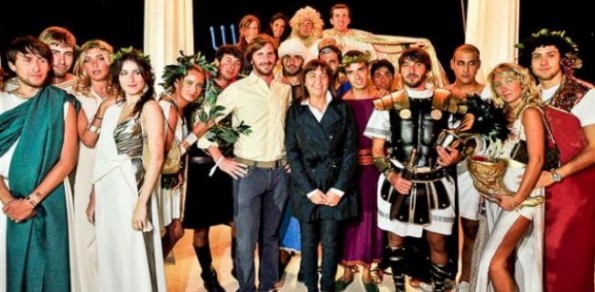
A toga party thrown by another regional councillor masqueraded as an electoral meeting. Some of the invitees wore pig masks (picture top of page) drawing the easy jibe “they didn’t need masks”. There was much reference in comments to Trimalchio’s feast in Petronius’ Satyricon – nouveaux riches showing off – crass enough in the first century but not very original today.
To make matters worse, there is a fair chance that a good deal of these expense are probably actually legal. If the prosecutors cannot prove that the invoices were false, or that funds were siphoned off to private foreign accounts, then many of the parties were probably not theft or embezzlement… so no conviction and no political sanction either. In Britain, when MPs were caught restoring their duck pond or an MP’s husband charged £30 for a porn video, the [innocent] Speaker resigned and most of the MPs’ careers ended with the last elections. Here, President Polverini refuses to resign saying that only she can clean up the mess though she is wobbling at the moment.
Her party secretary, Angelino Alfano, even has the nerve to say that the PdL is a victim of the scandal because a rotten apple has damaged the party’s reputation. I have always argued that chutzpah is actually and Italian word which yiddish only borrowed.
It is not only Latium that is bubbling – for months now, we have had the chronicles of how the president of Lombardy, Roberto Formigoni, enjoyed luxury holidays paid for by fixers working in the public health service. The Sicilian government had to resign in the summer because of their out-of-control debt and now investigators have started on Campania.
The laughs are all very well but they leave a very bitter taste. The scandals undermine what remains of public confidence in the lower levels of government and present a real risk that devolved powers will be curtailed or withdrawn completely, another reduction in Italian democracy. The more sensible alternative would be for all levels of government to have to generate their own income from taxes as the Americans do.
This particular scandal has a personal sting for me – two years ago the Region granted us €25,000 to support two development projets we are working on with partners in Ghana. Part is for a market garden for the Cape Coast School for the Deaf, an enterprise which supplies food for the kids, a little income and training in animal husbandry and vegetable cultivation; the other part is to support the Ghana School Bag project of our Ghana partners, the Kokrobitey Institute which recycles plastic advertising posters into satchels for school kids as well as making fashion items from recycled material. The work was which was given the grant was completed more than six months ago but we are still waiting for the second tranche of the grant, €9,000, a sum which hardly covers some of the er batman’s aperitifs but which goes a long way in Ghana. Ironically, the product that we are due to present president Polverini with at project completion is… a purse made from recycled publicity material.
Hundreds of companies who have done work for the Region (Latium and the others) are in a much worse state than us; many small businesses have been forced to close because public institutions have not paid the €10, 20, 30,000 owed. All this while the elected councillors were spending hundreds of thousands of euro on toga parties or actually stashing it away in private accounts. Twelve hospitals have been closed in Latium over the last couple of years as ways of reducing the budget. Those are the real follies.
Sunday, September 09, 2012
Election Watch 3 – Monti succeeds Monti? The temperature rises. Berlusconi again, “The White Thing” and left in disarray.
The buzz is all about what sort of government Italy will have after the elections and the very unsecret consensus is that it will be Monti again – either as prime minister or heading another ministry or as a deus ex macchina leading the government’s policies.
For the rest, as is often the case in Italy, there is uncertainty.
The Americans know exactly when they will vote for their next leader and for the last few months, they have known the choice of individuals. The two men’s policies are less clear but over the next month we should have a better idea.
Here in Italy, we’re pretty sure about the policies but we do not know what sort of choice of leaders the Italians will have, nor which parties and their alliances, nor what sort of electoral system they will be using. We are not even sure when they vote – it will most likely be April but it could just be March or May and it might just be in November.
A second Monti government is top of the business community’s wish list along with the centrist UDC. At the annual meeting of economic leaders at Cernobbio, a straw poll was taken and 80% of those questioned declared themselves in favour of what is called in Italian, a Monti-bis. (“bis!” is the cry for “Encore!” in a theatre of concert hall as well as being “twice” in Latin.)
The man himself has said explicitly, once again, that his job (as prime minister) ends with the elections. Others across the spectrum have reiterated the need for an elected government.
There is, of course, another job up for grabs next year: the presidency. Until two months ago, it was clear that Napolitano had greatly enhanced not only the prestige of the presidency but also its power. Constitutionally, the Italian presidency is mainly symbolic, but its powers and influence expand as that of other institutions wane. The new president might have expected to step into a more than ceremonial role. But because of Napolitano’s clumsy effort to protect himself and the presidency from judicial investigation, his and the presidency’s reputations are under discussion.
As for candidates, right from his nomination as prime minister last November there has been speculation that Monti might take over from Napolitano in the Quirinale. This is still a possibility but former Italian prime minister, European Commission president and leader of the Italian centre-left, Romano Prodi has also been put forward as a possibility though he has denied interest. No doubt Silvio Berlusconi still dreams of finishing his career on “Rome’s highest hill” as the Quirinale is often called in a political rather than altimetric epithet, but that is not on the cards.
If presidential hopefuls are keeping their powder dry, the real politicals are even more careful about their own ambitions, at least until we know what the electoral system will be.
As we move closer to elections and towards a Monti-bis with or without Monti, the space in the political centre is becoming more and more crowded with undeclared wannabes. Corrado Passera went to the centrist UDC’s summer gathering, expressed his sympathy and redeclared his technocratic neutrality. Another media-positive figure, Emma Marcegaglia, has said she is a definite undeclared for politics. She was the first woman to lead Confindustria, the employers’ association and was popular and successful. Another definite maybe is Montezemolo but he has been hovering on the edges of politics for years now so even in the country of uncertainty, he is perceived as too indecisive. The prospect of some new, centrist, post-Christian Democrat (DC) party appears and disappears like a ghost at the party: la cosa bianca, the “white thing”, an as yet undefined successor to the old DC’s epithet of “white whale”.
On the right, they all wait with bated breath to see if Berlusconi will stand again or not, the Great Unknown. He is due to appear as the star act on a cruise organised by one of his family papers, Il Giornale. Obviously, there is intense speculation that this will be the launch of his new candidacy. Whether he goes centre stage or not depends entirely on the opinion polls. He is unlikely to win outright but he does not want to crash (anything less than 20%). Berlusconi’s candidacy is a heady mix. There are his interests, financial and legal. He needs to keep political power to maintain Fininvest’s role in the media and publicity and to condition the courts and law reform to protect himself from present and future prosecution. Then there is the psychodrama of the almost 76 year old who needs to show himself and the world that he can still make it; Europe’s answer to Chavez and Mugabe.
The centre-left does not have quite the theatre, but they are trying hard. Within the Democratic Party (PD), the debate is more about leadership than policies. The Italian left has a vocation for seizing defeat out of the jaws of victory and they are trying again now. For the last year, opinion polls have given the PD with or without allies, a clear advantage over any other party. Now they are fighting over primaries in which from the party establishment’s point of view, the wrong person might win. The “wrong person” in this case is Florence mayor, Matteo Renzi, a bumptious youth (he actually 37, a respectable age for leadership prospects in most countries but in Italy, hardly out of political nappies and now definitely guilty of lèse nomenklatura). He might just beat PD party secretary, Pierluigi Bersani if the party can decide when to run them and with what rules.
Outside the PD, there is continuous sniping between them and Beppe Grillo’s 5 Star Movement (M5S) which picks up most of the protest vote, mostly on the left but some on the right too. Bersani has accused Grillo of using “fascist” language and Grillo has called Bersani a “zombie”. At the moment at least the PD is ready for an alliance with the left wing Nichi Vendola’s Left-Ecology-Freedom (SEL) party and has given up an alliance with Antonio Di Pietro’s Italy of Values (IdV) but this geometry could still change. Grillo’s M5S is also riven with dissent over uncertainty of the leadership and policies, with members criticising Grillo’s concentration of power.
It is as if electoral politics had become an almost irrelevant sideshow while Monti and the grownups, above all the other Mario, Draghi and the European authorities are dealing with the euro crisis. The rest of the government is addressing but not solving the Italian employment crises.
For the moment at least, the political parties are as far away as ever from regaining public confidence.
For the rest, as is often the case in Italy, there is uncertainty.
The Americans know exactly when they will vote for their next leader and for the last few months, they have known the choice of individuals. The two men’s policies are less clear but over the next month we should have a better idea.
Here in Italy, we’re pretty sure about the policies but we do not know what sort of choice of leaders the Italians will have, nor which parties and their alliances, nor what sort of electoral system they will be using. We are not even sure when they vote – it will most likely be April but it could just be March or May and it might just be in November.
A second Monti government is top of the business community’s wish list along with the centrist UDC. At the annual meeting of economic leaders at Cernobbio, a straw poll was taken and 80% of those questioned declared themselves in favour of what is called in Italian, a Monti-bis. (“bis!” is the cry for “Encore!” in a theatre of concert hall as well as being “twice” in Latin.)
The man himself has said explicitly, once again, that his job (as prime minister) ends with the elections. Others across the spectrum have reiterated the need for an elected government.
There is, of course, another job up for grabs next year: the presidency. Until two months ago, it was clear that Napolitano had greatly enhanced not only the prestige of the presidency but also its power. Constitutionally, the Italian presidency is mainly symbolic, but its powers and influence expand as that of other institutions wane. The new president might have expected to step into a more than ceremonial role. But because of Napolitano’s clumsy effort to protect himself and the presidency from judicial investigation, his and the presidency’s reputations are under discussion.
As for candidates, right from his nomination as prime minister last November there has been speculation that Monti might take over from Napolitano in the Quirinale. This is still a possibility but former Italian prime minister, European Commission president and leader of the Italian centre-left, Romano Prodi has also been put forward as a possibility though he has denied interest. No doubt Silvio Berlusconi still dreams of finishing his career on “Rome’s highest hill” as the Quirinale is often called in a political rather than altimetric epithet, but that is not on the cards.
If presidential hopefuls are keeping their powder dry, the real politicals are even more careful about their own ambitions, at least until we know what the electoral system will be.
As we move closer to elections and towards a Monti-bis with or without Monti, the space in the political centre is becoming more and more crowded with undeclared wannabes. Corrado Passera went to the centrist UDC’s summer gathering, expressed his sympathy and redeclared his technocratic neutrality. Another media-positive figure, Emma Marcegaglia, has said she is a definite undeclared for politics. She was the first woman to lead Confindustria, the employers’ association and was popular and successful. Another definite maybe is Montezemolo but he has been hovering on the edges of politics for years now so even in the country of uncertainty, he is perceived as too indecisive. The prospect of some new, centrist, post-Christian Democrat (DC) party appears and disappears like a ghost at the party: la cosa bianca, the “white thing”, an as yet undefined successor to the old DC’s epithet of “white whale”.
On the right, they all wait with bated breath to see if Berlusconi will stand again or not, the Great Unknown. He is due to appear as the star act on a cruise organised by one of his family papers, Il Giornale. Obviously, there is intense speculation that this will be the launch of his new candidacy. Whether he goes centre stage or not depends entirely on the opinion polls. He is unlikely to win outright but he does not want to crash (anything less than 20%). Berlusconi’s candidacy is a heady mix. There are his interests, financial and legal. He needs to keep political power to maintain Fininvest’s role in the media and publicity and to condition the courts and law reform to protect himself from present and future prosecution. Then there is the psychodrama of the almost 76 year old who needs to show himself and the world that he can still make it; Europe’s answer to Chavez and Mugabe.
The centre-left does not have quite the theatre, but they are trying hard. Within the Democratic Party (PD), the debate is more about leadership than policies. The Italian left has a vocation for seizing defeat out of the jaws of victory and they are trying again now. For the last year, opinion polls have given the PD with or without allies, a clear advantage over any other party. Now they are fighting over primaries in which from the party establishment’s point of view, the wrong person might win. The “wrong person” in this case is Florence mayor, Matteo Renzi, a bumptious youth (he actually 37, a respectable age for leadership prospects in most countries but in Italy, hardly out of political nappies and now definitely guilty of lèse nomenklatura). He might just beat PD party secretary, Pierluigi Bersani if the party can decide when to run them and with what rules.
Outside the PD, there is continuous sniping between them and Beppe Grillo’s 5 Star Movement (M5S) which picks up most of the protest vote, mostly on the left but some on the right too. Bersani has accused Grillo of using “fascist” language and Grillo has called Bersani a “zombie”. At the moment at least the PD is ready for an alliance with the left wing Nichi Vendola’s Left-Ecology-Freedom (SEL) party and has given up an alliance with Antonio Di Pietro’s Italy of Values (IdV) but this geometry could still change. Grillo’s M5S is also riven with dissent over uncertainty of the leadership and policies, with members criticising Grillo’s concentration of power.
It is as if electoral politics had become an almost irrelevant sideshow while Monti and the grownups, above all the other Mario, Draghi and the European authorities are dealing with the euro crisis. The rest of the government is addressing but not solving the Italian employment crises.
For the moment at least, the political parties are as far away as ever from regaining public confidence.
Friday, August 24, 2012
Italy’s Other Crisis
The weak economy is visible to all but there is a parallel crack in the system which is at least as dangerous to the country’s wellbeing and stability and undermines the very structures of the country. It is the clash between the powers of the state; the law on one side and the executive and legislature (usually referred to as la politica) on the other.
Both crises have been a long time brewing. The material hardships are due to a declining economy over the last 20 years combined with an uncontrolled growth of public spending. The crunch came when the waves from the US and then European bubbles hit Italy.
The institutional crisis also goes back a long way; 30 years when Bettino Craxi first bridled at magistrates investigating corruption in his Socialist Party in Genoa; 20 years ago when the Milan magistrates began prosecuting the kickback system used by all the parties. The conflict between “the judges” and la politica has rumbled on since then with occasional squalls; the final storm has now broken and is likely to be a very rough and dangerous one for the ship of state.

The opening lightening was an appeal by President Napolitano to the Constitutional Court. He is asking the Court to declare that the calls made to him by a former minister under investigation (and now charged with perjury) should be destroyed. The former minister is Nicola Mancino (above, with Napolitano) who was Minister of the Interior between 1992 and 1994 when there were secret negotiations between elements of Cosa Nostra and politicians and law enforcement officer apparently to alleviate prison treatment of convicted mafiosi in exchange for stopping the mafia bombs. Mancino is not accused of complicity in the deal but he swore that as minister he knew nothing of the negotiations; this turned out to be untrue, hence his indictment for perjury.
While Palermo prosecutors were preparing their case on these negotiations last year, they obtained judicial permission to intercept Mancino’s phone. He made a number of calls to the Quirinale seeking Napolitano’s intercession in the case. Most of the these calls were to the president’s legal advisor, Loris D’Ambrosio. These have been published and are part of the court records; in them Mancino pleads with D’Ambrosio to ask the President to move his case from one court to another where he thought his position would be improved. D’Ambrosio for the most part stalls (and between the lines, it is clear that he is trying to get Mancino off his own and Napolitano’s backs) but he does give a generic assurance that “the President is looking into the case”.
Later, it came out that Mancino had spoken directly with Napolitano. The Palermo prosecutors have already said that the conversations were not relevant to their case and the recordings would be destroyed as soon as the investigating judge orders it (and after the defence had been heard).
We can only guess that Napolitano reassured Mancino but made no commitment and that Mancino did not admit to any knowledge of the negotiations. The two men have known each other for decades and have been in government together and if an old friend or acquaintance makes an improper request, it is probably brushed aside or ignored politely. Whatever they said, it was irrelevant for the prosecution.
This was not enough for Napolitano who has made a presumably banal albeit embarrassing exchange between two old friends into a constitutional issue which risks tearing apart some of the fundamentals of parliamentary democracy – the separation of powers.
Napolitano is trying to convert his constitutional immunity from prosecution for his presidential functions (normal in most constitutions) into presidential untouchability. If a legitimate telephone tap reachs the President, that call should not even be transcribed and destroyed, he argues.
The only parallel that I can think of is if Governor Blagojevich (of Illinois, who was caught trying to sell President Obama’s vacated senate seat and is now in gaol) had called Obama when his phone was already being tapped. No US court could grant the president inviolability from incoming calls from louche characters.
Instead, in Italy, the media, the judiciary and the political classes are divided. On the one side are Napolitano’s supporters who have introduced a new phrase “judicial populism”. They feel that the prestige of the President has been damaged by the knowledge that the intercepts exist. They do not admit it, but the subtext is once again that anyone in politica (elected members of the legislature or executive), should be protected from any interference of the law.
On the other side are those who can see no constitutional prerogative in the single case and are terrified that if the Constitutional Court decides in favour of the President (both are “Guardians of the Constitution”) this would be a major blow against any judicial monitoring of the political world. In effect making the President into an ancien regime absolute monarch.
Prime Minister Monti weighed into the fray with an interview in the Catholic paper Tempi calling the Mancino-Napolitano intercepts “a grave abuse”. The founder of La Repubblica, veteran journalist Eugenio Scalfari has dedicated his last two Sunday columns to defending presidential prerogative (a position weakened by faulty logic, incorrect data and the possibility that he might be one of the next life senators appointed by the President).
Judges and academic lawyers have defended the Palermo investigators’ procedure.
All the government parties support the president with some of them insinuating a conspiracy of the independent paper Il Fatto Quotidiano, the ex-magistrate Antonio Di Pietro and his Italy of Values (Idv) Party and the Genoese comic Beppe Grillo with his 5 Star Movement (M5S) that allegedly would want to install a government of judges.
The judiciary, once again, complain that the criminal law is only used when politics has gone beyond any reasonable behaviour, in order to clean up the Augean Stables.
Whatever the Court’s verdict (and we will probably have to wait until after Napolitano steps down next year), the Presidency, politics, the Court itself and the whole magistrature will come out looking weakened and somehow sleazy. In the meantime, the thunder rolls and the lightening flashes. This is not the sort of storm Italy needed when facing its economic woes.
The constitutional conflict is the most serious and most abstract part of the spat. At the same time, much more concretely, the Palermo investigations on mafia 20 years ago and today are weakened not only by Napolitano’s appeal but by a combination of inspections and rearrangements of personel, in practice dismantling working police and judicial networks carried out under the veil of everyday bureaucracy.
Even more dangerous is the message which has now been put forward that telephone taps should be further limited. At the moment in Italy (and elsewhere), they are the cheapest and most effective way of investigating almost any form of crime. They are carried out under judicial supervision and with a warrant. Until now, it was mostly Berlusconi and the right which wanted to limit taps – now it is a good part of the left as well and the bill is ready in Parliament and could be passed by Christmas. This would be a body blow not just to investigations into mafia and political corruption but just about any other sort of crime.
Again, not the sort of message to send to a world wondering whether to invest in Italy.
Both crises have been a long time brewing. The material hardships are due to a declining economy over the last 20 years combined with an uncontrolled growth of public spending. The crunch came when the waves from the US and then European bubbles hit Italy.
The institutional crisis also goes back a long way; 30 years when Bettino Craxi first bridled at magistrates investigating corruption in his Socialist Party in Genoa; 20 years ago when the Milan magistrates began prosecuting the kickback system used by all the parties. The conflict between “the judges” and la politica has rumbled on since then with occasional squalls; the final storm has now broken and is likely to be a very rough and dangerous one for the ship of state.

The opening lightening was an appeal by President Napolitano to the Constitutional Court. He is asking the Court to declare that the calls made to him by a former minister under investigation (and now charged with perjury) should be destroyed. The former minister is Nicola Mancino (above, with Napolitano) who was Minister of the Interior between 1992 and 1994 when there were secret negotiations between elements of Cosa Nostra and politicians and law enforcement officer apparently to alleviate prison treatment of convicted mafiosi in exchange for stopping the mafia bombs. Mancino is not accused of complicity in the deal but he swore that as minister he knew nothing of the negotiations; this turned out to be untrue, hence his indictment for perjury.
While Palermo prosecutors were preparing their case on these negotiations last year, they obtained judicial permission to intercept Mancino’s phone. He made a number of calls to the Quirinale seeking Napolitano’s intercession in the case. Most of the these calls were to the president’s legal advisor, Loris D’Ambrosio. These have been published and are part of the court records; in them Mancino pleads with D’Ambrosio to ask the President to move his case from one court to another where he thought his position would be improved. D’Ambrosio for the most part stalls (and between the lines, it is clear that he is trying to get Mancino off his own and Napolitano’s backs) but he does give a generic assurance that “the President is looking into the case”.
Later, it came out that Mancino had spoken directly with Napolitano. The Palermo prosecutors have already said that the conversations were not relevant to their case and the recordings would be destroyed as soon as the investigating judge orders it (and after the defence had been heard).
We can only guess that Napolitano reassured Mancino but made no commitment and that Mancino did not admit to any knowledge of the negotiations. The two men have known each other for decades and have been in government together and if an old friend or acquaintance makes an improper request, it is probably brushed aside or ignored politely. Whatever they said, it was irrelevant for the prosecution.
This was not enough for Napolitano who has made a presumably banal albeit embarrassing exchange between two old friends into a constitutional issue which risks tearing apart some of the fundamentals of parliamentary democracy – the separation of powers.
Napolitano is trying to convert his constitutional immunity from prosecution for his presidential functions (normal in most constitutions) into presidential untouchability. If a legitimate telephone tap reachs the President, that call should not even be transcribed and destroyed, he argues.
The only parallel that I can think of is if Governor Blagojevich (of Illinois, who was caught trying to sell President Obama’s vacated senate seat and is now in gaol) had called Obama when his phone was already being tapped. No US court could grant the president inviolability from incoming calls from louche characters.
Instead, in Italy, the media, the judiciary and the political classes are divided. On the one side are Napolitano’s supporters who have introduced a new phrase “judicial populism”. They feel that the prestige of the President has been damaged by the knowledge that the intercepts exist. They do not admit it, but the subtext is once again that anyone in politica (elected members of the legislature or executive), should be protected from any interference of the law.
On the other side are those who can see no constitutional prerogative in the single case and are terrified that if the Constitutional Court decides in favour of the President (both are “Guardians of the Constitution”) this would be a major blow against any judicial monitoring of the political world. In effect making the President into an ancien regime absolute monarch.
Prime Minister Monti weighed into the fray with an interview in the Catholic paper Tempi calling the Mancino-Napolitano intercepts “a grave abuse”. The founder of La Repubblica, veteran journalist Eugenio Scalfari has dedicated his last two Sunday columns to defending presidential prerogative (a position weakened by faulty logic, incorrect data and the possibility that he might be one of the next life senators appointed by the President).
Judges and academic lawyers have defended the Palermo investigators’ procedure.
All the government parties support the president with some of them insinuating a conspiracy of the independent paper Il Fatto Quotidiano, the ex-magistrate Antonio Di Pietro and his Italy of Values (Idv) Party and the Genoese comic Beppe Grillo with his 5 Star Movement (M5S) that allegedly would want to install a government of judges.
The judiciary, once again, complain that the criminal law is only used when politics has gone beyond any reasonable behaviour, in order to clean up the Augean Stables.
Whatever the Court’s verdict (and we will probably have to wait until after Napolitano steps down next year), the Presidency, politics, the Court itself and the whole magistrature will come out looking weakened and somehow sleazy. In the meantime, the thunder rolls and the lightening flashes. This is not the sort of storm Italy needed when facing its economic woes.
The constitutional conflict is the most serious and most abstract part of the spat. At the same time, much more concretely, the Palermo investigations on mafia 20 years ago and today are weakened not only by Napolitano’s appeal but by a combination of inspections and rearrangements of personel, in practice dismantling working police and judicial networks carried out under the veil of everyday bureaucracy.
Even more dangerous is the message which has now been put forward that telephone taps should be further limited. At the moment in Italy (and elsewhere), they are the cheapest and most effective way of investigating almost any form of crime. They are carried out under judicial supervision and with a warrant. Until now, it was mostly Berlusconi and the right which wanted to limit taps – now it is a good part of the left as well and the bill is ready in Parliament and could be passed by Christmas. This would be a body blow not just to investigations into mafia and political corruption but just about any other sort of crime.
Again, not the sort of message to send to a world wondering whether to invest in Italy.
Saturday, August 18, 2012
American and Italian Universities

Summer in Italy is not just sun and sea, pasta and pizza, there is culture too, music for all tastes but also quite serious discussions. This was one of those summer initiatives that Italy is so good at; a beautiful setting, a balmy temperature and a good roundtable debate sandwiched between a good meal and divine almond and then blackberry granite or granulated water ice.
For the last three years, the Reggio based online paper, Strill.it, has organised “Tabularasa” a month long series of encounters and debates on a wide variety of subjects. Local and visiting speakers sit on a stage overlooking the Straits of Messina with a public seeking the evening cool and perhaps some enlightenment.

On my evening, we considered the merits and faults of the Italian and American university systems. The panel was made up of Salvatore Berlingò, a Roman lawyer and rector of Reggio’s University for Foreigners, Francesco Russo, an engineer from the University of Reggio Calabria, Susana Cavallo, from Loyola University’s Rome Campus, Massimiliano Ferrara, political scientist and functionary from the Calabrian regional government and Phil Pullella, Reuters’ Vatican correspondent. The discussion was chaired by the two editors of strill.it, Raffaele Mortelliti and Giusva Branca. Some of us had experience in both systems, some only in one.
The two most important questions at the basis of any discussion on this topic have to be – what are universities for? And how should they be financed?
Italy is unclear on both questions. There is a presumption that universities are primarily research institutions and that faculty should above all be judged on their production. And yet successive governments have consistently reduced funding for research. There is also a lack of consensus on how faculty should be rated and two of the panel had a heated discussion on that point – today there are new criteria, more or less international, which are being used to grade academics but Italy is still a long way from adopting the UK quality assessment methods or the US outcomes assessment. Particularly in the humanities, there are many Italians who feel that supposedly “Anglo-Saxon” criteria of peer review and citations in scientific journals miss the point. Maybe, but they do not come up with more convincing metres. This was the division between the Roman lawyer and the engineer on our panel.
On the cost side, there is even less consensus. Italian students are beginning to pay real money especially when they also have to pay for bed and board away from home, though the costs are still tiny compared to the US or even the US, they are much higher than in Scandinavia, say.
Student loan debt in the US is apparently now greater than mortgage debt for houses. UK student enrollment is down because of rising costs. The prospect of starting one’s working life seriously in debt is already discouraging British students from going to university.
For all the disadvantages of costly education, the cash nexus does mean that students are much more central to universities’ raison d’être. The buzzword for decades has been “student-centered learning” in the US. In the American system, we have to concentrate on what we expect students to have learned or be able to do after a class, a course or a degree. Not what we are teaching. The substance is almost identical but the focus is reversed. Whereas in the Italian system, I am very conscious of colleagues concentrating on their own skills and erudition rather than what the skills or knowledge that the students should acquire.
The US is far more responsive to the market – not just for jobs or for who will set up an endowment fund but also to social demands. The pressures are more varied than in Italy: students, social demands, commercial and industrial demands, city, state and sometimes federal government demands. Pluralism in education, as in government contributes to democracy. In Italy, the pressure is limited to the universities and the ministry with occasional outbursts from students when the situation is already terrible. Today there is an increasing input from the private sector but it is still a long way from the American model.
The American system is more democratic in the pressures that move university policy but is seriously flawed in internal university governance which in the majority of cases is structured more like a heirarchical business corporation than the traditional European model of an universitas studiorum where responsibility lies with faculty rather than boards of directors formed by outsider appointed officials. This model is unfortunately taking over in many parts of Europe too. Even in Italy where the system went too far in the other direction with university barons running a feudal power system, today there are administrative boards made up of local businessmen and politicians who are beginning to dictate policy as well as managing teaching content, research and even employment .
Another difference that many Italians, even those who work in universities, forget about is the huge difference in quality within the US system. Italians often presume that all American universities are Ivy League schools. There is an abyss between them and a backwoods community college, or worse, some radical religious foundations or for-profit institutions, whereas Italian state universities and even and private or religious institutions show less difference.
A point which we all made is that American higher education is mostly residential so that students are able to take advantage of much more than lectures in classrooms; sport, culture and above all student social life in which in its best version, students from different social and ethnic backgrounds studying different disciplines exchange ideas and form lasting friendships.
Most importantly, the American universities are based primarily on merit which the Italian ones mostly are not; we also discussed legality in the systems. A colleague here at the American University of Rome, Francesca Conti has studied Italians who leave the country to work in Britain; a recurrant theme is the difficulty of being judged on merit in Italy. In an article to be published in the Bulletin of Italian Politics, she quotes a graduate from the south of Italy who had moved to Britain and who speaks for many of her respondants:
The United Kingdom has offered me things which I would have never had in Italy. What I adore about this country is that they judge you for what you can do; there may be internal games but, in my case, I think that I would have never managed to get to the same position in Italy.
As if to underline this point and the one we addressed at Tabularasa explain, the day after the discussion, one of the local papers had an article about the 26 year old son of a local boss providing help to pass university entrance exams. He had shown his own mettle by passing 9 exams in 41 days. It shows how the Calabrian mafia, the ndrangheta adapts to modern needs and loses no opportunity for power and profit; it also makes my point that merit is secondary quality, far less important than loyalty and having the right friends.
The bane of the Italian system is the raccomandazione.
Subscribe to:
Posts (Atom)